
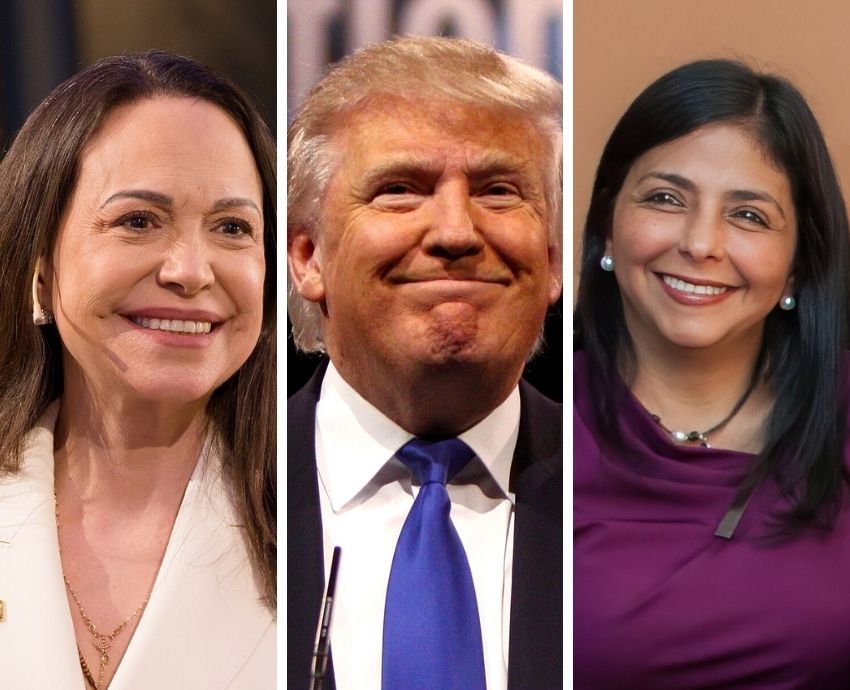
Venezuelan Acting President Delcy Rodríguez concisely summed up the situation in the country: “We are in a new political moment.”
The United States intervention in Venezuela, involving two hours of relentless bombing of Caracas, La Guaira and elsewhere, as well as the most shameful event in the national armed forces’ history, seems a distant memory.
Former president Hugo Chávez’s cry, “Fucking Yankees, go to hell!” still echoes outside Miraflores Palace. But for the past weeks, the presidential palace microphones have, in a measured manner, indicated any complaints about January 3 (including the kidnapping of President Nicolás Maduro and First Lady Cilia Flores) will be made exclusively through diplomatic channels.
US President Donald Trump’s assertion on the afternoon of January 3 cannot be refuted by the facts: Rodríguez has pledged to cooperate and not repeat Maduro’s mistakes.
Between 2014–25, Maduro dismantled the national-popular program that Chávez embodied, but failed to fully implement the political, legal and institutional measures to transform Venezuela into a new US colony.
Maduro’s error was not one of principles, but political calculation: he believed he could negotiate his continued hold on power in exchange for selling off the country’s wealth to the US.
Dismantling the Bolivarian revolution
The Bolivarian process reached January 3 like a zombie feeding on rhetoric devoid of any basis in reality.
The decline began before the US sanctions, but these clearly accelerated the transition from entropy to counter-revolutionary dissolution — most starkly expressed in the 2018 package of economic measures that shifted the burden of the crisis onto the working class.
The Maduro government also became authoritarian, dismantling even the most basic democratic freedoms.
But the question everyone asked was whether the January 3 imperialist attack on Venezuela could trigger an internal revolutionary response, led by the new government. Subsequent events have shattered that illusion.
Not only are diplomatic relations between Caracas and Washington being normalised within the framework of an illiberal and colonialist agenda, but needed counter-reforms are solidifying the new status of US-Venezuelan relations.
New colonial relations
At Rodríguez’s request, the National Assembly has simplified trade regulations to remove restrictions on foreign investment, while initiating reforms to the Hydrocarbons Law to legitimise the plundering of Venezuela’s oil and re-entry of transnational corporations ousted by the Bolivarian revolution.
These rapid restoration measures seek to align Venezuela with Trump’s aims, which were presented to the 16 oil magnates gathered to establish a $100 billion investment fund.
Venezuela is rejoining the SWIFT banking system, allowing local financial transactions to be routed through the US. Four private banks (BNC, BBVA Provincial, Banesco and Mercantil) have already been authorised by the Trump administration to receive a portion of the foreign currency transferred to the country from oil sales.
It appears these private banks will sell the foreign currency, while the Central Bank of Venezuela will only receive bolívars generated from this auction, less the respective intermediary fees.
On January 9, the White House made public its executive order, “Safeguarding Venezuelan oil revenue for the Good of the American and Venezuelan people” — the embodiment of colonial relationship when it comes to managing resources from oil sales.
The US assumed the role of “custodian” of Venezuela’s funds, whose use and circulation depends on the US secretary of state. The Rodríguez government responded by initiating legislative and institutional reforms to facilitate this.
It was like witnessing a competition to see who could present themselves as the most obedient to the White House occupant: while right-wing opposition leader María Corina Machado presented her Nobel Prize medal to Trump, Rodríguez was introducing the Hydrocarbons Law reform.
All this is occurring while Article 5 of Venezuela’s State of Emergency decree continues to allow the arrest of anyone who criticises the government.
As if this was not enough, it was announced on January 15 that the executive and legislative branches, together with the bureaucratic and employer-oriented Bolivarian Socialist Workers’ Central, would fast-track a labour legislation reform, creating a new Labour Code adjusted to the “new political moment”.
Capitalist class
The reaction of the capitalist class and business leaders remains to be seen.
However, Rodríguez is very adept at moving in business, financial and banking circles. In fact, between 2018–25, she was tasked by Maduro with finding common ground with the traditional business sector — something she accomplished efficiently.
Fedecamaras, the main big business chamber, had participated in the 2002 coup against Chávez and severed all ties with the government. But Rodríguez successfully achieved the seemingly impossible: not only was she the star guest at national business meetings starting from 2021, but she managed to break them away from Machado’s calls for confrontation.
This experience could prove useful for Rodríguez in achieving what Maduro could not: an agreement among the various capitalist factions for an orderly transition, where all the wealthy win and no particular sector loses. Of course, in such agreements, those at the bottom always lose.
Changes are happening at breakneck speed, while any anti-imperialist perspective seems to further fade.
Anti-imperialism and the missing factor
Internationally, people are asking: Where is the popular response? The truth is, there have been no spontaneous mass mobilisations or autonomous responses.
The small marches that have taken place have been called by the government, mobilising mainly public employees and the social base it still holds onto that, although diminished, is nonetheless important for these purposes.
How can we explain this? Maduro’s regime created such a disaster for workers’ living conditions that large segments of the population see his departure as the only chance for change.
Citizens seem to have reached a point where they are willing to see if the new circumstances will lead to improved wages; allow for the return of the 8 million migrants whose exit fractured Venezuelan families; restore the regular and stable functioning of public services (water and electricity); and establish institutions to address the healthcare, food and housing needs of the vast majority.
However, this colonial-style administration is unlikely to meet these aspirations. A mobilised social movement will only return to the extent that this becomes evident.
Given this situation, there is no doubt about the priorities. The central task is defending national sovereignty from an anti-imperialist working-class perspective; that is, every step in defence of the republic must be accompanied by demands to re-democratise Venezuelan society and for wage justice.
There is no territorial sovereignty without political sovereignty. It is very difficult to cohere a defence of Venezuelan sovereignty that omits the need to resolve inequality and lack of freedoms in Venezuela.
Correctly combining these demands is the challenge of anti-imperialism today.
[Abridged from LINKS International Journal of Socialist Renewal.]