
Ecuadorians resoundingly rejected far-right President Daniel Noboa’s plans to undermine the country’s sovereignty and change the constitution in favour of his neoliberal project, in a referendum on November 16.
A majority voted “No” to all four questions, rejecting Noboa’s proposal to allow foreign military bases, eliminate state funding for political parties, reduce the size of the national assembly and form a constituent assembly to rewrite the constitution.
Noboa’s proposal to authorise foreign military bases in the country was rejected by nearly 61% of voters.
Noboa’s militaristic, neoliberal policies are closely aligned with those of the United States, and he wants to re-establish a US military presence in the country. He has already signed treaties that allow the US military to use the biodiversity-rich Galápagos Islands with impunity, despite significant social and environmental concerns.
For now, the referendum result blocks Noboa’s plans to re-establish a US military base in the port city of Manta, in the coastal province of Manabí. The base served as a key hub for US imperial incursions into other parts of South America for more than a decade, until President Rafael Correa refused to renew the lease for the site in 2008.
During his “citizens’ revolution” (2006–17), Correa implemented some key demands of the social movements, including closing the base, defaulting on the country’s illegitimate foreign debt and facilitating a process to democratically draft a new constitution reflecting the progressive aspirations of the majority of Ecuadoreans.
As previously reported, policies directed at wealth redistribution, particularly in the oil sector, along with a doubling in government social spending, helped spur an unprecedented cut in the poverty rate (which fell by 38%) and extreme poverty (down 47%) during Correa’s 10 years in office.
Amid the context of the US’ intensifying military build-up in the Caribbean and eastern Pacific, US homeland security secretary Kristi Noem visited Ecuador earlier this month to strengthen “cooperation efforts” and discuss the re-installation of US bases in the country.
The US government has already carried out several illegal, inhumane military attacks on boats in the region — which have killed more than 80 people — and issued threats of potential military operations against Venezuela, Colombia and Mexico.
In Manabí, the “No” vote against allowing foreign military bases was more than 70%. This is unsurprising, given that in the region surrounding the base — as is the case with US bases around the world — military personnel were responsible for violence against local communities, including the sexual abuse of women and children.
The second question, whether to eliminate obligatory state funding for political parties, was rejected by 58% of voters. The proposal would have worsened an already unequal playing field for smaller and new parties that do not rely on wealthy private backers. Noboa — the son of Ecuador’s richest person — spent vast sums of private and public money on his re-election campaign earlier this year, in violation of the country’s electoral laws.
The third proposal, to reduce the size of the national assembly from 151 MPs to 73, was rejected by about 53% of voters. Noboa said the reform was necessary to reduce state expenditure and increase efficiency. The national assembly is filled with careerist politicians on bloated salaries. An MP’s monthly salary is US$4759 (A$7339), plus benefits, while ordinary Ecuadoreans live on a minimum monthly wage of US$470 (A$724). Noboa’s proposal would have concentrated power in the hands of the major parties and reduced representation from rural, Indigenous areas.
The least popular question was whether to establish a constituent assembly to write a new constitution, with nearly 62% of voters rejecting it.
The current constitution, won through mass mobilisations, also enshrines important safeguards, such as prohibiting the privatisation of public services, protecting the collective rights of workers and Indigenous people and recognising the rights of nature. Although Noboa has already violated the constitution on several occasions, it does provide some legal defences to his plans to accelerate privatisation, deregulate labour and finance and open the country further to transnational mining and oil companies.
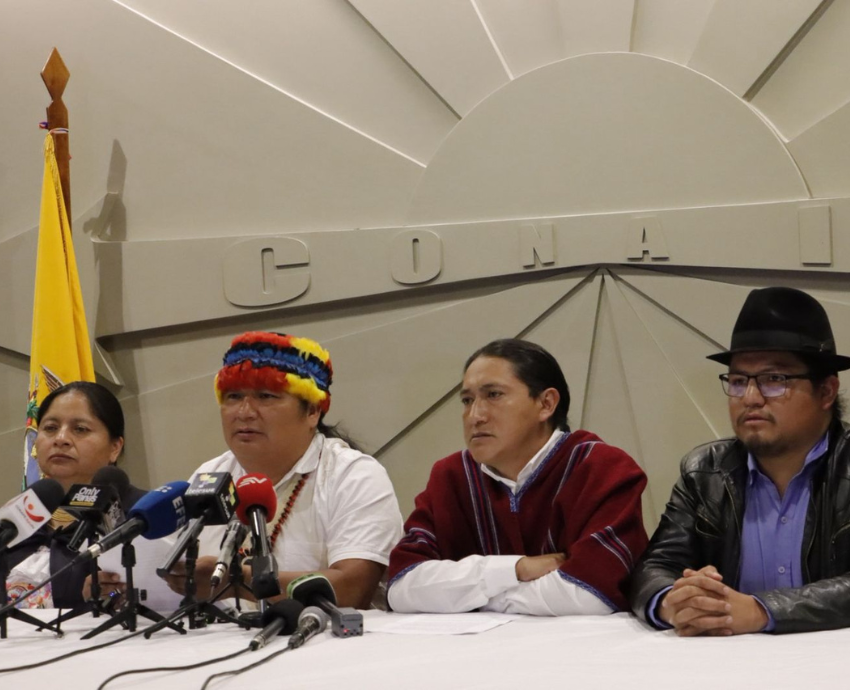
The referendum result follows an intense campaign by grassroots groups, particularly the Confederation of Indigenous Nationalities of Ecuador (CONAIE) — the country’s most powerful social movement — to articulate the threats posed by Noboa’s proposals.
CONAIE led a month-long national strike — which ended on October 22 — against the government’s International Monetary Fund-sponsored neoliberal measures. They include: slashing public funding, including for healthcare and education; expanding extractive frontiers for private capital; dismissing thousands of public sector workers; and further deregulating the financial sector.
Following the publication of results on November 16, CONAIE said: “This victory belongs to the people that mobilised, to the communities, to the youth, to the women and to all those who defended their rights in the streets.
“We recognise the value of the National Strike as well as the Quinto Río de Cuenca [a mass anti-mining protest in the city of Cuenca], as legitimate expressions of resistance that made it possible to expose the government’s attempts to impose an agenda contrary to the people’s interests.
“We demand that the government stop its authoritarianism, violence, populism and policies that privilege private interests.”