-
Cheang Thida (pictured below) is a young woman local union leader of the Cambodian Alliance of Trade Unions (CATU) at Kin Tai Factory in Phnom Penh. Last December she led 10,000 workers on a legal and peaceful strike demanding a minimum wage that satisfies the workers' basic needs. As a consequence, she was sacked from her job making Armani Jeans. -
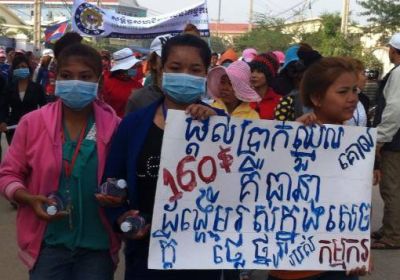
I was deeply saddened to read the article by Anne Elizabeth Moore titled “What’s the Price of Workers’ Lives in Cambodia?” published on January 17 in the US-based Truth-out.org website. This story contained an outrageous attack on the Cambodian garment workers demonstration over the minimum wage by a well-known Cambodian blogger, academic and human rights activist Sopheap Chak. -
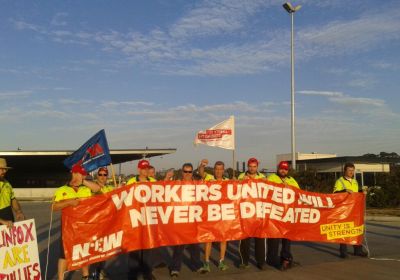
About 400 members of the National Union of Workers took a day's strike action on January 17, with a picket line at the Coles/Linfox warehouse facility in Truganina, on the western fringe of Melbourne. The strike action was in support of the union's demand for a site agreement, something other Coles warehouses have. The workers are asking for a range of improvements in conditions, including an extra paid rest break per shift and a fair pay rise. NUW delegate Mathew Davies told Green Left that the workers are demanding “fair pay for everyone.” -
An estimated 700,000 Cambodian garment, accessories and footwear workers (90% of whom are women) are among the lowest paid in this globalised industry. They produce fashionable products sold at high prices in the West under big brand names like Gap, Walmart, H&M, Puma, Nike, Adidas, Columbia and Levi Strauss. Major Australian retailers that source garments from Cambodia include Coles, Kmart, Target, Big W and Pacific Brands.
-
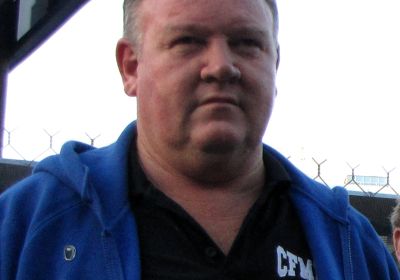
Five hundred construction workers walked off the job following the death of a young worker, who fell 30 metres from scaffolding at the Barangaroo construction site in Sydney on January 9. The NSW Construction Forestry Mining Energy Union (CFMEU) said emergency services were called to the site at 8.30am after Lend Lease construction workers reported that a man had plunged about 30 metres to the ground. Workmates on site attempted CPR, but the 26-year-old was pronounced dead when the paramedics arrived on site. -
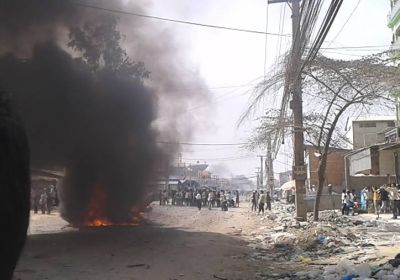
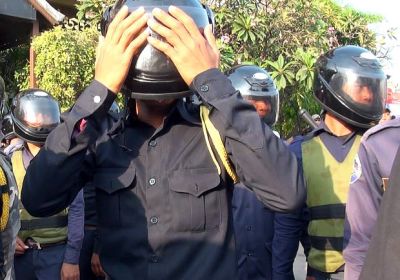
At least three strikers were killed on January 3 when police in Cambodia opened fire to break up a protest by garment workers. Phnom Penh Municipal Police deputy head Chuon Narin claimed three were killed and two others wounded in a suburb of the capital. Police fired AK-47 rifles after several hundred workers blocking a road began burning tyres and throwing objects at them. Police described the protesters as "anarchists destroying public and private property". -
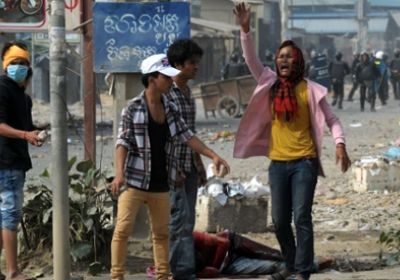
Striking Cambodian shoe and clothing workers have blocked roads and scuffled with police. At least seven people were injured and seven others arrested after clashes between the workers and riot police, local rights monitors said. Community Legal Education Centre spokesman Huy Pichsovann said that police had beaten the marching workers with truncheons. After the clash thousands of workers led by two of Cambodia's biggest unions blocked roads in front of the Labour Ministry.
-
Three hundred firefighters gathered in Treasury Gardens on December 12 and marched to Parliament House to protest against inadequate staffing levels.
-
Hundreds of paramedics rallied on December 11 for a better deal from the Victorian government. Poor pay and long hours have adversely affected ambulance response times. Negotiations have been delayed 16 months by the Napthine government.
-
In response to the announcement by General Motors from its corporate headquarters in Detroit that it will discontinue vehicle and engine manufacturing and significantly reduce its engineering operations in Australia by the end of 2017, the Socialist Alliance calls for the immediate nationalisation of General Motors Holden (GMH) plants under workers' and community control. -
Venezuelan President has Nicolas Maduro announced a raft of new regulatory measures as part of his ongoing “offensive” to deal with the country’s economic problems. In a television interview on December 1, Maduro said the government’s economic policies were aimed at “stabilising” the economy in order to be able to develop a “productive” economic model. This year, Venezuela has experienced shortages in several basic food and household goods, a black market dollar worth ten times the government-set exchange rate, and annual inflation of 54%.
-
Is that a faint glimmer light at the end of the European economic tunnel? Or is it just a bunch of conservative politicians brandishing torches and yelling: “Look, a light at the end of the tunnel”? The “Light-At-The-End-Of-The-Tunnel” mantra is a vital part of conservative government strategy in depressed Portugal, Greece, Ireland and Spain (the European “periphery”). Every skerrick of non-disastrous economic news gets boosted as proof of a coming resurrection ― and one more reason why people should forget about revolt in the streets or ballot box.