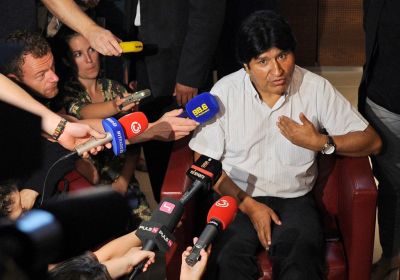
Venezuela and Bolivia have agreed to raise cooperation to a “higher level” following Venezuelan president Nicolas Maduro’s visit to Bolivia on May 25.
During bilateral meetings held in Cochabamba, Maduro and Bolivian President Evo Morales signed key accords in food production, industrial development and communications.
“It’s necessary to place the strategic map of bilateral cooperation at a higher level, including a more organised one,” said Maduro.
-
-
Founder of Venezuela’s world famous El Sistema music program, Jose Abreu, met with President Nicolas Maduro on May 22 to discuss expanding the program. They agreed on a project called Musical Program Simon Bolivar, which aims to have 1 million Venezuelan youths and children playing musical instruments.
-
An important summit of global significance, held in Brazil May 16-20, has largely passed below the radar of most media outlets, including many left and progressive sources. This summit was not the usual type, involving heads of states and business leaders. Instead, it was a gathering of social movement representatives from across Latin America and the Caribbean -- the site of some of the most intense struggles and popular rebellions of the past few decades. -
Registrations are now open for the Australia-Venezuela Solidarity Network’s (AVSN) next brigade to revolutionary Venezuela. The solidarity tour, to run over December 4-13 this year, will be a special one for the AVSN, the first since the election of President Nicolas Maduro following the death of Hugo Chavez on March 5. Since 1998, when Chavez was first elected president, the Bolivarian revolution has achieved remarkable things by putting control of Venezuela’s politics and economy back into the hands of the poor majority.
-
The open letter printed below, which was sent to the New York Times public editor Margaret Sullivan was signed by more than a dozen experts on Latin America and the media. Signatories to the letter, released on May 14, signatories included academic Noam Chomsky, filmmaker Oliver Stone, Venezuela Analysis founder Gregory Wilpert and several other experts. To join the campaign, visit New York Times Examiner. * * * Dear Margaret Sullivan,
-
Venezuela's new Labour Law for Workers came into effect on May 7, guaranteeing shorter working hours, longer maternity leave and pensions for all Venezuelans. Described by the Venezuelan government as the “most advanced labour law in the world”, the law reduces the working week from 44 hours to 40, and requires that employers provide two consecutive days a week off. When the law came into effect, labour minister Maria Iglesias said the new working hours are part of the process towards a “just distribution of wealth”.
-
Bolivia has earned more than US$16 billion from the energy industry since President Evo Morales nationalised the sector in 2006, Spanish newsagency EFE reported government officials as saying. EFE reported that hydrocarbons minister Juan Jose Sosa said: “Seven years before the nationalisation, from 1999 to 2005, the state received around $2 billion. After these seven years, the state received more than $16 billion.” EFE said: “Morales issued an executive order on May 1, 2006, nationalising the seven oil companies, the majority of them foreign firms, operating in Bolivia.”
-
"Haiti offers a marvelous opportunity for American investment," reported Financial America in 1926. "The run-of-the-mill Haitian is handy, easily directed and gives a hard day's labor for 20 cents, while in Panama the same day's work costs [US]$3." That may be the most honest portrayal of the offshore industry in Haiti yet. -
It would be hard to find somewhere that celebrates May Day more enthusiastically than Venezuela. But this year celebrations were marred by claims made in a document that could easily be mistaken for a lift-out from a UFO enthusiasts' magazine. -
There’s a new president in Latin America, and his name isn’t Nicolas Maduro. The election that brought him to power was called by an illegitimate regime following a coup d’etat, and his name isn’t Porfirio Lobo. He’s a wealthy, conservative businessman, and his name isn’t Sebastian Pinera. His party ruled for over 60 years, and his name isn’t Enrique Pena Nieto. -
When East Timor won its independence from Indonesia in 1999, the country's medical infrastructure in rural areas was almost non-existent. When then-Cuban President Fidel Castro heard about the problem at a regional summit, he offered to send Cuban doctors free of charge — as many as were needed. So began the largest Cuban medical assistance program outside Latin America. In 2010, after a six year program of study in Cuba, the first of nearly 500 East Timorese medical students graduated and took up their posts in East Timorese villages and towns.
-
Bolivian President Evo Morales told a May Day demonstration in La Paz that his government would expel the US Agency for International Development (USAID), the BBC said that day. The US government-funded agency provides funds and training to groups around the world that support US interests. In countries such as Bolivia and Venezuela, USAID has funded groups involved in bids to bring down elected governments.