-
Cuba & Its Neighbours: Democracy in Motion By Arnold August Fernwood Publishing January 2013 288pp, C$29.95 Surrounded by emerging participatory democracies unshackling themselves from US hegemony, Arnold August writes that Cuba is a laboratory for people-powered politics. -
The United Nations general assembly voted on March 27 ― with 100 votes for, 11 against and 58 abstentions ― to not recognise the results of the March 16 referendum in Crimea. In the poll, most voted for the territory to leave Ukraine and join Russia. The resolution was put by Ukraine and sponsored by the United States, the European Union and other Western powers, including Australia. -
It is the end of the “age of entitlement”, we have been told by the federal Coalition government. But now they have brought back feudal titles. Not content with making the poor poorer and the filthy rich even richer, they want to rub our noses in their class privilege. They add insult to injury, just in case we didn't already know who was running the country. -
PRIME MINISTER TONY Abbott introduced a “red tape repeal day” on March 26. About 9500 regulations contained in more than 50,000 pages of legislation and related documents got the chop. One of the “red tape regulations” that will be scrapped is the Commonwealth Cleaning Services Guidelines, which apply to cleaners employed on government contracts.
-
What is really going on in Venuezuela since January. An important antidote to the corporate media attacks on Venezuela, its democracy and popular revolution.
-
Venezuelan students who support the Bolivarian Revolution speak out against recent oppositional violence, and urge the nation's youth to think for themselves in the midst of the media-backed polarisation.
-
The news below is mostly accumulated from recent coverage at Venezuela Analysis, asides from the first report from Prensa Latina. Venezuela Analysis is the best English-language source of news and analysis on Venezuela, its popular revolutionary process and the media war against the country and its democracy.
-
Thousands of people protested against British Conservative Chancellor George Osborne's budget on March 19, the Morning Star said the next day. The protests were part of a national day of action called by the People's Assembly. Across Britain, there were marches, rallies and festivals demanding a people's budget for Britain. -
“Ecological strain” and “economic stratification” could lead to the global fall of modern civilisation within decades, researchers warn in a disturbing new study sponsored by NASA's Goddard Space Flight Center. History shows that “complex, advanced civilizations” from the Roman to the Han empires are capable of collapse, note the authors, who hail from the Universities of Maryland and Minnesota.
-
With Newmont-Buenaventura set to resume building operations at the controversial Conga mine site this year, the Peruvian government has passed a new law granting legal immunity to security personnel who injure or kill protesters. The promulgation of Law 30151, which was officially gazetted on January 14 after being signed by President Ollanta Humala, indicates the state and its transnational corporate backers are planning an expanded campaign of repression against Peruvian communities resisting their neoliberal development model.
-
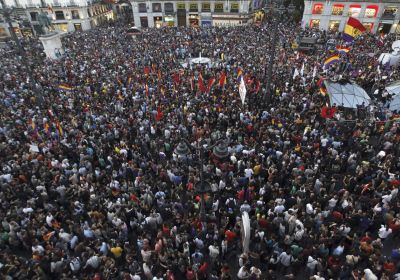
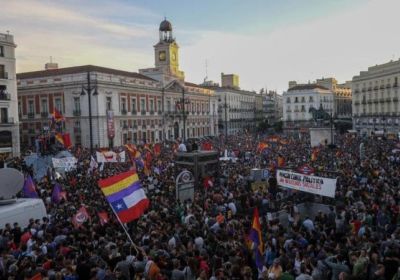
The six columns of the “Marches for Dignity”, protest marches against austerity, corruption and the repression of social and civil rights in the Spanish state, reached Madrid on March 22. Hundreds of thousands of people took over the streets of Madrid that day. It was the crowning moment for a movement that began in early March with marches leaving from cities across the Spanish state. -
The People’s Assembly Against Austerity was launched last year to help create a mass movement across Britain against the austerity measures imposed by the government in a bid to make ordinary people pay for the economic crisis. It was supported by quite a few trade unions, the Coalition of Resistance, many campaign groups and several MPs.