-
PRIME MINISTER TONY Abbott introduced a “red tape repeal day” on March 26. About 9500 regulations contained in more than 50,000 pages of legislation and related documents got the chop. One of the “red tape regulations” that will be scrapped is the Commonwealth Cleaning Services Guidelines, which apply to cleaners employed on government contracts.
-
A former welfare worker at the Nauru refugee detention camp says the July 19 riot that razed most of the Topside compound was an “inevitable outcome” of a “cruel and degrading policy”, in a new book released last week. The Undesirables by Mark Isaacs follows several big whistleblower revelations that have come from Nauru since the camp was re-established by then-PM Julia Gillard in August 2012. -
"The solution to Qantas's problems is being framed as a choice between lifting the level of permissible foreign ownership or a public debt guarantee,” Chad Satterlee wrote in article in the Guardian on March 3. “There is another option: renationalisation". -
To get elected, wait until the existing government makes itself unelectable. Say as little as you can about your real policies. Smile, and present a small target. Those were the perspectives of South Australia’s Liberal opposition in the run-up to the state elections on March 15. The key Liberal slogan, outside polling places throughout the state, was “A Fresh Start”. A start to what, specifically? Voters weren’t supposed to ask. -
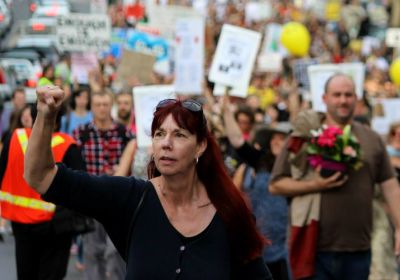
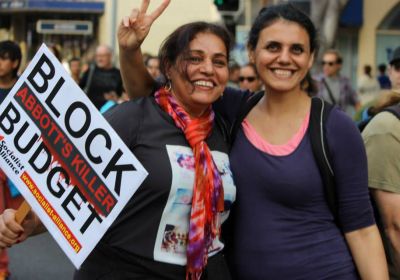
The March in March protests across Australia over March 15-17 were a resounding success – not just because of their size, focus and breadth. Just as significant is the fact that March in March tore apart the idea – seeded by the cynical rhetoric of John Howard's spin doctors in the wake of the invasion of Iraq – that protests don't work. This protest worked precisely because it brought between 80,000 and 110,000 people out of their homes and into the streets in a disparate yet united way against the Tony Abbott government's attacks. -
Washington's role in the fascist putsch against an elected government in Ukraine will surprise only those who watch the news and ignore the historical record. Since 1945, dozens of governments, many of them democracies, have met a similar fate, usually with bloodshed. Nicaragua is one of the poorest countries on earth with fewer people than Wales, yet under the reformist Sandinistas in the 1980s it was regarded in Washington as a "strategic threat". The logic was simple; if the weakest slipped the leash, setting an example, who else would try their luck? -
As David Harvey reminds us, capital never solves its crisis tendencies, it merely moves them around. Since the turn to neoliberalism in the 1980s there has certainly been a lot of movement. Throughout the 1980s there were big recessions in all of the rich countries. Across Africa, Latin America and Western Asia at that time there was a depression, although it was not called this because of a self-imposed taboo on the word by mainstream economic commentators since 1929. -
Jock Palfreeman is serving a 20-year sentence for murder in Sofia Central Prison, Bulgaria. His conviction followed a trumped-up trial in a dysfunctional state where the local gangsters known as mutri hold sway, and hatred of Roma is a national pastime for many. Palfreeman was alleged to have killed Andrei Monov in Sofia in December 2007 while trying to defend two Roma men. Monov was the son of a Bulgarian MP who wants Jock to spend the rest of his life in jail. -
More than five years since the global financial crisis, many OECD countries are still facing high rates of unemployment, losses in income and worsening social conditions. This was confirmed in the latest OECD social indicators report, Society at a Glance 2014, released on March 19. The reports says: "The financial upheaval of 2007-08 created not just an economic and fiscal crisis but also a social crisis ... Some 48 million people in OECD countries are looking for a job – 15 million more than in September 2007 – and millions more are in financial distress.
-
In the strange furore surrounding right-wing columnist Andrew Bolt demanding an apology from the ABC over a guest on Q&A suggesting he was racist, it is Bolt's long-time readers and fans for whom I feel the most.
-
Community gardeners were stunned when AusVeg, the peak body for the vegetable industry, publicly welcomed the federal government’s cut in funding the Food Grants Program. Mentioning “biosecurity risks” and “food safety concerns”, AusVeg spokesperson William Churchill said the program “has been identified as a potential risk to the national horticulture industry”. -
The Liberal Party swept to victory in the Tasmanian elections on March 15, winning 14 seats of the 25 seat parliament. The Labor Party, which had governed for the past three years in coalition with the Greens, received a swing against of 9.5%. It won only six seats. The Greens were also heavily punished, losing two seats in an 8% swing against them. Party leaders Nick McKim and Cassy O’Connor managed to keep their seats. Kim Booth looks likely to be re-elected as well.
Analysis
Analysis