-
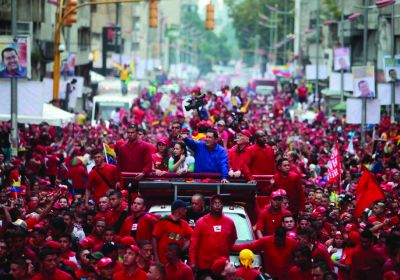
Venezuela's socialist President Hugo Chavez has won the October 7 Venezuelan elections with over 54.44% of the vote against 45% of the vote for right-wing opposition candidate Henrique Capriles. The National Electoral Council's Tibisay Lucena announced more than 80% of the 19,119,809 registered voters in Venezuela participated in the election. -
On the eve of the October 7, Venezuelan presidential election, Green Left TV's Peter Boyle spoke to Tamara Pearson (below), an Australian socialist who has been living in Venezuela since 2007. She writes for Venezuela Analysis and for Green Left Weekly. Pearson lives in Merida but was in Caracas for the final stage of the election campaign and to help lead the 2012 Australia-Venezuela Solidarity Network brigade whose members are also there to witness this election campaign.
-
On our third full day of activity on the Australia-Venezuela Solidarity Network (AVSN) 2012 Presidential Elections Brigade we visited Sala de la Batalla Sociales, LA Communa. This is a grouping of 35 Community Councils in the barrio of Petare. We visited the community medical centre (where free health care is provided by Cuban and Venezuelan doctors), a community radio station and had an exchange with community council members. The commune of Petare is building a chocolate factory which will sit alongside a community university. Photos by Pip Hinman.
-
Photos from the Australia-Venezuela Solidarity Network (AVSN) 2012 Presidential Elections Brigade. The brigade's program kicked off with an introductory talk on Venezuelan history and politics by Dr Marcelo Alfonzo, Central University of Venezuela. Then visits to National Institute of Hygiene plant, a world leader in the manufacture of vaccines, the Bolivarian University, ALBA (the Bolivarian Alternative for Latin America) and the Latin American School of Medicine. Photos by Pip Hinman unless otherwise designated.
-
In Venezuela's October 7 presidential elections, the candidate leading the polls — President Hugo Chavez — is standing on a platform of pushing a socialist transformation. Leaked documents show his main opponent, Henri Capriles Radonski, has a neoliberal agenda. But publicly he presents himself as a social democrat who supports pro-poor policies such as the Chavez government's health and education social programs. -
As Venezuela's October 7 presidential elections approach, polls are showing a clear, large victory for President Hugo Chavez, with a 13%-28% lead. The socialist incumbent — who has survived a US coup and other attempts to overthrow his government — is campaigning on a detailed platform to deepen the social changes that are redistributing wealth and political power to the poor majority. His right-wing opponent, Henri Capriles Radonski, supports privatising state industry and cutting social spending. -
As the final weeks of the Venezuelan presidential election campaign unfold, an intense battle of ideas is under way. The poll on October 7 is looming as one of the most important elections in the country´s history. -
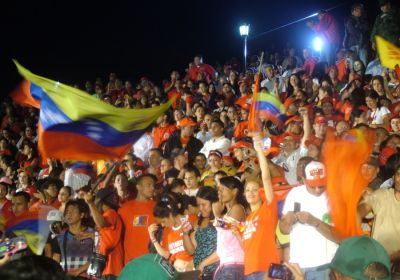
“My plan is to demolish the ultra-right so that a true opposition arises, because I am ready to work with them,” Venezuelan socialist President Hugo Chavez told a mass rally of supporters of his re-election campaign in the Caracas neighbourhood of Charallave on September 9.
-
The 34,000 employees who work at the Polar Business food production conglomerate in Venezuela have denounced what they describe as a violation of their labour and social rights. The workers accused the company of trying to destabilise the country in the run up to the presidential elections on October 7. Polls show that President Hugo Chavez is far ahead of his right-wing rival, Henrique Capriles Radonski. Chavez is campaigning on a platform of deepening the socialist transformation of Venezuela.
-
In May 2008, Venezuelan President Hugo Chavez endorsed Plan Socialist Guyana (PGS), drawn up by elected representatives from workers in Venezuela's heavy industry sector in Guyana. This plan calls for the introduction of workers' control across the state-owned industries grouped in the Guyana Venezuela Corporation(CGV), as well as a shift away from producing raw materials for multinationals towards Venezuela's development needs and taking the needs of communities and the environment into consideration. -
Carolus Wimmer is a widely respected Venezuelan political scientist, educator and writer, lecturer and columnist nationally and internationally. Elected to the Latin American Parliament in 2005 he served as Vice-President from 2008 to 2011.
-
The article below was abridged from Correo Del Orinoco International.