-
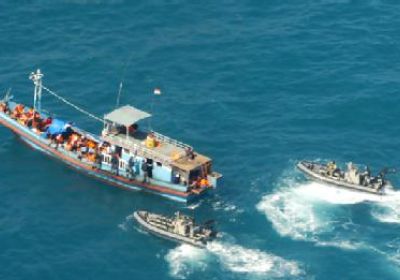
Labor and Coalition MPs have shed thousands of crocodile tears claiming that Australia needed to “stop the boats” to “save lives” by making offshore processing of asylum seekers government policy. Labor backed a private members bill put by independent MP Rob Oakeshott that would allow Australia to expel refugees to any country that was part of the Bali Process, including Malaysia. -
The 2012 Resistance conference, in Adelaide July 20-22, will feature international guests including from CLASSE in Quebec (the largest and most radical student organisation leading massive student strikes); the Socialist Party of Malaysia (hugely involved in the Bersih democracy uprising); and from the brave Palestinian People's Party.
-
Three leaders of the People's Justice Party (Parti Keadilan Rakyat — PKR), a major parliamentary opposition party in Malaysia, were arrested on May 22 under provisions of a controversial new Peaceful Assembly Act. The three were PKR de facto leader Anwar Ibrahim, PKR deputy president Azmin Ali and Badrul Hisham Shaharin. The charges relate to the April 28 Bersih 3.0 mass democracy protest in the capital Kuala Lumpur, involving 100,000-200,000 peaceful protesters. The march was violently attacked by riot police after a few protesters pushed through police barricades.
-
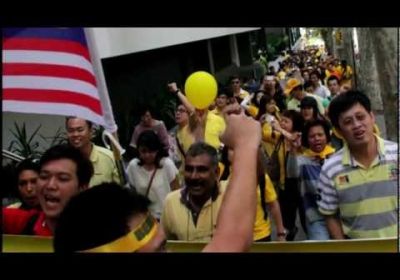
Footage from the 'Malaysian Spring': the inspiring 250,000-strong Bersih ('clean') rallies for free and fair elections in Malaysia plus from Australian support rallies in Melbourne (1200 people), Sydney (500) and Perth (400).
-
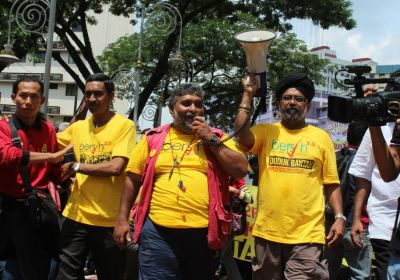
S. Arutchelvan, secretary general of the Socialist Party of Malaysia, is a veteran of many demonstrations. But the Bersih 3.0 mobilisation, which he estimates was between 100,000 and 150,000-strong, was the biggest he's been a part of in the country.
-
The Coalition of Free and Fair Elections (known as Bersih — which means “clean” in Malay) called for a mass sit in on April 28. It did so due to suspicions that the country’s Barisan Nasional (BN) government was about to call a general election before addressing widespread electoral irregularities. The irregularities were confirmed by a review forced on the government by the previous Bersih 2.0 mass rally on July 9 last year. -
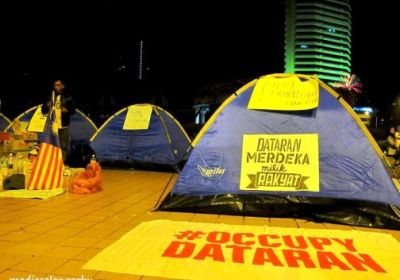
At 2.36am, in the early hours of April 19, the student and Occupy Dataran encampment in Kuala Lumpur was violently ambushed by a big group of men. After the ambush, everyone sat down, and victims of violence started to tell stories of what happened. Here is a brief summary of the stories.
-
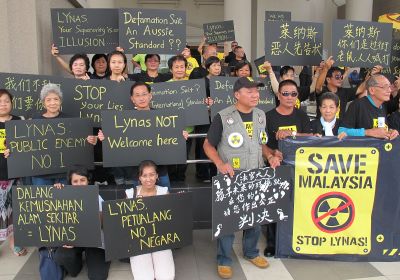
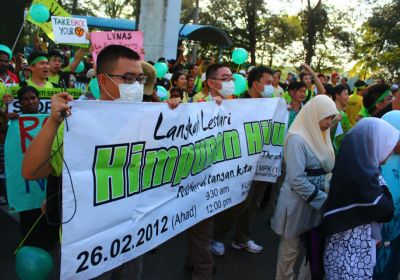
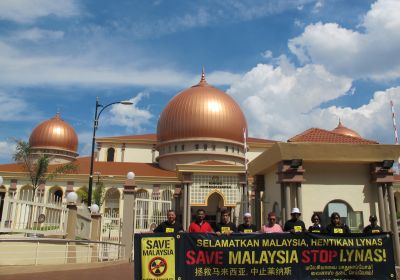
Lynas, an Australian mining company, is building a rare earth refinery close to the heavily populated area city of Kuantan in Malaysia. The ore is to be shipped from a mine in Western Australia but the highly toxic and radioactive waste which the refinery will produce will not be accepted back by the WA government. -
Malaysian opposition leader Anwar Ibrahim, of the Parti Keadilan Rakyat (PKR) ,was acquitted on January 9 by the country’s High Court of the second round of politically motivated “sodomy” charges. He was jailed for six years under the former Barisan Nasional (BN) government of Mohamed Mahathir on similar charges. Police dispersed jubilant opposition supporters outside the court using the excuse that three small bombs had exploded nearby. -
Since 2008, Seksualiti Merdeka (Independent Sexuality) festival, the LGBTiQ's main vehicle for awareness raising and education made its contribution to Malaysian society in a beautiful, intellectually artistic manner, devoid of vulgarity. It made “straight” heterosexual society realise and appreciate that other forms of sexual love existed and that these could be as genuine as a woman-man love. It had been and still is a struggle for gay men and women to survive even in apparently liberal-minded societies. -
Petty politicking over whether refugees should be illegally deported to Malaysia or to Nauru forced the Australian government to abandon its policy of “offshore processing” of refugees on October 13. Since the “Tampa election” in 2001, competition between the two main parties over who can most mistreat the small number of refugees arriving in Australia by boat has been at the centre of Australian electoral politics. -
A confidential United States cable released by WikiLeaks on July 29 documents the arrest of controversial Malaysian blogger and Malaysia Today editor Raja Petra Kamaruddin. Kamaruddin had been outspoken in his criticism of the government. On September 12, 2008, Kamaruddin was arrested at his residence under the Internal Security Act (ISA) ― which allows for detention without trial. Kamaruddin’s arrest came days after Malaysian Prime Minister Abdullah Ahmad Badawi threatened to use the ISA to repress those purportedly stoking racial and religious tensions.