
I am a construction worker based in Naarm/Melbourne. From mid-2021 to mid-2022, I worked for a labour hire company at a host company operating nationally with a market capitalisation in the hundreds of millions of dollars.
This company mainly does construction work for the Victorian government, but also for federal government projects and private companies.
Soon after I started working for the company, it relocated to a larger factory.
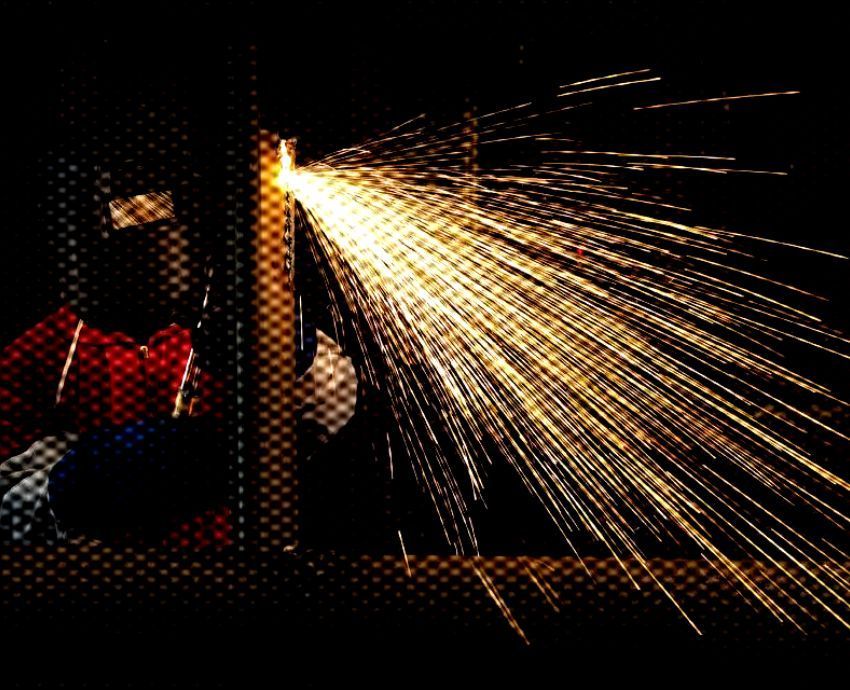
Welding was happening near my work area, for several hours two to three times a week, and yet there were no welding screens to protect workers.
I knew there is no safe distance at which ones eyes can safely be exposed to welding flash on a regular basis. So I asked my supervisor when welding screens were likely to be set up. I was told to be patient and that the issue would be addressed.
After several months and much lobbying, a single welding screen on a cable was jerry-rigged from a gantry crane (that was being used daily for other heavy lifting tasks).
It was an ad-hoc solution, but it provided some relief — for me. However, the screen only protected one side of the structures being worked on, which meant workers elsewhere could still be exposed to welding flash. In addition, sometimes the screen was not erected and there was no clear process for who was responsible for setting it up or finding it if it got misplaced.
One day, I complained to the company safety representative that the welding screen was once again not being used. By this stage I had been working there for about nine months; my numerous complaints to my team leader and supervisor about the need for the screen and then its inconsistent use had been largely ignored.
My supervisor reprimanded me for speaking to the safety representative rather than to them. This is a breach of section 76 of the Victorian Occupational Health and Safety Act 2004 (OHS Act), which states that workers must not be dissuaded from discussing safety matters with a safety representative.
The following morning, I was moved to a different department, after being told I was “too slow” at my job. My labour hire supervisor also abused me on the phone for having raised the welding screen issue with the safety representative (again, a breach of the OHS Act).
The only action the company took was to reprimand and move me to another area. The welding screen matter was not mentioned at any toolbox meeting and welding without screens continued over the following couple of months. Knowing my job was at risk, I stopped trying to have the matter addressed, but I did take photos each time people were welding without screens and I kept a diary.
About three months later, after having endured 10 work days in a row of welding without screens, and repeatedly complaining to my team leader, I posted photos of welding without screens to a private union group chat. I believe some images that contained information used to identify me were leaked to management.
Not long after posting the images, I came to work to find, all of a sudden, two welding screens up (using both the available gantry cranes).
This meant that two out of four sides of the structure being worked on had a welding screen up — an improvement. That afternoon, I received a text from my labour hire employer telling me the host company had informed them that “my services were no longer required”.
I lodged two complaints with WorkSafe; one was a detailed complaint (including diagrams) about the lack of fit-for-purpose custom-built welding screens and the inadequacy of the ad-hoc crane solution that relied on using heavy lifting cranes that were required elsewhere. My complaints were far more thorough than what I believe the average construction worker would put together.
The other complaint regarding my sacking. In theory, under the OHS Act, labour hire workers have the same level of protection against being victimised for complaining about safety issues as a direct employee of a company.
I was to discover those laws do not count for much.
In the first instance, WorkSafe attended the site and decided that as there were screens up there was no problem. The brief inspection report I obtained by freedom of information ignored the fact that the screens still left large areas that were not screened off and that this “solution” relied on using both of the available cranes in the bay to handle screens, even though the same cranes were needed for other tasks.
The “investigation” into my sacking was pretty much non-existent.
If you are sacked from your job for raising a safety concern, here is the extremely opaque and bureaucratic process you can expect from WorkSafe. First, you will likely get one phone interview from an investigator. There is every likelihood that WorkSafe will not interview the employer who sacked you, much less carry out any sort of proper investigation. This was what I found about my case via a freedom of information request.
You will not be provided with any sort of overview of the process or any timeline of what to expect. If you ask for any of this, you will glibly be told by WorkSafe that “as this matter is still under investigation WorkSafe cannot comment”.
Eventually the investigation will end, but you will not be notified. This makes it difficult to apply any pressure. WorkSafe will have its own “investigation”, open for an arbitrary amount of time, during which you cannot receive information about it. Once it closes the investigation, it will be hard to reopen it. You will not be provided with any explanation as to why the investigation was terminated.
I learned from my experience that WorkSafe is, effectively, an extension of companies’ useless “safety” regimes. It gives the appearance of taking safety matters seriously, while turning a blind eye to problems that require some investment to remedy. Profit margins always come first.
Given my experience, news reports about the Construction Forestry and Maritime Employees Union (CFMEU) pressuring state-based agencies like WorkSafe shows they are acting in their members’ interest. Without external pressure, these agencies are useless.
I used to believe that WorkSafe represented an alternative pathway to getting safety issues addressed if you were working somewhere with a non-existent or minimal union presence.
However, I learned that a fully unionised job site, with a union agreement and an elected union health and safety representative, is the only effective way of having safety issues addressed properly and promptly. The attack on the CFMEU by the Labor party, bosses and media is to turn it into an obedient “tame cat” union. It will have a disastrous impact on worker safety if it cannot be repelled.
[Joe Hill is a pseudonym.]