
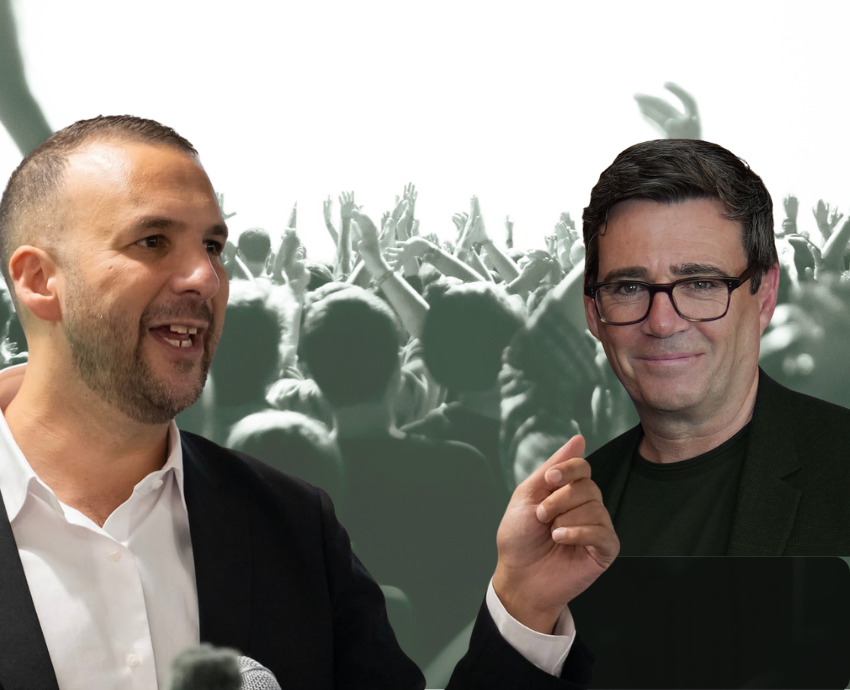
The Makerfield by-election in Manchester, England, on June 18 was described by the BBC’s political editor Chris Mason as the “most important by-election” in his lifetime. The by-election was triggered by the resignation of British Labour Party MP Josh Simons, who said he was stepping down to allow Andy Burnham to contest the Labour leadership.
Burnham’s clear victory, beating Reform UK’s Robert Kenyon by more than 9000 votes, was followed by Keir Starmer’s resignation as Labour leader, on June 22. This paved the way for Burnham to mount a takeover as the new Labour leader and PM.
Derek Wall, ecosocialist, writer and former coordinator of the Green Party of England and Wales, told Green Left: “Andy Burnham’s victory [in Makerfield] is a defeat both for the far right and Starmer, so we should celebrate this. However the Labour Party is in deep crisis.”
Wall said British politics is “fractured and unstable”.
“The Conservatives were swept out of office in 2024, and Labour swept in. Now there is disillusionment with Labour,” he said. The Starmer government’s poll ratings are “in the teens” having been through “a series of very difficult elections”.
In the face of an economic crisis, made worse by United States President Donald Trump’s war on Iran, Labour has continued with neoliberal policies that have alienated people, Wall said.
“Incomes are falling and a lot of industries are facing job cuts and decline. A lot of people in Britain are increasingly angry.
“Labour has been trading on the chaotic and populist rhetoric of its political opposition in Reform and the Conservatives, and claiming it alone can manage the economy, increase economic growth and be ‘steady managers’.
“But that hasn’t worked, and they have not come up with economic policies that are attractive to people.
Disillusioned
“Starmer has been disastrous for Labour. He is not in any way charismatic and does not have the ability to rally people.
“Unless Andy Burnham deepens Labour’s commitment to addressing climate changes, reverses its persecution of Palestine Action and others opposing Israel’s genocide and tackles accelerating poverty and inequality, he will soon be just as unpopular as Starmer.”
Wall said there is a lot of disillusionment with politics among working people, who are looking for alternatives to the traditional ruling parties.
The deep unpopularity of Labour and the Conservatives has created space for parties to the right and left. “Reform UK, who are a reactionary, racist, anti-net zero party, are topping the polls, and a lot of the time Greens are coming second.
“The Scottish National Party, Sinn Fein and Plaid Cymru are utterly dominant in Scotland, the North of Ireland and Wales respectively.”
While the rise of Reform matches the rise of far-right parties around the world advocating cruel and racist politics, Wall said, Britain has also seen the left advancing.
The election of Jeremy Corbyn as Labour leader in 2015 on a left program reflected growing interest in left ideas.
While Labour used its internal bureaucracy, backed by the corporate media, to “purge and suppress” Corbyn and the left within the party, Wall said, “those voters haven’t gone away, and increasingly see the Greens as representing them.
“A lot of councillors who have been expelled from the Labour Party have become Greens councillors, such as Martin Abrams who was expelled because of his support for Gaza and is now a Greens councillor in Lambeth Council in south London.
“It is incredible for what purports itself to be a broad social democratic party to have purged so many activists and councillors. They have absolute discipline in terms of views they don’t like.”
Zack Polanski’s impact
Wall said the impact Polanski has had on the Greens and political discussion in Britain has been significant. “There is space in British politics for strong left-of-Labour candidates, and before Zack Polanski there was a more timid Greens leadership who weren’t prepared to exploit that.
“While the Greens have been slowly organising over decades and have longstanding policies which support Palestine, wealth taxes, nationalising water and so on, and are in many ways a natural left choice, people perhaps weren’t aware of that.
“Having a new and remarkably effective leader in Polanski has really helped.”
Wall said Polanski has been able to articulate “green” arguments alongside cost-of-living arguments. “He acknowledges that people are getting poorer and angrier and is providing solutions such as a wealth tax, while linking that to things like net zero emissions.”
While this approach has been effective at reaching the majority who are politically disengaged, it has had important impacts on the politically active left as well, Wall said.
“There are hundreds of thousands of people who are politically active on the left in some ways, and many are joining the Greens, creating space and encouragement for tens-of-thousands of new activists to get involved.
“That helps because elections are won on the ground, not just through culture and media.”
Local government
Prior to recent local government elections, the Greens only had a dozen councillors across London and about 800 councillors across England and Wales. Now they have more than 1300 and control five of London’s 30 boroughs.
“Local government is very underfunded, you constantly have to cut budgets, and these challenges could lead to more resentment towards the Greens,” Wall said.
“Groups like the Socialist Party say the Greens should commit to a ‘no-cuts’ budget, which would require mobilising massive numbers of people and strategising, I don’t know if it could work.”
Wall said political parties often have a “resolutionary approach: you replace the bad people with good people and bring in resolutions … but the nitty gritty of how do you things in a practical way is very challenging and not something many people have experience of.”
He said the buildup of experience within the Greens since it won its first councillor — John Luck in Rye, Sussex, in 1976 — is an advantage, as well as Polanski’s experience on the Greater London Authority, which — since its establishment in the 1990s — has generally been controlled by Labour in cooperation with Greens.
“Local government is not easy in Britain.”
Possibilities
The rise of the Polanski Greens came after the initial excitement for the Corbyn and Zarah Sultana-backed Your Party, which drew an enormous 800,000 sign ups by August last year.
However, internal divisions, including between Corbyn and Sultana, disorganisation, purges of left groups and the growing popularity of the Greens dissipated much of that energy.
“Nearly everybody on the left was excited by Your Party,” Wall said. “It’s in sharp decline; it hasn’t really coalesced and has had these big splits.”
Wall said Your Party and the Greens are prepared to work together. “At the last general election, a number of left independents, including Corbyn, became members of parliament, representing a kind of electoral left.
“Come a future general election, I think there would be collaboration between those people and Greens, I think that is significant.”
While a lot of left groups have been positive about Polanski and the Greens rise, there are also criticisms, including Counterfire’s May 22 article, “Why the Green Party is not the new party of the left”.
Wall said the example of European green parties moving to the right once they hold power within centre-left governments is a real threat. “But equally, the opportunities for the left within Labour look very limited, and if you look at the disparate English far-left, they have not built successful organisations that have captured people’s imaginations.
“Your Party hasn’t succeeded, so what else have you got? You’ve got the Greens.”
Politics and strategy
Wall said the focus of the Greens has been “very much electoral, very much local government and ‘target to win’.
“Polanski is very focussed on elections, but in many ways he has taken it to the next level so now winning parliamentary seats is more realistic.”
However, Wall said Polanski is concerned with movement building, and regular attends demonstrations for Palestine and other causes.
“There is this mass membership of something like 216,000 people, and many of those people come from activist milieu like the far-left, or Labour or movement campaigns.”
Wall said his longstanding criticism of the Greens is its lack of internal political education. “This means the Greens tend to drift to whatever is the common sense of the people … there seems to be no discussion of how they have political education and debate Greens ideas and strategies.
“That’s one thing the far left has been able to do effectively, and the Greens should look at that.”
Climate
Action to stop climate change is high on the Greens list of priorities. First in the “Objects and Aims” section of the party’s constitution is to “develop and implement ecological policies consistent with the Philosophical Basis of the Party as expressed in Policies for a Sustainable Society”.
Wall said climate policy is a relatively positive element of British politics, with successive governments managing to largely decarbonise the electricity grid.
However, there is a push from Reform and the Conservatives to reverse progress on climate. “Reform are campaigning on the Trumpian style of claiming net zero is wrong and that we need to get rid of it.
“Having been a political consensus, with both Labour and the Conservatives implementing emissions cuts policies, the Conservatives have now turned against their own net zero policies.
“If Labour lose to Reform or the Conservatives, a lot of practical progress will be lost.”
A heat wave swept through Britain in May and June, with record-breaking temperatures rising to 40⁰C, driven by changing climate patterns and global warming.
Wall said climate policy is largely absent from public debate, but that shifts towards renewable energy sources have taken place behind the scenes. “That is a challenge for climate activists and means there is a lack of consciousness about climate action.
“While on the whole, climate action policies are fairly popular, the climate movement as an activist movement seems weak at the moment. To achieve our climate goals we will need a resurgence of the climate movement.”
Beyond elections
The election of Hannah Spencer in the February 26 Gorton and Denton by-election was an impressive victory for the Greens, and gave a boost in credibility to Polanski's approach.
“Reform is at the top of the polls with 27% of the vote, which because of Britain's electoral system could give them a landslide in parliament. However if the Greens or Labour push above them, then they could win a landslide.”
However, Wall said to win real change will mean looking beyond the next election.
“Ultimately capitalism is destroying the planet, and we do need a Marxist, revolutionary left.
“I’m not going to come up with a range of criticisms of the Greens, although they can be made, but we do need an effective Marxist left and that has not cohered during the past 100 years in Britain.
“I am very positive about the base-building work, building strength in the community and building alternative institutions. I am particularly enthused by the Welsh Underground Network, a generation of working class Marxist youth who engage in base building and building republican socialism.
“That is something we need to do in a wider way on the left, we need to be in the community, while balancing that with having clear principles and effective theory drawing on Marx and Lenin in a way that isn’t brittle or sectarian.
“We have to go beyond purely reformist politics, but I think it’s positive what the Greens are doing, including building membership and changing the nature of political debate in Britain.”