
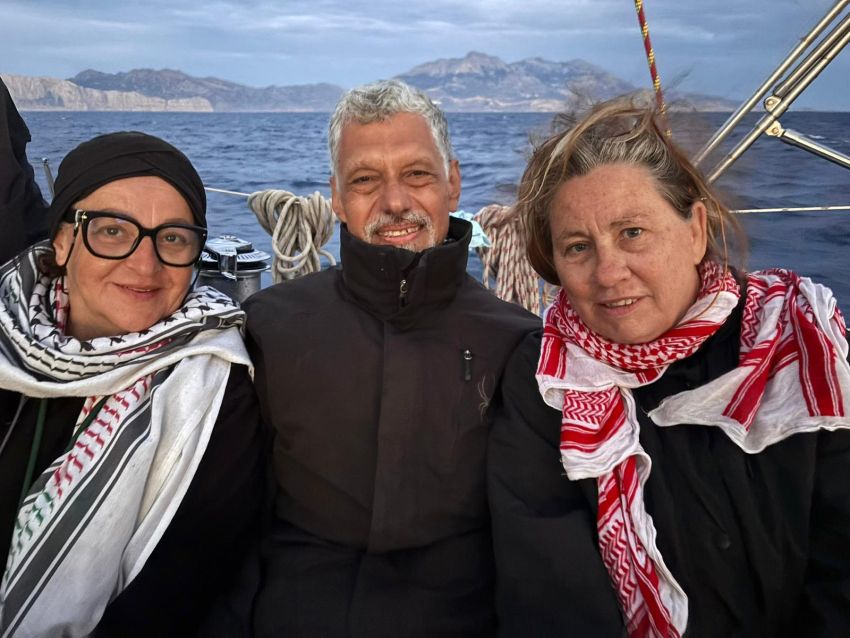
Gaza Freedom Flotilla member Helen O’Sullivan, two weeks after returning to Australia, following her abduction and detention by the Israeli Occupying Forces (IOF), told Green Left that the movement for a free Palestine must continue.
O’Sullivan was detained with 10 other Australians from the Global Sumud Flotilla: Neve O’Connor; Sam Woripa Watson; Anny Mokotow; Isla Lamont; Juliet Lamont; Surya McEwen; Zack Schofield; Bianca Webb-Pullman; Gemma O’Toole; and Violet CoCo.
O’Sullivan, CoCo and O’Toole represented Free Gaza Australia and the Freedom Flotilla Coalition. O’Sullivan was aboard the Canadian vessel the Perseverance, along with seven others. They formed part of the more than 50-strong Global Sumud Flotilla of vessels, which set sail in May to deliver urgent humanitarian aid to Palestinians in Gaza.
The Global Sumud Flotilla, Freedom Flotilla and Thousand Madleens to Gaza had partnered for the mission, but Thousand Madleens withdrew as international pressure to prevent the mission going ahead mounted.
Israel has shown its willingness to use lethal force against humanitarian missions. In May, 2010, Israeli soldiers shot and killed 10 Gaza Freedom Flotilla participants aboard the Mavi Marmara; last year, a Freedom Flotilla vessel, the Conscience, was bombed by an Israeli drone; and in late April and early May, Israeli forces intercepted the Global Sumud Flotilla in international waters near Greece.
Israel has also dismissed reports that the IOF sexually assaulted flotilla participants, saying the allegations were “already proven to be false”. Reports of rape and sexual abuse by several Australian flotilla participants were also initially dismissed by the Australian government, but on June 16 after finally meeting some of the detainees, foreign minister Penny Wong announced she had asked the Australian Federal Police to investigate. This has only happened after sustained efforts by flotilla activists and the pro-Palestine movement more broadly for Australia to take the abuse reports seriously.
O’Sullivan said the flotilla “was a beautiful mix of people”. It included Ehab Lotayef, a Montreal-based Canadian activist, poet and IT manager, and Alima Boumediene-Thiery, a French politician and former member of the Greens Party. Along with the rest of the flotilla, the Perseverance was boarded by the IOF in international waters on May 18.
“We were able to track what was happening with our comrades on the other boats. We could see that, one by one, they were being abducted. Our boat was a fast one and we were ahead of the flotilla, but we knew our number was coming up.
“We had livestreaming in the cabin ... I remember sitting there with about six signs that summed up our reasons for what many would describe as a ‘dangerous campaign’ ... I couldn’t talk, all I could do was put up these signs saying ‘Stop the genocide’, ‘Stop killing children’, ‘Stop stealing land’, ‘We are sailing for love’, and ‘They are coming for us’.”
As the IOF closed in on the Perseverance, O’Sullivan recalled her friends up on the deck with their life jackets on were trained in non-violent action. “It was very important that we were disciplined. We sat quietly; we didn’t move fast. Anything that could be interpreted as a weapon, like kitchen knives, were thrown overboard, so there was no excuse for Israel to shoot people like it did in 2010.”
No stranger to state violence
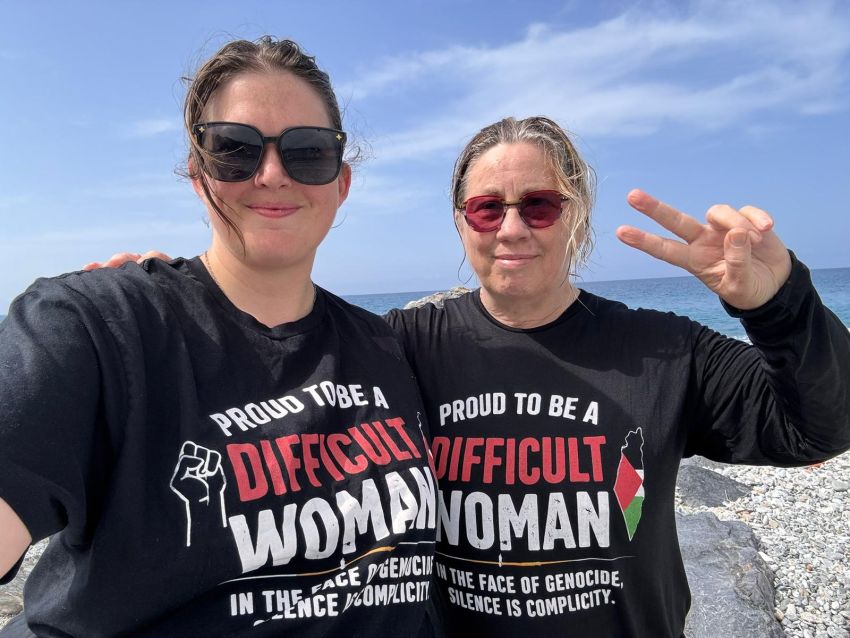
O’Sullivan is no stranger to Israeli state brutality. She joined the International Solidarity Movement (ISM) in the West Bank in 2024, where she and 26-year-old Turkish-American citizen and ISM volunteer Ayşenur Ezgi Eygi provided “protective presence” at a peaceful protest in Beita. An Israeli sniper shot and killed Ezgi Eygi as they stood together in an olive grove.
O’Sullivan said that despite providing a witness statement at the time to the Turkish Prosecutor for a complaint to the international courts, no one has been held accountable. “I witnessed, almost on a daily basis [In the West Bank], the brutality of both settlers and the soldiers. So I was under no illusion as to what we were in for [on the Perseverance].”
The IOF ordered the Perseverance flotilla activists to their knees and then destroyed the boat’s satellite communication and broadcasting equipment. The military sailed the boat to a dinghy “full of soldiers”, who took them to one of two war ships that had been converted into prisons.
“It was like a completely dystopian world from then on, for the next three nights and four days,” O’Sullivan said.
The abductees had their jackets and possessions taken and were “tagged like sheep in a pen going to slaughter”, O’Sullivan said. “My arm was ripped up behind my back by this massive Israeli soldier and my head forced as low as it could go while I was standing. He pushed me forward. I must have cried out, because he pushed my arm even higher and I collapsed. As I was coming to, I could hear them say ‘Give her a needle’. I stood up, dazed, and then my head was forced down again and I was walked into a [shipping] container full of soldiers.
“It was dark and we had to run the gauntlet of soldiers kicking and hitting us. We came to a small quadrant, surrounded on all sides by three other containers that ended up being our sleeping quarters. The floor was wet. The first night, there were about 60 people in each shipping container, with very little water and a bag of bread that many of us refused to eat. Many chose to hunger strike.
“There were about five porta-loos, but they only unlocked two. There was also a can or bucket to use. No toilet paper. There was no water other than the limited supply of small bottles of water.
“On the second night, we heard screaming and we knew the IOF had caught another boat. We could hear the flotilla participants being pushed through the container and beaten up. We were lucky to have Dr Margaret Connolly [sister of Irish President Catherine Connolly] along with another young Malaysian woman doctor and nurse who were checking on the most injured. They were an incredible team.
“Our prison ship had 35 suspected rib fractures alone. There were numerous sexual assaults, one eye injury and one head injury. Our skipper — from Belgium — ended up with a punctured lung from rib fractures. I have no idea how he stayed in the stress position for hours. If you moved, or tried to lift your head, a soldier shouted ‘The next one who lifts their head up is going to be shot’.”
O’Sullivan was not injured, but she said her bad knees made staying in the stress position very painful. “All I could do was to remind myself, and whisper to those around me, ‘This too will pass’.”
Helen said she knew her passport gave her and the others hope of release from their ordeal, and held Israel in some small way accountable for its actions. But they were very aware of the plight of more than 10,000 Palestinian prisoners — men, women and children — held in Israeli prisons without due process and “without access to the same civil rights as any other human being”.
Detainees were denied sleep by their captors, who shone bright lights into the containers and dragged chains across the roof.
O’Sullivan recalls a number of “chilling moments” during her detention.
“I woke up. I didn’t know what time it was. That night, there were about 90 of us in the container, trying to find a little bit of space to sleep. Many were injured. My friend Ehab didn’t take a space to sleep and I later found out he had a rib fracture. He would have known that the soldiers had a neon green [targeting] laser on his forehead.”
O’Sullivan said 200 people were crowded into one end of the quadrant and the IOF soldiers positioned themselves above “with their state-of-the-art weapons supplied by the US and other Western countries”. She said they chose to only speak in Arabic, because if they had spoken in English “we would know where they were from … Texas, or Utah or Ukraine”.
She said the IOF became frustrated “when we didn’t do what they wanted us to do because they refused to speak in English”. They fired rubber-coated steel bullets and stun grenades at the flotilla activists. “It was about creating fear … a sense of terror.”
O’Sullivan said on the final day “many of us were dehydrated, women were menstruating, but there were no sanitary pads. Dr Margaret Connolly kept calling out … the men started calling out … but they were ignored. Then an Irish woman came out of the toilets, having written in her own menstrual blood ‘PADS!’ on a piece of cardboard. After a time, they gave them to [the women]. But this was the humiliation they wanted to put us all through. And that wasn’t the worst of it.”
Itamar Ben-Gvir
Footage of right-wing politician Itmar Ben-Gvir mocking detainees started spreading on social media as the prison ship docked in the Port of Ashdod. O’Sullivan said her group was forced to kneel, heads down, and made to listen to the Israeli national anthem, on repeat, until they were taken into a large tent.
O’Sullivan said the soldiers started to behave differently to those on the prison ship. “They started to play night club music. It was really sinister. We know that women who had come through the container with soldiers [after boarding the prison ship] were sexually assaulted as they came through. I feared that they were going to take a few women away … It was a very chilling moment.
“What struck me most was how much the soldiers, the prison guards and even the immigration officials loved what they were doing to us. This was ‘normal’.”
The April 21 United Nations Secretary General’s report on conflict-related sexual violence highlighted a dramatic increase in sexual violence being used as a deliberate tactic of war, torture and political repression. Verified cases have more than doubled year-on-year and overwhelmingly, women and girls bear the brunt of abuses, with men, boys and gender-diverse people also targeted, frequently in detention.
O’Sullivan believes that the world has combined to create “a monster”, because it has “allowed Israel to continue breaking international law” without any accountability.
“There were moments, in the containers late at night, that I knew the IOF had the capability to push those containers into the sea … Given the number of people they have massacred in Palestine, it would be nothing to be done with us.
“I feared for the lives of those being targeted — the women in hijab, doctors, transgender people — and anyone who had a potential leadership role in the group or that they had identified as a skipper of a boat.”
O’Sullivan believes that Israel’s intention was to “make us afraid” of joining another flotilla. “But every time I see this violence, it makes me more committed to put my body on the line. Everyone around me, young people included, would get back on a boat tomorrow.”
O’Sullivan’s group was eventually taken to the infamous Ketziot Prison, in the Negev desert, where she was held with the other abductees overnight in the women’s section. “They put us in prison gear and kept moving us, like jigsaw pieces, from one prison cell to another, for 15 minutes at a time and then put us in the stress position in between. We couldn’t sleep. There was no water, except from the bathroom. Many of us were dehydrated and hadn’t eaten for four days. We were tightly handcuffed, and our wrists were bruised and swollen.
“Even there, Ben-Gvir showed his face. If not for my friend who disobeyed orders and lifted her head up, we would not have seen him. They forced 20 women into the stress position and shouted at us to make sure we didn’t lift our heads. We only saw a group of shiny boots come in and they would have been taking selfies with us. Those photos never made it to the public, because there had already been a big reaction internationally [to the previous images posted by Ben-Gvir]. Even members of his own party distanced themselves from it.
“It was the bad PR Israel was most concerned about, not the brutalisation of us. Israel denies that any of the international volunteers were harmed by the Israeli military or prison guards.”
They were told by their lawyers as they went through Israel’s immigration process that they would attend a magistrate’s court the following morning. They were put in shackles and made to walk fast — leaving many with bruises and swelling on wrists and ankles.
The next day, the activists were put on a prison bus that didn’t move for hours and then started heading into the desert. They initially thought they were being taken to the court.
“The thought crossed my mind that they were going to do away with us,” O’Sullivan said. “It felt like forever and it may have been three hours … I’m not sure ... but when we got out we realised we were at an airport and we started to get excited. You could tell they were reluctantly taking the handcuffs off, reluctantly letting us off the bus.”
Power and law
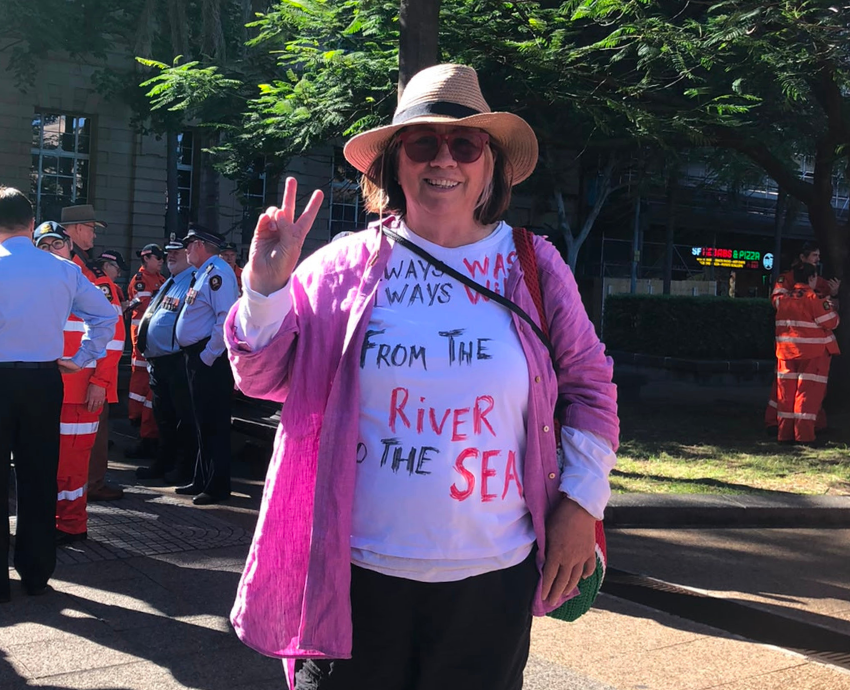
O’Sullivan said that, for four days, she felt like she “had absolutely no power”. But when she saw a small group of Israeli supporters, with their cameras out, watching the detainees unload to go into the airport, she raised her hand with a victory sign.
“My one sense of triumph was to raise my hand with my two fingers up. A soldier dived at me, shouting at me to put my hand down. But I didn’t. He realised the cameras were on him and pulled away. That was probably the gateway for me to regain my sense of control and agency again. That was my favourite, very personal, moment over the whole four days of brutal incarceration.”
O’Sullivan said that once they arrived by plane in Istanbul, Turkey, local NGOs had lined up hundreds of doctors, forensic medical experts, lawyers and police for the flotilla activists to give statements and evidence. “They did blood and urine tests, because there were at least two people injected with some unknown substance. I wasn’t sure if I had been.”
It was only then that O’Sullivan saw any Australian government representatives. She felt they were going through the motions and compelled to “look like they were doing something”.
O’Sullivan strongly believes Australia must be forced to uphold international law.
“Australia has obligations under international law to hold [Israel] accountable; not to trade with it. It has obligations to hold anyone who goes there to fight, or to support this genocide, accountable, to not provide Israel with weapons. But we are doing all of that.”
More than 500 Australians are believed to have been fighting with the IOF last year.
O’Sullivan said the government’s lack of interest in Israel’s brutality against the flotilla members was “disappointing but not unexpected”. However, she said the invitation to Israeli President Isaac Herzog disgusted her more. “Choose your friends carefully. This is a country being charged with committing genocide. This is a state where people are witnessing every single day children being murdered.”
“Out of at least 75,000 Palestinians that have been killed in the past three years, since October 7, more than 21,000 are children. Those numbers are massive. And don’t forget the ones left orphaned, the ones left to deal with the ongoing trauma of this, from one generation to the next.
“Even if the Palestinians rebuild Gaza, even if somehow people get sick of seeing Israel the aggressor commit this horrific crime and allow Palestinians their right to their own land, there will be children who will be living with the trauma of what they have witnessed for years to come.
“The Australian government is on the wrong side of history. But the very worst crime is the government saying we are ‘friends’ with Israel — a rogue state.”
Asked to comment on laws to silence protesters, including banning phrases, O’Sullivan said it “blows her away” that a democratic country criticises calls for freedom from occupation, freedom from apartheid and freedom from genocide.
“I have witnessed the apartheid system in the West Bank. I have witnessed settlers attacking farmers to try and weaken, over time, their economic ability to collect olives. I have witnessed soldiers chasing villagers off their own land so they couldn’t collect olives. I have walked Palestinian kids, my grandchildren’s age, to school to stop settlers getting in the way of them participating in the education system. I am disgusted by our government.”
O’Sullivan said the flotilla had “absolutely served its purpose”. This was her third mission.
“There is a long history of trying to break an illegal siege that will not stop. It is not just about food, but really important medical equipment. Gaza has the highest child amputee rate in the world, thanks to Israel, and it cruelly stops prosthetics from coming in because they contain a little bit of metal. The siege has huge impacts.”
Has there been a change in attitude towards Israel’s genocide, because of the flotilla’s missions? “There have never been so many [vessels] and this was certainly the largest number of people. Did we achieve our aims? People might think it failed because we didn’t get aid into Gaza. But it’s not a failure; even if we could get a little aid into Gaza, it’s only a drop in the ocean compared to what Palestinians need. We knew the risks before we came. We knew this from 2010.”
O’Sullivan believes many are willing to take the risk to bring worldwide attention and bring hope to the Palestinians. “One child a week in the West Bank is being shot by either military or settlers. The West Bank is going to become the new Gaza. Gaza is 80% rubble now, with people living in tents.
“Our aim was to get the world to remember that genocide is still occurring in Palestine. The world needs to hold Israel accountable for the war crimes it has committed since October 7, 2023, as well as the decades beforehand,” O’Sullivan said.