
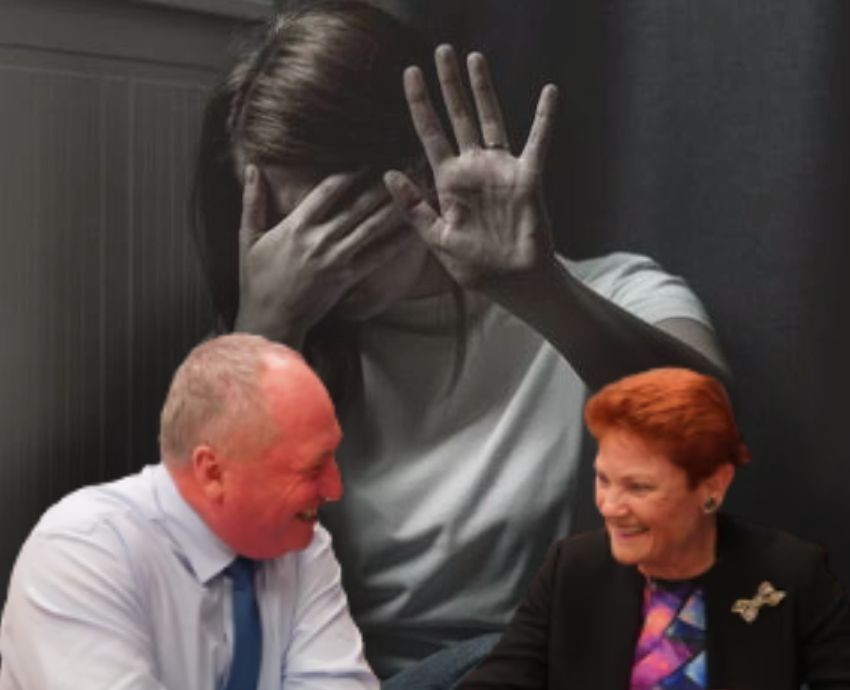
Pauline Hanson told Brisbane’s 4BC radio on July 21 that domestic violence is “wrong, but it’s also a two-way street“. She attributed it to the “pressures of living” and said “women can lose their cool as well”.
Fellow One Nation Senator Barnaby Joyce had used the same program earlier that day to advise men to “walk out of the house” before losing their temper, reaching for James Bond as a model of masculine self-control. Brittany Higgins called the framing atrocious, given at least 38 women had already died so far this year at the hands of men. Advocates point out that “just leave” ignores everything known about the danger of separation.
All that criticism is accurate but none explains why “two-way street” sounds true to people who aren’t invested in gender politics. Hanson isn’t inventing this belief. She’s surfacing one that already exists and giving it a slogan; the response to her keeps stopping at her character instead of asking why the slogan lands.
When the backlash built, Hanson posted that she’d been “taken out of context” and that rival media had “used only a few quotes” to make it look like she’d downplayed domestic violence. It’s worth checking, because a genuine misquote reads better in full. The longer version of her comments adds that women “shouldn’t put up with it” if they don’t feel safe at home, the same advice already covered, restated with softer framing rather than corrected.
There’s no context in which “two-way street” becomes something other than what it says. It’s a reflexive move, not a considered one.
Days earlier, when her comments on a podcast about the White Australia policy drew criticism, her daughter went on Sky News to say Hanson had been “taken out of context” there too. Hanson largely let others front the cameras.
Whatever the specific claim, her response is identical: not a correction, but an accusation that the record is being distorted.
Hanson’s cost-of-living framing doesn’t just shift violence onto an external stressor, it states plainly that hitting a partner is a legitimate response to stress. Nearly a quarter of the country already agrees: the 2021 National Community Attitudes towards Violence against Women Survey (NCAS) found 23% of respondents believe domestic violence is “a normal reaction to day-to-day stress and frustration”.
This is not a new position for Hanson. In 2019, as deputy chair of a parliamentary family law inquiry, she told ABC radio that women were “nothing but liars” who fabricate abuse allegations to gain leverage in custody disputes, a claim she couldn’t substantiate beyond her own son’s case. On this one she has real company: 37% of NCAS respondents agreed that women going through custody battles often make up, or exaggerate, claims of domestic violence to gain tactical advantage.
Her “two-way street” view only holds together if domestic violence is real, but that recognition survives only in the abstract. When a specific woman describes her own experience of it, Hanson’s position flips: she becomes someone probably lying, using it, weaponising it against a father.
Domestic violence is real in the abstract, real enough to build a slogan on, and suspect every time an actual woman describes it. That isn’t a contradiction Hanson has failed to notice; it’s the anti-feminist mechanism.
That two-sidedness belief has been getting more common, not less. The same NCAS found 41% of respondents believe domestic violence is equally committed by men and women, and that only 57% recognise men as the predominant perpetrators, down from 74% in 2009.
That’s not evidence the belief has simply always been there, immune to effort. Attitudes towards gender inequality and sexual violence both improved significantly over the same period, so shifting public belief clearly works. It means that whatever has been pulling in the other direction on domestic violence specifically has been working too; figures like Hanson and the wider manosphere ecosystem of influencers and forums that have spent the same period normalising grievances against women.
Hanson’s comments are one part of that pull, not a stray remark landing on inert ground.
There are also documented ways this data gets misread, and setting them out doesn’t vindicate her framing. It explains why the misreading is available for her to use.
Hanson’s framing
While the vast majority of violence orders issued in Australian jurisdictions are issued against men, women do have orders made against them too, and that’s the genuinely useful question: Where does Hanson’s framing get its supporting evidence? Because it does get some, and pretending otherwise leaves the actual grievance unaddressed.
Any woman who has been served with an Apprehended Violence Order (AVO) she didn’t deserve has lived evidence that the system gets this wrong. Naming that failure is not the same claim men’s rights framing makes when it casts violent men as the system’s real victims. Those are different arguments and this piece is only making the first one.
The mechanism is specific. Police arriving at a call-out are often responding at the first moment a victim has felt safe enough to speak the way the relationship has been training her not to speak — to shout back, to name what he is, to stop managing his mood for a few minutes because someone with power is standing in the room.
Her assertiveness, not her distress, is what gets read as the problem. A 2014 investigation reported that more than two-thirds of women defending AVOs had themselves previously reported being victims of violence, and Victims of Crime Assistance League chief executive Robyn Cotterell-Jones described the pattern directly: A woman who has just been assaulted may be the one shouting when police arrive, and that gets read as her being the aggressor.
This keeps happening because police training does not equip officers to recognise a victim-survivor’s sudden assertiveness as normal defensive behaviour rather than aggression. A 2024 Australian Institute of Criminology (AIC) study of police body-worn cameras found the footage can entrench this rather than correct it: a victim’s visible distress or resistance reads as volatility on camera, while a controlling partner’s practised calm reads as credibility.
The NSW Bureau of Crime Statistics and Research has since tracked what this produces in the data: Police proceeding against both partners, rather than identifying a single primary aggressor, has risen from 0.7% of intimate partner violence events in 2010–11 to 2.5% by early 2023. Cross-Apprehended Domestic Violence Orders (ADVOs) have grown from 5.7% of ADVOs in 2016 to 13.7% in 2023.
That rising line is, plausibly, the exact statistical trace “two-way street“ thinking points to. What it actually measures is a training gap at the point of first contact, not a shift toward genuine mutual violence.
Data misinterpreted
Domestic violence data has also been regularly misrepresented in public discourse. A 2020 AIC study of police narratives involving a female person of interest in a domestic violence incident found about half of those episodes involved what researchers term “violent resistance”; the woman had either just been the victim of violence in that incident or was responding to a partner who had been abusive in the lead-up. The pattern is more pronounced in incidents involving Aboriginal and Torres Strait Islander women.
When this gets folded into a headline count of “female-perpetrated domestic violence” it produces a number that looks like symmetry but describes something closer to a response to danger.
The same flattening happens with frequency and severity. A woman who has been repeatedly hospitalised is treated the same as a man whose partner slapped him once. Treating those as comparable data points is how “both sides do it” gets said without any single number being technically wrong.
Exacerbating this data distortion is the reality that men’s experience of family violence is overwhelmingly at the hands of other men, not female partners. This is the piece most consistently missing from both sides of the argument.
Health data shows that for family violence hospitalisations, the most common perpetrator is a spouse or domestic partner for women and an “other” family member (a father, a brother, another male relative) for men. Hospitalisation rates where the perpetrator is a partner run around six times higher for women than for men.
So when “men experience domestic violence too” gets used to rebut concern about violence against women, it is frequently smuggling in under-discussed violence men experience from other men, which is real, but says nothing about whether violence between heterosexual partners runs in both directions at anything like equal rates.
Similarly, Hanson’s assertion that women should “just leave” has no relation to reality.
A quarter of NCAS respondents agreed a woman who doesn’t leave an abusive partner is partly responsible for the abuse continuing. In fact, separation is the point in a relationship at which the risk of a woman being killed goes up, not down.
Analysis of pathways to intimate partner homicide found heightened danger for women who had separated or intended to separate in the weeks and months before the homicide. Australia’s National Research Organisation for Women’s Safety has described the period around three months after separation as particularly dangerous. That is because in violent relationships, violence is aimed at maintaining control, and the threat of that control ending results in escalating violence.
Enabling women to safely leave a violent relationship requires that we create readily available and believable paths to safety.
This is a bigger problem than Hanson saying things that let violent men see themselves as wronged, or her victim-blaming. It is a continuous political project, not a slip, and it has deep roots.
Anne Summers documented in 2003 how Coalition PM John Howard’s embrace of father’s-rights politics, an embrace already under way at the time she was writing and one that culminated three years later in the 2006 shared parental responsibility reforms assuming both parents had a right to equal access to children, was both an electoral strategy and consistent with Howard’s view of the nuclear family as a self-sufficient economic unit the state should be stepping back from, not subsidising.
Family violence services have long argued that change led to unjust outcomes and compromised children’s safety by pushing courts to preserve contact with a parent even where violence was alleged. They made the same argument in 2023 when a later government tried to remove it.
The deeper pattern goes back further.
After One Nation won 22.68% of the primary vote in the 1998 Queensland election, Howard responded by absorbing her positions rather than confronting them, shifting Liberal Party policy on immigration and refugees into her electoral territory. Hanson herself complained the Liberals were stealing her policies. It didn’t work the way it was meant to. Treating her positions as reasonable enough to become government policy didn’t neutralise the constituency that held them, it legitimised it, and left that constituency waiting for whoever would go further once the mainstream had caught up.
Hanson’s family law and child support positions follow the same shape; staking out ground further right than the Coalition will yet go, on terrain it has a documented history of following her onto once she’s tested it.
One Nation’s family law policy describes wanting “both parents involved” in a child’s life and a “fairer” system — language euphemistic enough to obscure what it argues for. As deputy chair of the parliamentary committee on family law, Hanson opposed the 2023 removal of the presumption of shared parental responsibility, a mechanism family violence services had spent years arguing pushed courts toward preserving contact with a parent even where violence was alleged.
On child support, Hanson has told parliament that where a non-custodial parent has between 35%-65% access, there is “no real need for child support payments at all”, a position that assumes a mother’s budget and a child’s budget are separate from the household budget the payments actually go into. There is no such separation: a child’s needs are met, or aren’t, out of whichever household they’re living in day to day, so reducing the transfer can only shrink what’s available to the child inside it.
Research on the Child Support Scheme has documented former partners withholding or minimising payments as a form of financial abuse that continues well after separation, with little relationship to the child’s actual needs. Nearly four in five single mothers surveyed were experiencing violence at the time of separation and only one in 10 had sought a family-violence exemption from pursuing child support. Cutting the payment obligation doesn’t interrupt that dynamic. It hands someone already using the system as a lever another way to use it.
Hanson refused to support a 2020 Senate motion calling for greater funding of front-line family and domestic violence services “until this chamber acknowledges the hurt of domestic violence experienced by both sexes”. It’s the same false symmetry examined throughout this piece, attached as a precondition to a funding vote rather than left as a talking point.
Hanson’s July 21 comments came as the same position restated for a news cycle in which two women and two girls were allegedly murdered over four days in early July. Her comments regarding domestic violence are part of an ongoing strategy of building an electoral base not around indifference to violence against women, but around active opposition to the specific measures (funding, services, legal reform) that would address it.
Responses that only re-litigate Hanson’s character miss that this is the target.
[Lisbeth Latham is a trans feminist and trade unionist writing on Wurundjeri land. This piece is reprinted with permission from their Revitalising Labour Substack. Support their work there.]