
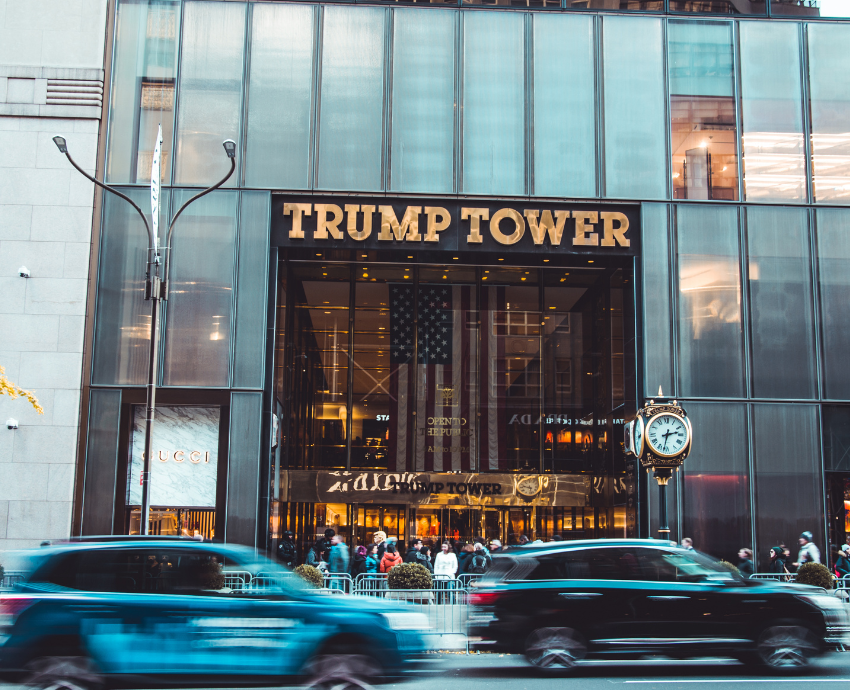
Ana Cristina Carvalhaes is a founding activist of Brazil’s Socialism and Liberty Party. In this interview with Green Left’s Federico Fuentes, Carvalhaes explains US President Donald Trump’s aggressive neo-colonialist shift and the imperialist and sub-imperialist role played by some “middle-sized economies”.
* * *
US imperialism today is in clear decline. What factors explain this?
As the hegemonic imperialist power, the US was the main driving force (along with Britain and the other European imperialist powers) behind the neoliberal changes that occurred in both global governance and in most states from 1990–2007.
The global capitalist elite — the majority of the imperialist bourgeois factions — devised the neoliberal regime of capitalist accumulation as a solution to restore rates of profit and accumulation, which had been declining since the 1970s.
Neoliberalism was facilitated by the defeat of the Soviet Union and the Eastern European regimes, which triggered a tremendous political-ideological crisis among workers.
It was also aided by China agreeing to participate in this neoliberal economic redesign. China’s capitalist restoration — which began in the 1980s but built on the “pre-capitalist” accumulation made possible by the 1949 revolution — was essential to neoliberal globalisation.
Despite neoliberalism’s successes — its spread across the West and parts of the East, its imposition on governments of all stripes, including social democrats and progressives — it also opened the door to the rapid industrialisation of China and East Asia (the “tiger” economies) by exporting production lines.
In contrast, the US has largely deindustrialised and lost economic strength and influence — a trend that has worsened since the 2007–08 crisis despite maintaining control over the global currency (the US dollar) and worldwide financial transactions.
One US business sector to escape this decline is information technology (IT, Silicon Valley), particularly AI companies. The new oligarchs of Big Tech, fintech firms and cryptocurrency investors are seeking to counter China’s advance.
Does Trump’s foreign policy represent a fundamental shift in the role US imperialism seeks to play globally?
Francisco Louçã and Diogo Machado point out that, even before Trump’s return to the White House in 2025, major transformations were underway in the capitalist mode of accumulation after the great crisis of 2007–8 and subsequent recession.
These transformations, which affect everyday life through smartphones, social media, platform-based work and mass digitisation, helped create the breeding ground for neo-fascist far-right movements to flourish around the world.
The neo-fascist coalition in the White House does not represent a minor “shift in course”. The Trump administration governs in the interests of Big Tech, AI companies, fintech firms, asset managers and cryptocurrency investors.
From a political-economic standpoint, the power bloc in the White House — the US bourgeois factions in government — has changed, even from Trump’s first term.
The new oligarchies — or new billionaires — back the most brazen, violent and racketeering supremacist wing of Trump’s Project 2025 and his extremist coalition.
The Trump administration expresses, domestically and on the world stage, a certain desperation by sectors of hegemonic imperialist capital to halt the US’ relative decline.
Faced with China’s rise, Russia’s unchecked influence and autonomy, and the equally unprecedented situation in Latin America and Africa (where Chinese investments have surged), these capitalists support Trump’s aggressive neo-colonialist shift.
With accumulation rates too low and a rising competitor, this shift is also closely linked to efforts to make the US political regime even more authoritarian.
The changes are significant and qualitative, but I would not say “fundamental” — at least for now. This avoids the misconception that Trump represents “another” or “new” form of imperialism.
Rather, it is capitalist imperialism in a “new” guise that is actually quite vintage, resembling a kind of 19th-century imperialism in the age of platforms, social media and AI.
How should we understand the growing US-China rivalry, given both economies are more integrated than ever and the US maintains a significant military advantage?
This is the main contradiction in Trump’s agenda and actions: preventing China from challenging the US’s monopolistic control over the club of imperialist countries — that is, preventing China from taking the US’s place — without completely severing economic ties with the Asian dragon.
Trump fuels fierce economic and geopolitical competition with tariffs, targeted measures against Chinese chips and TikTok, as well as speculation and meddling in disputes over the South China Sea and the Taiwan Strait.
Yet parts of Trump’s rhetoric and practice indicate he wants a dialogue with China (and Russia) over consensually redrawing spheres of influence.
US imperialism has an underlying interest in “containing” China and preventing its rival’s growing influence and military strength. But it is not in the same position nor faces the same conditions as in the 20th century to prevent this.
As for military dominance, the US undeniably remains the strongest power in history; however, the war in Iran has shown it is not invincible.
At the regional level, we have seen Russia invade Ukraine, and nations such as Turkey and Saudi Arabia project military power beyond their borders. How should we understand these regional dynamics within global capitalism? Is the term “sub-imperialism” useful here?
Sub-imperialism is real, and it is not just a useful but an indispensable concept. Furthermore, it is not something new.
The debate on “middle” economies and countries began in the 1960s. Ernest Mandel referred to those countries as late-industrialising countries. Immanuel Wallerstein called them semi-peripheral.
The concept of subimperialism was elaborated by Latin American Marxist dependency theorists, specifically the left-wing structuralists at the Economic Commission for Latin America and the Caribbean (ECLAC) and, more concretely, Ruy Mauro Marini.
Amid changes in the international division of labour after World War II, Marini examined the phenomenon of dependent “middle” countries that combined the following features:
• a degree of labour super-exploitation and inequality, which limited the realisation of value within national borders;
• diversion of a large portion of its industrial production toward exports due to the aforementioned limitation;
• extracting profits from and exercising geopolitical influence over more vulnerable countries in its regions; and
• ongoing wealth transfer and politically subordination to a hegemonic imperialist power.
Marini considered Brazil, Mexico and Argentina to be sub-imperialist at that time.
With the emergence of other sub-imperialist powers over the past 40 years, such as South Africa, the term is now used in a broad and imprecise manner. For a country to be sub-imperialist, it must be subordinate to an imperialist power.
This does not apply to Russia, for example, and even less to China, which today can not even be characterised as a middle-sized economy. Both Russia and China can instead be considered new forms of imperialism.
What is your view on the concept of multipolarity?
Multipolarity identifies a situation where the international system has multiple poles of power. This is viewed positively, in comparison with its opposite, unipolarity, where there is only one pole (a single imperialism).
But this view fails to take into account the peoples and workers of these countries, national exploitation and oppression by great powers, or emancipatory struggles.
Most of the broad left in the Global South, having been cut off from the Soviet bloc and oppressed by US imperialism, seeks deceptive refuge in the rise of competitors to the US and Europe — namely, Russia and China.
In practice, however, they simply side with the adversaries of their “main enemy”, without taking into account the nature of Russia and China’s economies and political regimes. They also do not take into account the interests of Russian and Chinese workers and people.
This stance is a negation of internationalism. Internationalists are not neutral — we stand with the peoples and workers.
What should 21st century anti-imperialist and anti-capitalist internationalism look like?
The ideal, strategic approach is building anti-imperialist, anti-fascist and anti-capitalist movements against all forms of imperialism.
Movements that raise their voices against wars, tariffs, interference and invasions by the US, should do the same against Russia’s invasion of Ukraine, for example.
We also need an internationalism that allies with Chinese peoples and workers on the mainland and in Taiwan.
Those of us who conceive of the struggle this way must be part of all these movements.
But uniting them all is a difficult task, given the strength of the idea on the left that Russia and China are allied states.
What should we do in the face of these difficulties?
On one hand, we must forge any possible tactical alliances (united fronts) and be involved in any broad, specific initiatives against the US. On the other, we must do the same against Russia for its war on Ukraine. We must do both while maintaining our political independence.
In urgent times, it is not a wise or useful strategy to remain isolated by demanding others adhere to our position before participating in the anti-fascist and anti-imperialist unity we need today.
[Abridged and slightly edited from a much longer interview published at links.org.au.]