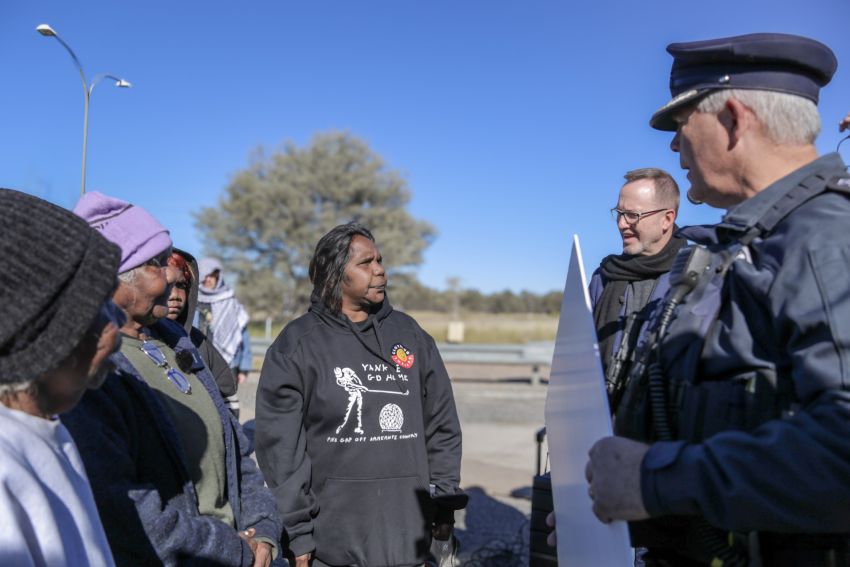
Along with hundreds of other anti-war and indigenous activists, I joined the Close Pine Gap Sacred Land Back Convergence at Mparntwe/Alice Springs over July 18–21. The organisers had expected around 150 people to join from around the country, but more than 600 came.
The weekend was spent in a series of forums, meetings and musical events, discussing the struggle to shut down the Pine Gap United States military base since it was established in the 1960s.
The event was organised by Mparntwe for Falastin (Palestine), which was formed in the Northern Territory after Israel’s attack on Gaza in October 2023, and Naarm/Melbourne-based group, Anti-Militarism Action Network.
The groups hosted a series of public discussions on the impacts of colonisation in Australia, foreign policy, military spending and the government’s alliance with the US.
“We are a local community concerned about a foreign military surveillance base, located a 15-minute drive from town, which Arrernte custodians want closed,” the organisers stated. “We are aiming to contribute to a national debate, and we will continue to oppose genocide and colonisation here and abroad.”
The organisers want to help build a national anti-war campaign to close the base down.
Felicity Hayes, one of the Arrernte Traditional Owners of Kuyunba, the land Pine Gap occupies, welcomed us with a smoking ceremony on July 18.
“This Pine Gap has been going on too long,” Hayes said. “Some of our sacred paintings have been stolen. Part of our art work has been chiselled out by somebody.
“We want them to bring it back home. The US is using Australia for just killing people. We are so sorry about that. We want our land back. We want to close down Pine Gap.”
The Arrernte people were not consulted in 1962 when the Australian government seized their land to construct the base.
The Traditional Owners have not been allowed back on their land for more than 60 years. Many custodians of the land on which the Pine Gap facility is situated live at Irrkerlantye/Whitegate town camp, 5 kilometres from the centre of Mparntwe on Antulye Country.
Professor Kathryn Gilbey, Remah Naji and Ahmed Adam presented talks on July 18 on the John Howard Coalition government’s 2007 NT Intervention, imposed on the Aboriginal people of the territory, and other related issues.
That afternoon, Justice Not Jails provided insight into the injustices in the NT, now governed by the Country Liberal Party. About 90% of incarcerated children are First Nations and on remand.
Karina Lester, daughter of Yankunytjatjara Elder Yami Lester, told us on July 19 how her father, as a 12-year-old, witnessed the British nuclear bombing of Maralinga. Four years later, he became totally blind.
Lester is an ambassador for the International Campaign to Abolish Nuclear Weapons. She reminded us of nuclear testing before Maralinga at Emu Field, South Australia, in October 1953.
NSW Greens Senator David Shoebridge said that Pine Gap, which is expanding, has a central role in the US war machine.
“It is supposed to be a joint facility between Australia and the US, but it is paid for by the Australian taxpayer. Information from Pine Gap is downloaded by US satellites. It is targeting regions such as Gaza, Lebanon and Iran,” Shoebridge said
“The North West Cape base, north west of Broome, will be expanded so it can communicate with nuclear submarines.”
At the Tindal air base, 120 kilometres north of Mparntwe, the RAAF has extended the tarmac to take B-52 bombers, which are nuclear capable.
“The US won’t tell us if they have nuclear weapons,” said Shoebridge. “There are thousands of US marines in Darwin. The nuclear submarine base just near Perth at Port Stirling will cost Australian taxpayers $8 billion, intended for the war against China.
“The US will station five nuclear submarines there. It all means we have foreign bases for a foreign military. It makes us a target.”
Gomeroi elder Barbara Flick spoke about her journey, and the history of indigenous struggles, at a workshop on US and Australian military presence across northern Australia.
Richard Tanter, from the Nautilus Institute for Security and Sustainability, told the same workshop on US imperial power projection that the International Secret Treaty of 1966 between the Australian and US governments continues to lie by omission and deception. Pine Gap is an indispensable surveillance installation of the US war machine.
Vince Scappatura, an academic from Macquarie University, spoke about the role of the B-52 bombers. Without any public discussion, Tindal air base has six long-range strategic B-52 bombers with enhanced aerial capacity.
The surveillance capabilities of the Pine Gap facility make nuclear warfare more likely, the convergence organisers said, because they strengthen US options for a first-strike nuclear attack on its enemies.
The military significance of Pine Gap, in turn, makes central Australia a target, they said, adding that a new nuclear arms race is underway, while Pine Gap undergoes its largest-ever expansion.
The cavalcade
We emerged from our tents bleary-eyed at 6am on July 20 for an early breakfast supplied by our wonderful Mparntwe hosts. We assembled into our allotted cars and buses and drove off in a convoy of 100 vehicles. Many locals joined the cavalcade.
The convergence began 10 kilometres from Pine Gap’s locked gate. There is only one road to the entrance. Two checkpoints had signs saying “No photographs allowed”.
We saw police for the first time on the road leading to Pine Gap. They pulled us over and tested every driver for alcohol and drugs.
We parked the cars about 500 metres from the main gate to Pine Gap; a police line blocked any further advance. We had dozens of signs asking for land back to the Arrernte people, to Close Pine Gap and to scrap AUKUS.
Arrernte Traditional Owner Felicity Hayes, her daughter and other family members, with Shoebridge and Palestinian representatives, were permitted to walk past the gate to deliver a letter to the US director of Pine Gap.
They were followed a little later by two First Nations women with their little girls on their shoulders.
It was a sight I will never forget. It was amazing the NT police did not create a disturbance. It is possible the US authorities did not want any bad publicity, so the police were on a tight leash.
Shoebridge told us they were refused a meeting with the US director, but the police superintendent took the letter from the Hayes family.
Palestinian-Australian Remah Naji told us of the important role of Pine Gap in facilitating the Israeli military’s mass murders in Gaza. Former NSW Greens Senator Lee Rhiannon spoke, after which solidarity letters were read by members of the NSW Nurses and Midwives Association and the Maritime Union of Australia. The Hayes family thanked us for our presence.
It was a historic moment. It was the first time in more than 50 years many of the Traditional Owners had been allowed to stand on their own Country inside the base.
We slowly marched back to our cars, chanting and drumming, and arrived back at the camp very happy with our modest, but important, achievement, highlighting the Traditional Owners’ demands.
We had succeeded in shutting down Pine Gap for a day.
[Coral Wynter, a veteran socialist and peace movement activist, also participated in the September 2016 Pine Gap protest, organised by Victorian Trades Hall.]