
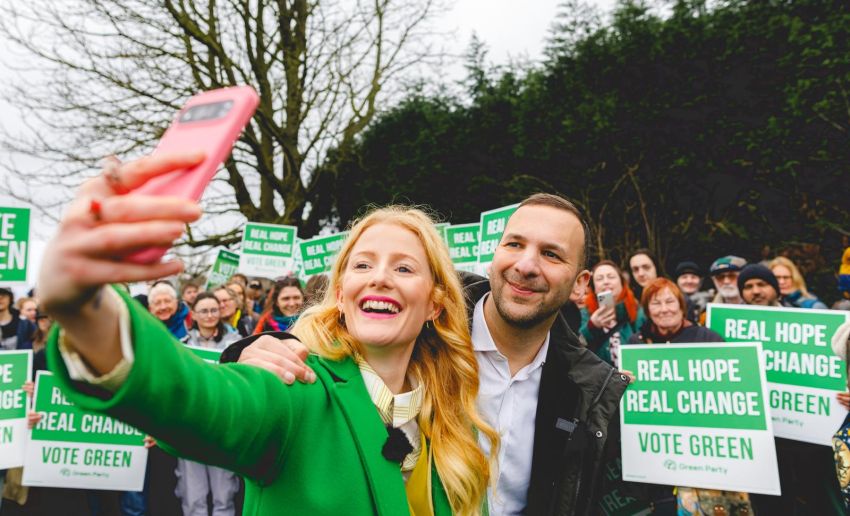
The Green Party of England and Wales produced a political shock on February 26, cruising to victory with nearly 41% of the vote, in a by-election in the Manchester seat of Gorton and Denton.
The winning candidate, Hannah Spencer, became the Green Party’s fifth MP, and the first in Northern England.
While governing parties — in this case Labour — often slide in popularity and dramatically lose by-elections, this was an exceptional result and is likely to have long-term effects on British politics.
With the election of charismatic ecosocialist Zack Polanski as leader in September last year, the Green Party has seriously upped its game. Polanski is a skilled media communicator, and before the by-election, party membership and poll ratings were rising rapidly. With a large number of university graduates and a Muslim population, Gorton and Denton was always going to be a potentially strong constituency for the Greens.
Muslims, appalled by the Keir Starmer government’s support for Israel during the Gaza war, are moving to the Greens in large numbers. The election of Mothin Ali, a gardener from Yorkshire, as the Greens’ first Muslim deputy leader has also helped the party.
Labour’s missteps
However, Spencer’s victory is also down to specific missteps by Labour Prime Minister Starmer.
Suffering in the polls, many Labour MPs have been calling for a change of leader. Scottish Labour leader Anas Sarwar asked Starmer to stand down in a media conference speech on February 10. Waiting to take his chance was Andy Burnham, the popular Labour mayor of Manchester.
Andrew Gwynne resigned from the Manchester seat of Gorton and Denton in January on health grounds This triggered the by-election and provided a constituency for Burnham, as any Labour leader needs to be an MP. However, fearing that Burnham would oust him if elected, Starmer blocked Burnham’s selection as the Labour candidate, causing outrage.
This all helped the Greens to overcome Labour’s previous massive majority. In the 2024 general election, Labour took 51% of the vote. In contrast the Greens came a distant third in that election, with just 13%.
Challenging Reform’s far-right agenda
The right-wing Reform party has dominated British politics for the past year. Think in an Australian context of One Nation. Every opinion poll for months has put Reform in first place. An anti-immigration party, close to United States President Donald Trump and strongly opposed to climate change action, it has been making the political weather.
With Labour in decline and the removal of Burnham as a potential candidate, it was seen as the favourite to win the by-election. Reform selected Matt Goodwin, a former academic who studied the far right and later adopted the right-wing policies he had been researching.
However, while Reform leads the polls nationally, tactical voting means that if an anti-Reform candidate can unite support in a fractured political landscape, Reform can be beaten.
Labour’s strategy has been to move closer to Reform by bringing in restrictions on asylum seekers and migrants, and on the other hand, to proclaim that it is the tactical voting choice to beat Reform.
Obviously, introducing policies to appeal to right-wing voters and arguing that Labour is the tactical choice against Reform has introduced a contradiction. The Labour government’s home secretary Shabana Mahmood has been bringing in even harsher policies. For example, she recently introduced a move to review asylum seekers’ residency in Britain every 30 months, introducing permanent insecurity for those fleeing war and abuse. Such cruel policies have been driving voters away from Labour, but so far have failed to attract Reform voters to Labour.
Greens’ base growing
The Greens have traditionally been poor at fighting parliamentary by-elections. I remember as a young member of the Ecology Party — the Green Party’s previous name — watching party by-election results in the early 1980s. The tallies were uniformly terrible, typically in the 1980 Glasgow Central parliamentary by-election, where the party gained a miserable 45 votes — just 0.6%.
While the Scottish Greens are now independent, and both it and the English and Welsh Greens are doing much better, parliamentary by-elections have continued to produce low votes. Prior to Gorton and Denton, the record highest vote for the party in a parliamentary by-election was 10% in the 2023 Somerton and Frome by-election. Thus, even given Starmer’s failures, leaping to more than 40% of the vote in Gorton and Denton is impressive.
Under Polanski, the party is getting more organised and members are becoming far more active. The party mobilised thousands of election workers, which was key to building momentum and beating Labour and Reform. Quite simply, the party has never mobilised as many activists for a by-election campaign.
In turn, commentators argue that Polanski’s ecosocialist approach has allowed the party to gain support from those on the left previously enthused by Jeremy Corbyn, former Labour leader and now Your Party co-founder.
Spencer was clearly an attractive candidate and her working-class credentials built support. She worked as a plumber and, before becoming a candidate, retrained as a plasterer. During the campaign, she made much of the economic pain many voters are suffering and the need for working-class representation.
Labour, on the other hand, is increasingly distant from workers, and with continuing economic pressure, many British people feel unrepresented.
Left cooperation sparks hope
Spencer was also helped by wider support on the left. George Galloway’s Workers Party of Britain, having gained 10% of the vote in the constituency in 2024, dropped out to prevent the anti-Reform and anti-Labour vote from being split.
Your Party co-founder Zarah Sultana knows how to defeat Reform and, along with Corbyn, endorsed Spencer’s campaign. Following the by-election victory, Corbyn said the new left Your Party would “work constructively with the Greens”.
Despite Labour’s dirty campaign focusing on the Greens’ support for decriminalising drugs, the Greens pulled off a remarkable win. The effects are already being felt. In one recent poll, the Greens are now second to Reform in the national vote.
Party membership has climbed even higher. When Polanski was elected leader, it was about 60,000, but is now at 215,000. Parliamentary elections are being held in Scotland and Wales in May and the Greens are predicted to make major gains.
Local council elections will be held in England at the same time, with the Greens also predicted to do well in London. Polanski has stated that he is willing to cooperate with Your Party in defeating Labour and Reform.
Pressure is growing for Starmer to resign as PM and Labour leader. The growing Green vote is making it more difficult for Labour to support right-wing policies. Starmer’s lack of enthusiasm for the US and Israeli assault on Iran has displeased Trump.
Rather than British politics moving ever further right, the left, for once, seems to be getting major electoral support. There is a significant possibility that the Greens could replace Labour and, working with others on the left, eventually form government.
Of course, Greens in coalitions in continental European countries have drifted to the right and often lost support, so nothing is certain. However, the by-election win is, for the present, a source of hope — especially for those of us concerned with challenging war, inequality and climate change.
[Derek Wall is a former international coordinator of the Green Party of England and Wales and an ecosocialist, academic and writer.]