
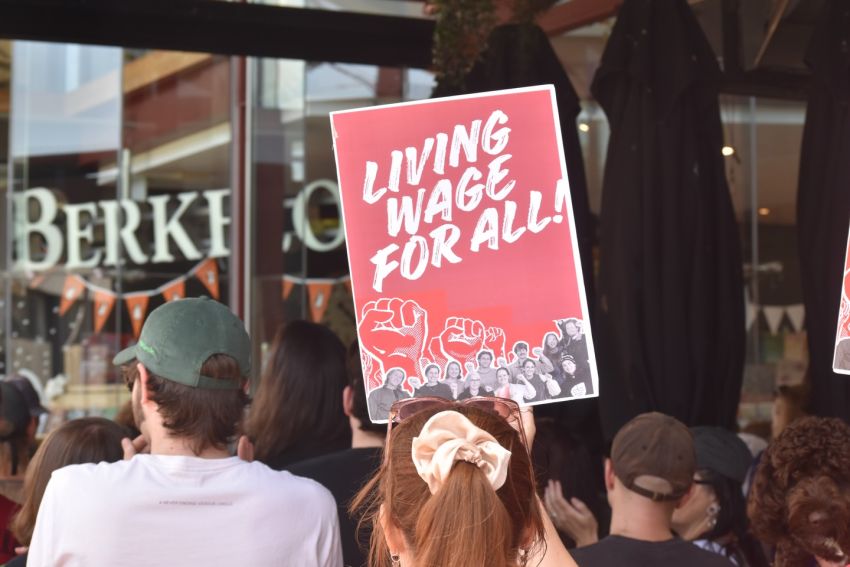
The Fair Work Commission’s (FWC) landmark decision to abolish junior rates for workers aged 18–20 in retail, fast food and pharmacies is a positive step, but the deck is still stacked against young people.
Currently, junior pay rates apply to workers under the age of 21 on a sliding scale. Those aged 20 receive 90% of the minimum wage, 19-year-olds receive 80%, 18-year-olds receive 70%, 17-year-olds get 60%, 16-year-olds get 50% and under 16s just 36.8% — about $9 an hour.
The FWC decision means workers aged 18 and over will now receive the minimum wage, while those under 17 stay with the lower rates. The change for the former will be phased in over four years, rising by 5% a year from December to July 2029. About 500,000 workers will receive a pay rise.
However, workers will have had to be with the same employer for at least six months to receive the full minimum wage.
Junior rates exploit young people, who often do the same work for less remuneration. The FWC found that many young workers perform the same duties with the same skills as those aged 21 and older.
The McKell Institute calculated that young people earn an estimated $3.5 billion less in wages each year, compared to those on the full minimum wage.
There has been a lot of enthusiasm for the reform, including from the Australian Council of Trade Unions (ACTU), which said it is a “big win for young workers”, and the Shop, Distributive and Allied Employees Association (SDA) said the decision is “momentous” and “up there with the introduction of equal pay for women in the 1970s”.
The National Union of Students said it would “take pressure off students balancing work and study”.
However, others were more cautious. The Retail and Fast Food Workers Union (RAFFWU) warned that FWC’s decision not to change junior rates for under-18s, or for those with less than six months with the same employer, will “entrench poverty rates”.
RAFFWU secretary Josh Cullinan said “rotten low junior rates” create job insecurity as bosses “churn workers to keep them ever younger”. He said workers who turn 18, or reach their six-month probation mark to be eligible for their wage to almost double, will likely be fired or lose shifts. He said that means that most young working people will not benefit from the change.
Cullinan said the “simple solution is to abolish all junior rates”.
Junior rates are just one of the ways young workers are exploited; they cannot access the JobSeeker payment until they are 22 and are only eligible for the lower Youth Allowance payment.
Young people also have to pay increasingly high university education fees, burdening them with huge HECS-HELP debts.
Young workers are also more likely to be employed in casual and insecure jobs. About 76% of 15–19 year olds and 41% of 20–24 year olds are casual, compared to about 25% of the overall workforce.
Housing security has either become an unattainable dream or a source of crushing debt and anxiety for those who have managed to put down a deposit. Many are stuck paying exorbitant rents, or living with family for longer.
They also face an unjust income tax system, which rewards high-income earners and asset holders, who also benefit from capital gains tax exemptions and negative gearing.
In the lead-up to the budget, there are calls to make the tax system fairer for young people. Bill Kelty, a former ACTU secretary and Reserve Bank of Australia board member, has proposed raising the tax-free threshold and reducing taxes for lower-paid workers.
Young people know the deck is stacked against them, which is why they are increasingly turning away from the major parties at the ballot box. A March Demos poll of 18–34 year olds in New South Wales had the Greens (36%) in front of Labor (31%), on a two-party preferred basis. One Nation was polling at 13%, just behind the Liberal National Party (15%).
Green Left has long campaigned against the profits-first system that leaves workers, and particularly young workers, worse off. We say a better world is possible, but only if we get organised and fight for it. You can help us by becoming a supporter or donating to our 2026 Fighting Fund.