
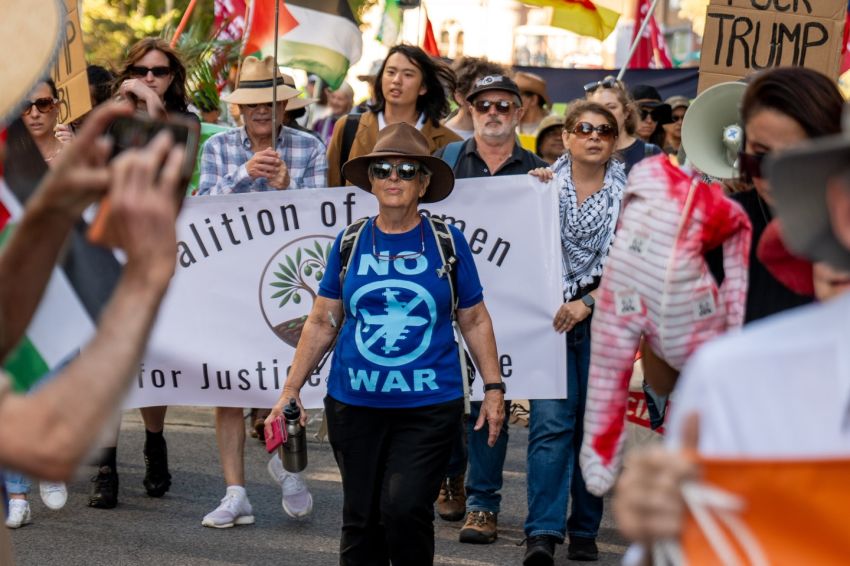
Successive Australian governments’ misplaced priority on military “security” against a fictitious threat has left us without adequate fuel, food and transportation security.
The disruption to oil supplies arising from the illegal US-Israeli war on Iran has exposed this vulnerability.
At the time of writing, more than 500 service stations are without petrol or diesel and the cost of both fuels has skyrocketed, impacting the cost and ability to transport produce from farm to supermarket. The cost of everyday foodstuff is escalating.
The recent interest rate hike has put further financial pressure on mortgage holders. Workers are being urged to use public transport or work from home to reduce demand on scarce fuel supplies. A prolonged war could bring in petrol and food rationing.
Even before this round of US-Israeli attacks, Foodbank Australia said around 20% of households nationwide were severely food insecure, meaning people are skipping meals or going entire days without eating.
Its report highlighted how the housing crisis is intensifying the problem, with 48% of renters experiencing food insecurity and having to choose between paying rent and buying food.
Why in a rich country like Australia are so many people are struggling to survive? Why has our fuel, food and transportation security become so vulnerable to overseas war disruption?
The responsibility for these problems lie with successive major party governments which have, for decades, spent heavily on military “security” despite any military threat, imminent or foreseen.
The bipartisan agreement with US foreign policy has persisted with the Force Posture Agreement and AUKUS allowing an even bigger US military footprint here and rising expenditures on so-called defence. This means arming the Australian Defence Forces for integration with the US armed forces and providing extensive facilities for US military operations.
Australian facilities being provided include training facilities at the Bradshaw Training Range and Delamere bombing range in Northern Territory, accommodation for 2500 US marines in Darwin each year, port facilities at HMAS Stirling in Western Australia for US nuclear hunter-killer submarines. The government is also considering an east coast port for the same purpose.
RAAF Tindal in the NT is being upgraded to allow the stationing of up to six US B52 bombers, some of which are nuclear capable.
US military officers are now embedded in our defence intelligence system in a combined operation based in Canberra. Billions of dollars have been given to US and British shipyards to prop them up in the hope that will enable Australia to buy/build up to eight nuclear hunter-killer submarines, which, if we get them at all, will inevitably be drawn into US wars.
All this comes in addition to Pine Gap, the most important US military intelligence gathering facility outside the continental US and the North-West Cape submarine communications station which, according to journalist Peter Cronau, was most probably the source of the firing command which resulted in a US submarine recently sinking the Iranian frigate with heavy loss of Iranian life.
Any realistic assessment of the US military build-up and bases expansion, either US or jointly operated, makes Australia a target for retaliatory strikes in the event of war between the US and its numerous enemies.
Governments’ myopic, misplaced focus on military “security” has led to other vital human security being neglected, including fuel security, food security, health security, transportation security, climate security, shelter security and communications security.
Successive governments’ failure to ensure that Australia has the internationally-recommended 90 days supply of fuel in case of disruptions to overseas supply is not due just to misplaced priorities, but is clearly a dereliction of duty verging on incompetence.
The Labor government has allowed the level of storage to drop to one third of this recommended level. Successive governments have allowed this industry to be privatised and therefore controlled by foreign, mainly US, corporations.
It means the industry operates with only one third of the recommended level of fuel security storage and, even worse, to close six of the eight refineries that once operated here and instead rely on refineries overseas.
Because of this, transportation fuel is now vulnerable to shipping disruption due to the illegal war and the closure of the Strait of Homutz.
The way forward is clear: The Labor government must cease its involvement in the war on Iran, recall ADF personnel and equipment from the Middle East, close US access to Pine Gap and the north west submarine communications station, and push for a return to the table to negotiate peace and security for all the peoples in the Middle East.
Longer term, Labor must become involved in the energy supply industry. This is to reduce dependence on fossil fuels, accelerate the electrification of transportation, including trucks, and build enough publicly-owned fuel storage capacity and, if necessary, refining capacity, to ensure Australia meets the recommended 90 days of fuel security.
The government must refocus its priorities away from contrived security threats and the US war alliance and concentrate on real security needs — fuel/energy, food, transportation, shelter, health, communications and the climate crisis.
[Bevan Ramsden is a long-time peace activist and edits the Independent and Peaceful Australia Network’s monthly e-publication Voice.]