
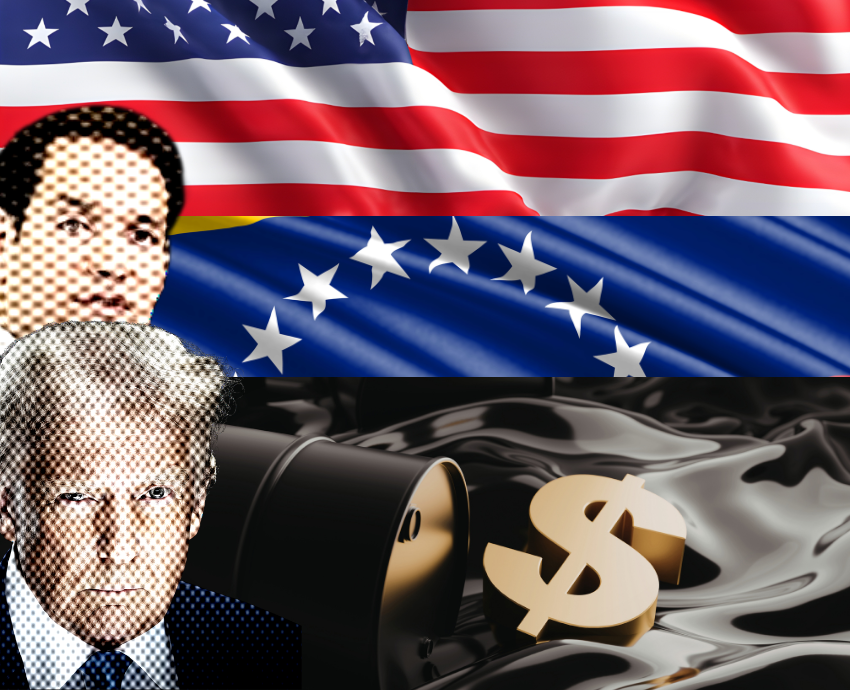
Carlos Mendoza Potellá is an economist and university professor with vast experience and expertise regarding the Venezuelan oil industry.
In this interview with Ricardo Vaz, Mendoza Potellá offers his analysis on the recent reform of the Hydrocarbon Law and the struggle for sovereignty.
* * *
In late January, the Venezuelan National Assembly approved a reform of the Hydrocarbon Law. What are your views on the new law?
In broad terms, it is the relinquishing of our condition as a sovereign nation, plain and simple. We are not a nation anymore. We are a territory with some delegate administrators implementing decisions made abroad.
Who decides? Emperor Trump, who has his proconsul Marco Rubio.
The approved law meets the maximum demands that the Venezuelan right and the oil conglomerates have been making for at least the last 25 years. The 2002 coup against Hugo Chávez was to impose something like this, the return to the old concession model.
It is the fulfillment of all the dreams of the old “meritocratic” leadership of [state oil company PDVSA], the people who did everything to minimise the fiscal contributions to the country, whether that meant buying 37 refineries abroad or other disasters that wrecked the country.
The reform is a victory for international oil capital, alongside a discourse that hands over the destiny of the industry to major corporations and diminishes national participation as some unproductive “rentierism”.
We have seen that sovereignty is a central issue. How is it affected on different fronts?
For me, a fundamental issue is the return of concessions. Because that means going back decades, handing control back to transnational conglomerates.
With taxes and royalties, the problem is not whether the rate is 30% or 15%; that flexibility existed in the past.
But now it is the transnational corporations that tell the government what their operating costs are and how much goes to the Venezuelan state. There is no oversight body to verify this; instead, the company says, “I need you to lower royalties to this level” for the project to be profitable.
The return of international arbitration is also a brutal setback, because it means that disputes are not settled in Venezuelan courts, but in other bodies that have a history of defending corporate interests. There is no role left for the Public Solicitor’s Office, which is essentially the nation’s attorney.
For months we were told we were ready to confront imperialism, but the truth is that everything is being imposed on us.
Even the National Assembly is castrating itself. It has enacted a law stating that oil projects no longer require the parliament’s approval; they need only be notified.
And on top of all that, there is also the constitutional issue. The reform conflicts with Articles 1, 12, 150, 151, and several others of the Constitution.
But this is not merely a constitutional violation; it is a total surrender. A surrender of sovereignty that calls into question our status as a republic.
One of the arguments in favour of reforming the Hydrocarbon Law was the need to attract investment to so-called “green fields.” However, major corporations have not shown much enthusiasm. What is your reading on this?
Those are fantasies about oilfields that have always been unviable; it is the obsession with the Orinoco Oil Belt.
The idea that an avalanche of investment is coming is an illusion, and the oil companies themselves know it.
Trump talks about investments of $100 billion, but transnational corporations like ExxonMobil use the word “uninvestable”. With market volatility, no one is thinking about investing in oil with extremely high production costs.
There is a study that concludes that increasing production to 2.6 million barrels per day based on the Orinoco Belt would require US$90 billion in investments and $122 billion in operating expenses over the next 10 years to drill 13,000 new wells!
In other words, it is completely unfeasible.
So who stands to benefit from this new landscape? On the one hand, small “rogue” companies that can take on a well here and there.
But above all, the conglomerates that are already here, like Chevron, which know the lay of the land and can expand their operations or make their current operations more profitable.
The same goes for Eni and Repsol, which have some crown jewels, like the offshore Perla natural gas field. The corporations that come will be betting mostly on conventional fields, not the Orinoco Belt.
It is very commonplace to hear about US refineries in the Gulf of Mexico that are built to receive Venezuelan crude. That is true, but it is not oil from the Orinoco Belt! It is oil from the Oriente (East) and Occidente (West) oil-producing regions.
The oil reform took place in a specific context, following years of economic sanctions that have left PDVSA in a very difficult situation. What would be an alternative path? How can the industry recover without surrendering sovereignty?
There are no magic solutions, obviously. We are facing imperialism in the Trump era; we see all its destructive potential. It is a phase where the US, paradoxically, recognises its weakness and is entrenching itself in its “backyard”.
But we must be aware that the industry’s current course is one of total capitulation.
Whether we can recover, whether it is possible or not, we must think about it rigorously, in a sovereign manner. And above all, we must have a serious plan.
What does the future hold for Venezuela’s oil industry?
The future is to build a post-oil Venezuela.
In recent years, many began talking about a post-oil or post-rentier country, but mostly to cover up their incompetence and inability to maintain production levels.
There is no magic solution, and the oil industry will have to play an important role. But the current situation is dire. We are in a new phase of absolute political dependence.
It’s not just about oil, or that the US controls revenues, imposes concessions, and so on. It is that the country has lost the ability to make its own decisions.
There are also expectations of the people, who to a large extent have become accustomed to the idea that their oil will last forever. That creates the illusion that things can improve very quickly. The path will be slow, but it has to start with regaining sovereignty.
[Abridged from Venezuela Analysis.]