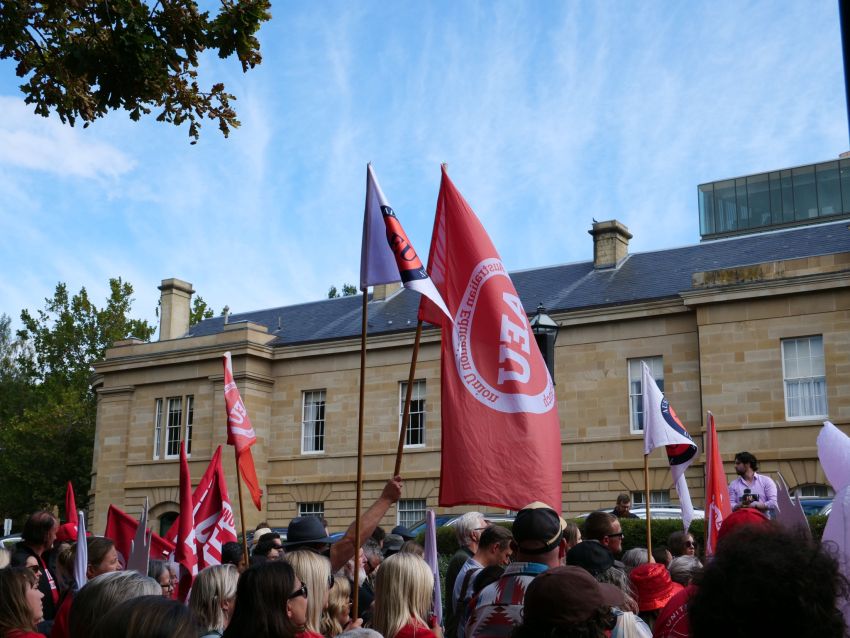
Teachers and other public sector workers face unsustainable workloads, a lack of funding and staff shortages, David Genford, President of the Australian Education Union (AEU) Tasmania, told Green Left.
It’s why more than 4000 public sector workers across Lutruwita/Tasmania went on strike on March 26.
Genford, a former public school teacher, said teachers have to deal with intense workloads and rising violence. He said depending on the result of the Victorian teachers’ strike, Tasmanian teachers could become the lowest paid in the country.
The lack of staff in schools means teachers have no choice but to pick up the slack and do hours of unpaid work to deliver the curriculum. “Morale is low,” Genford said. “Teachers and support staff do a great job … but when resources are low it impacts what can be done in schools.
These challenges not only affect teachers, but student performance too. “If teachers leave the state, the shortage will only get worse, and this will impact on students’ learning.”
According to the AEU, Lutruwita has the worst rate of public school under-staffing in the country. As of last year, 82% of schools face critical staff shortages and all the principals who were surveyed reported that there were unfilled positions in their schools.
Teachers are reporting high burnout rates; in 2024, 34% planned to quit before retirement, up from 12.5% in 2020.
Genford said staff shortages “hit some schools harder than others” because some principals “haven’t been allowed to employ extra teachers out of their budget”.
Regional centres have been hit disproportionately hard. Genford said one teacher, who left Tasmania to teach in Bendigo in Victoria, calculated that over four years she would be $80,000 better off. “When other states offer $50,000 to relocate, it’s hard to compete.”
The state government funds about 75% of all public schools, with the rest provided by the federal government. The state government also sets teacher salaries and conditions. This is why Genford said teachers had “no other option” but to strike. “The government only listens when the impact is on them.”
He said teachers would prefer to be in the classroom, and the series of passionate speeches, delivered by teachers, at the March 26 rally was an indication of this.
The AEU is demanding enforceable “triggers” in its new agreement, to allow for additional time or support when workload thresholds are exceeded. For example, classes with a higher number of individual learning plans — for students with disabilities or learning difficulties — would entitle teachers to more planning time, while larger class sizes would require more in-class assistance.
The crumbling public sector reveals the inability of neoliberalism to sustainably deliver public services, such as education, healthcare and transport, with workers forced to absorb the pressures of a failing system.
Genford and AEU members are calling on the Jeremy Rockcliff Liberal government to recognise the critical role of the public sector and deliver the urgently-needed pay rise and workload reduction that teachers are calling for.