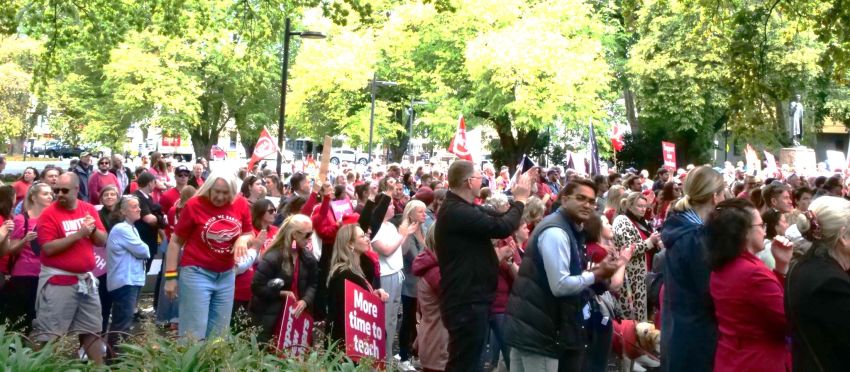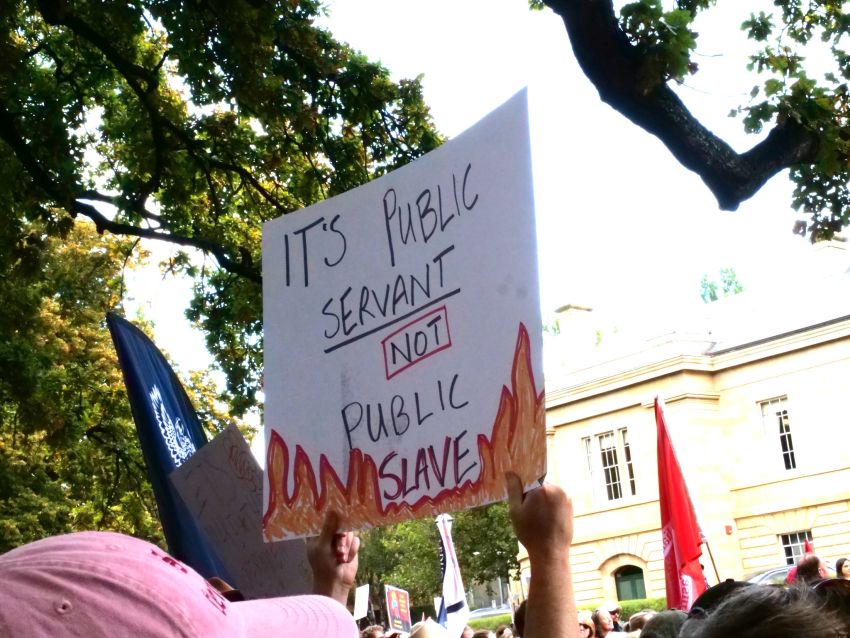
Thousands of public sector employees in Lutruwita/Tasmania, including health workers and teachers, walked off the job on March 26.
It was part of a coordinated series of strikes in response to the Liberal state government’s refusal to negotiate a decent wages claim and as workplace conditions degrade amid acute staff shortages. All public schools in the south of the state closed, with the northwest closing on March 24 and the north on March 25.
The government is refusing to offer public sector workers more than a 3% wage rise in year one, 3% in year two and 2.75% in year three, despite the rising cost-of-living pressures and a former higher commitment.
Unions point out the offer is well below inflation, failing to address the 6.9% pay gap between them and public sector workers on the mainland.
The majority of those striking were members of the Australian Education Union (AEU), Health and Community Services Union (HACSU) and the Community and Public Sector Union (CPSU). They were joined by other unions, including the United Workers Union and the United Firefighters Union.
The strike began at 12.20pm, with workers gathering at the AEU office on Patrick Street. As they marched through Nipaluna/Hobart’s streets, they were joined by thousands of others, causing traffic to halt and some very cramped footpaths.
The march ended at Tasmania’s Parliament lawns, where David Genford, branch president AEU Tasmania, estimated there were 4000 people.
Andrew Michael, from HACSU, outlined the terrible work conditions in the hospital sector. He addressed the hypocrisy of Liberal MP Eric Abetz, who downgraded the health sector as being “less significant” than the police, saying their 3% pay deal should be taken up by other public sector workers.
Michael said their HACSU workers often have had to respond to medical emergencies that go well beyond safe parameters. This, he argued, was a product of under-staffing, under-resourcing and the growing severity of violent incidents.
He recalled how exhausted staff have to manage being attacked, citing one incident where staff had to administer CPR on an unconscious patient while being filmed and berated by their child. One protester shouted: “[Tasmanian Premier] Jeremy Rockliff, you have blood on your hands!”
Other unionists, while passionate about their work, are suffering burnout and exhaustion. One speaker from the AEU said a colleague had confided that she was so tired that the only thing keeping her from quitting was her moral dedication to the job.
The strike is a response to chronic understaffing, escalating administrative burdens and a workplace culture that relies on unpaid labour to sustain even the most basic level of service delivery.
The CPSU said: “Public services have been underfunded for decades and the community is now feeling the impact of this long-term under-resourcing.”
The Liberal government wants to cut 250 full-time jobs from the Department of State Growth and plans to reduce the public sector workforce by 2500–2800 by 2032.
Meanwhile, MPs are pushing for a pay rise. Last year, the Tasmanian Industrial Commission, backed by the Labor Party, proposed a 22% pay rise, which would take their wages from $140,185 to $171,527.
While the Rockcliff government formally opposed the rise, after the Upper House passed the measure several Liberal MPs accepted the full pay rise, including the premier, who now earns $368,784 a year.
For many, the attacks on the public sector show up the failure of the neoliberal economic model to deliver public services. The Liberals’ refusal to deliver adequate public services shows it is failing the very systems that are the foundation of all other productivity.