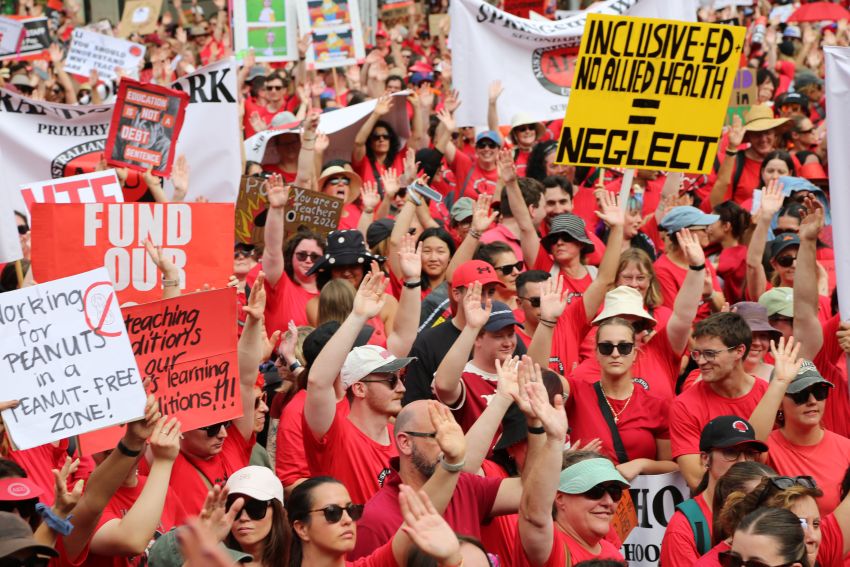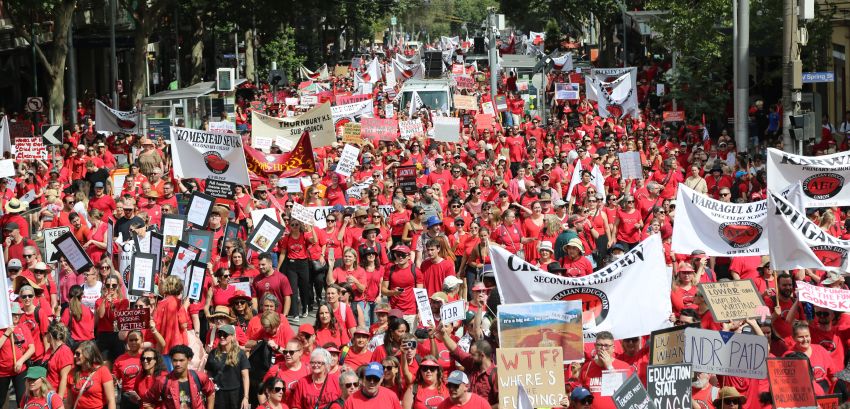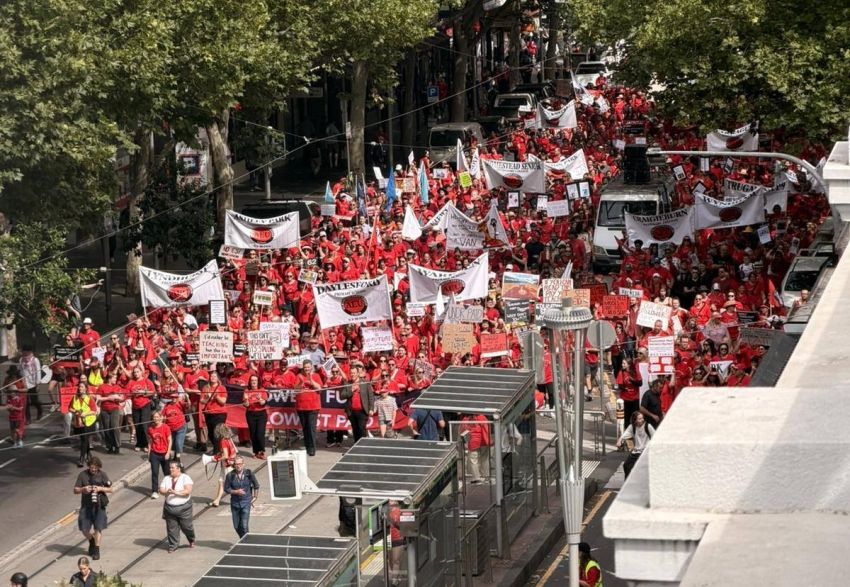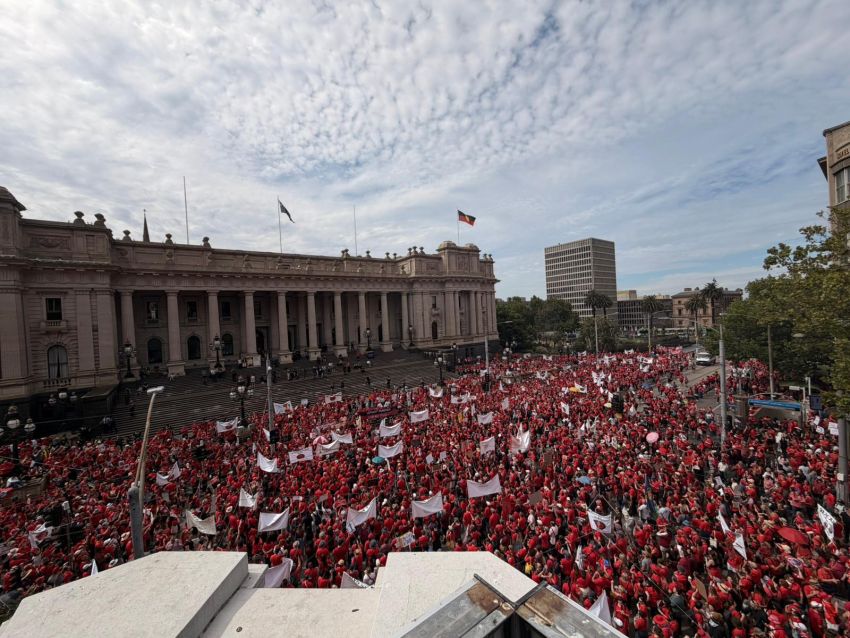
Victorian public school teachers walked off the job on March 24 in the first statewide strike in more than a decade.
It was the biggest show of support for the Australian Education Union (AEU) to fight for a fair wages and conditions agreement. The union estimated that at least 32,000 teachers joined the rally in Naarm/Melbourne.
The previous agreement, which lapsed last year, locked teachers into pay rises of just 2% a year — well below inflation.
Teachers’ anger has been building ever since. But many AEU sub-branches fell into a malaise, especially in secondary schools, where members left the union in protest at its lack of action.
The call for strike action has brought people back to the union with renewed focus on winning a fair agreement.
When the AEU put its Protected Action Ballot Order to members, the response was a decisive 98% “Yes” to industrial action.
In the lead-up to negotiations, the log of claims included a 35% pay rise over four years, smaller class sizes and better conditions for education support (ES) staff.
The Victorian Labor government responded by offering an 18% pay rise over three years to teachers and 13% for ES staff, along with more meetings and scrapping time-in-lieu, which teachers can accrue for extra work undertaken.
Staff saw this offer as insulting. It completely missed the key elements of their demands, showing that Labor does not recognise the problems in the education sector. Its offer does not seriously tackle workload, undercuts ES staff and would keep teachers in Victoria as the lowest paid in the country.
A first-year teacher in Victoria earns $79,589, compared to $90,177 in New South Wales. The government offer did not take into account that the system is under pressure because schools are underfunded and staff are overworked. The workforce is burnt out.
Thousands of teachers gathered at Trades Hall before marching to Parliament House on March 24. Many schools closed or operated with minimal staff supervising the most vulnerable students.
As there was no mass rally to finish the march, there was some frustration for union members who wanted to share their concerns and expectations with the union leadership; many feel excluded from the industrial process.
However, the size of this protest shows that members are willing to fight. One strike will not settle this dispute with Labor and, with a state election on the horizon, pressure is only going to grow.
Victoria’s teachers are signalling that they are in this struggle for the long haul. Hopefully, the union’s leadership has taken this strike seriously and will prepare members to do it again if needed.
[Adam Bremner is a public school teacher and member of the Australian Education Union.]