
Josef Benedict is a researcher covering the Asia Pacific region for the CIVICUS Monitor, a publication of the CIVICUS global civil society alliance that is headquartered in Johannesburg, South Africa. He spoke to Green Left’s Peter Boyle on March 3.
* * *
What does CIVICUS do?
We work primarily to protect civic space and civil society because civic space and civil society have come under attack over the many years from states and other actors and we work to support civil society in pushing back on that.
We also work towards creating an enabling environment for civil society to operate in, to ensure laws and policies do not restrict civil society and to ensure that civil society has the resources in order to undertake their work.
We also monitor very closely violations against civil society and the trends in different parts of the world or civil society.
I work as a researcher for the CIVICUS Monitor and I focus on countries in the Asia-Pacific region. We document what's happening with regards to activists and civil society in the region and then we use the data that we monitor in order to undertake advocacy and to bring about positive change in these countries.
You’ve been monitoring the human rights situation in the South-East Asian region. What patterns have you seen over the past few years? Has the human rights situation improved or gone backwards?
I think overall the situation has regressed in South-East Asia. We are seeing countries like Myanmar, Laos and Vietnam where civic space is virtually closed, where human rights activists cannot operate or face a lot of repression, and where people who want to speak up are silenced. It is a very challenging environment in these countries.
There are other countries, like Thailand, Malaysia and Indonesia, where activists have more space but still face various challenges. There are a range of restrictive laws that are used against them, protests are restricted and they also face censorship.
So while civil society is trying to organise and mobilise across South-East Asia, the overall situation for human rights is extremely challenging.
What sort of laws and what kinds of technologies are being used to restrict human rights?
In some countries, we are seeing anti-terrorism laws being used against human rights activists. In other places, defamation laws are being used against activists. Anything they have posted online is being used against activists — who are accused of inciting violence or inciting instability.
We are also seeing new kinds of technologies being used ... technologies to censor what people say online, technologies used to shut down their social media sites and also increasing surveillance of activists through social media.
Spyware is being used on activists’ phones. In particular, Israeli technology is being used to monitor their movements.
This creates a very challenging environment for activists. It has a chilling effect for many who want to speak up and be active.
Apart from Israel, where are these new technologies being developed and exported from?
We also see a lot of these technologies coming out of China. China has developed very sophisticated technologies around censorship and surveillance and many of their companies are selling this technology to many South-East Asian countries and they are being used to monitor what's happening around protests and to collect data about the individuals taking part in these protests.
This is really challenging and we need to really push back on the use of these technologies and particularly when there is such a lack of transparency in the governments of many South-East Asian countries.
There is a lack of freedom of information laws, even to allow us to find out who is buying this technology and for what purpose and how data that's being collected in these technologies is eventually being used by law enforcement.
Is Artificial Intelligence (AI) being used to restrict human rights?
I think AI is now boosting the kind of surveillance and censorship technologies that exist, because lots of data is being fed in by individuals and so forth when they use AI technologies. This is being used to automate the kind of surveillance being used.
Surveillance is increasing across the region, using cameras and other forms of surveillance.
AI is enhancing [this surveillance] in many ways that can penetrate many parts of private life. There is a real lack of privacy around the data that we put online and ultimately this undermines a lot of the human rights that we as individuals should have.
So I think there's a real need to have proper oversight over these AI technologies, the companies that are producing them, but also the states that are using them and deploying them to target activists and go after those who want to speak up for human rights.
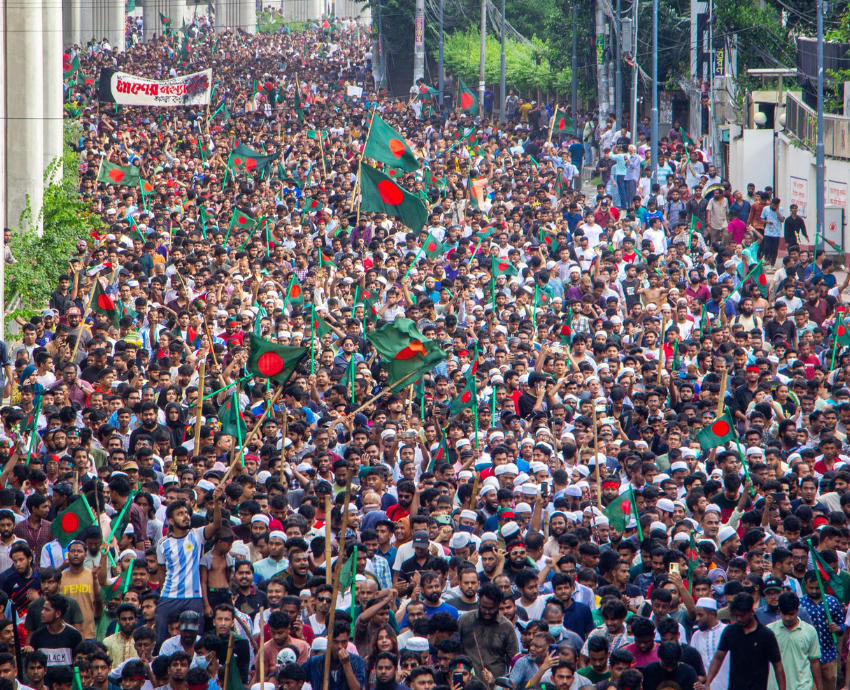
Over the past few years, there have been some big youth uprisings in the region, such as in Bangladesh, Nepal and, more recently, Indonesia. What have been their impacts? Have they won more democratic space or have they provoked a repressive reaction?
I think the protests in Bangladesh were very interesting because they were mobilised by young people across the country and led to the fall of a very oppressive regime under [former Prime Minister] Sheikh Hasina.
What we then saw was an interim government that came into power and actually brought about a set of reforms. We saw new laws being passed and old laws being repealed — which was a positive step.
In Nepal, we also saw an interim government come into power that is also taking steps to make improvements to the conditions there.
But ultimately, the challenge is what kind of political party comes into power after that, whether these parties will commit to sustaining these reforms, whether they will commit to hearing the voices of those who brought about those changes.
While there is positive change happening in the short term, in the longer term, we see political parties that want to maintain the status quo. So there is an ongoing battle between those who want reforms and those who want to maintain power.
Recently we have seen dramatic examples of major powers, in particular the US and Israel, totally ignoring the international rule of law. In this context, is it still important to defend legal rights to democracy, human rights, freedom of expression and freedom to protest? Or is it a waste of time?
I think it is extremely important to defend these rights. These rights are never given to us. These rights have been fought for over many years. And then, these rights were enshrined both in international law as well as in many of our national constitutions in Asia.
So, while we fear the tremendous attack on international law that has happened in recent years by the US and other big powers, we cannot give up on these international standards because these are references that we use to ensure that states uphold their obligations to ensure that we have the right to civil liberties, to protest, to speak up, to form associations and so forth, but also our fundamental right to access to healthcare, to housing.
Those who believe in these rights need to continue to protect and to speak up for them — not just in our own countries but also around the world. If we don’t, we’ll see lawlessness and more authoritarian states justifying their actions on the basis that there is no respect for international law.