
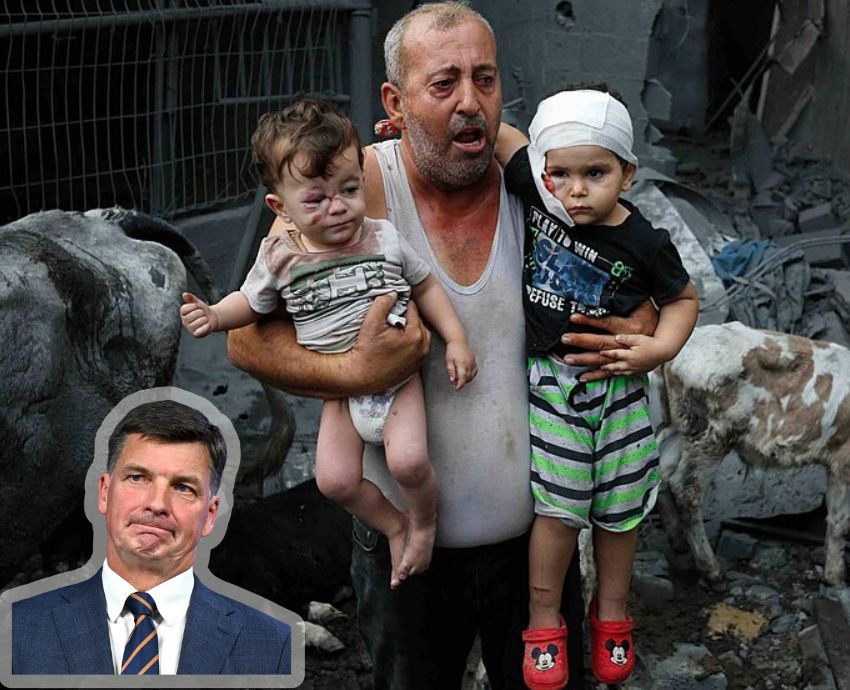
Liberal opposition leader Angus Taylor has put forward a new immigration policy built around what it calls “Australian values”.
It is not limited to general tightening measures; it includes specific steps such as introducing “values” as a criterion for visa assessments, expanding visa cancellation powers, prioritising migrants from certain countries and, most notably, calling for a collective reassessment of arrivals from Gaza.
Taylor has stated that people arriving from Gaza pose a “security risk”.
These are not minor details, but the core of the policy itself and they point to one clear conclusion: Palestinians are being directly targeted.
It is not enough to understand his views as just immigration policy. The idea that Australia needs to be defended from threats transforms what should be a humanitarian issue into a security one.
For instance, a Palestinian who has fled war and lost their home or family is no longer treated as a person in need of protection, but as a potential risk. The Palestinian is not treated as a survivor of war, but as a threat to be contained.
This is not interpretation, but a direct consequence of the policy Taylor is arguing for.
More troubling, his policy does not rely on individual assessment but on collective suspicion. The law assumes that each person should be assessed based on their conduct, yet what Taylor is proposing is the exact opposite: “Arrivals from Gaza are a risk” and “they should all be reassessed”.
This is collective suspicion, where identity itself becomes the issue rather than behaviour.
Under Taylor’s framework, a Palestinian would no longer be an individual with rights, but a “security file” to be managed. It constitutes one of the clearest forms of discrimination.
Taylor argues that his approach does not discriminate on the basis of race, but it operates in a racist way. It links Gaza to danger, imposes collective reassessment on Palestinians and relies on a vague and undefined notion of “values” that can be applied selectively.
The result is that Palestinians are treated differently from others, not because of what they have done, but because of who they are.
This is the essence of racial discrimination, even when it is framed in the language of “security” and “values”.
This approach also reveals a stark contradiction. The Opposition claims to defend “Australian values” yet, in practice, this policy discriminates between people, links identity to risk and grants the state broad powers to discriminate.
If these values include equality, justice and non-discrimination, then this new approach directly undermines them. Values cannot be defended by violating them, nor can justice be upheld through vague and selectively applied criteria.
Taylor is happy to promote a form of state-sanctioned violence, where laws and policies are used to harm specific groups. His policy may not target Palestinians through direct force, but it casts suspicion on them, places them under scrutiny, reduces their opportunities and turns their very presence into a subject of political debate.
This form of legal violence is particularly dangerous because it is presented as normal.
But it would mean undermining this country’s international obligations. Australia is a signatory to the 1976 International Covenant on Civil and Political Rights and the 1951 Refugee Convention, both of which require non-discrimination, the protection of refugees and fair individual assessment.
Yet what is being proposed is discriminatory; it targets a specific group and associates identity with risk, opening the door to clear violations of these principles.
Taylor is calculating that this will put the Liberals back on the electoral map and distinguish themselves from Pauline Hanson’s One Nation.
The Opposition is not treating immigration as a legal or humanitarian issue, but as a political tool, particularly through its alignment with pro-Zionist narratives.
This approach has been tried before. Former Coalition leader Peter Dutton escalated the fear-based rhetoric and linked certain communities to risk but his approach did not deliver political gains. Instead, it carried a political cost.
Today, the new Liberal leader is trying the same strategy despite greater awareness of, and solidarity towards, Palestinians. We have also seen a broader rejection of attempts to link immigration with fear and racism.
The strategy of stoking fear of Palestinians no longer works, politically or socially. Taylor’s speech to the Menzies Research Centre on April 14 was a clear escalation in the rhetoric of fear directed at Palestinians. While they are portrayed as a threat, suspicion can be generalised and new laws created to increase the intimidation.
Be warned: If this logic is accepted today against Palestinians, it will not stop with them.
[Shamikh Badra is a Gadigal/Sydney resident, originally from Gaza, Palestine. He is a convener of the Coalition for Justice and Peace in Palestine, a PhD candidate at the School of Humanities and Social Inquiry at the University of Wollongong and holds a master’s degree in Peace and Conflict Studies from the University of Sydney. His research examines Palestinian peaceful and diplomatic resistance to the Zionist movement and the creation of the state of Israel.]