
Peter Malinauskus and South Australian Labor were re-elected in the March 21 state election, with 37.7% of the vote and 32 seats, despite a -2.3% swing.
In what Antony Green describes as a “political earthquake”, Pauline Hanson’s One Nation (PHON) gained 22.1%, winning two seats in the upper house and, at the time of writing, at least two seats in the lower house (Hammond and Ngadjuri). It beat the scandal-ridden South Australian Liberal Party, which had preferenced PHON, and challenged the two-party Liberal-Labor domination of electoral politics.
Despite its anti-worker policies, PHON pitched itself to disenfranchised, working-class voters looking for an alternative to the major parties. After four decades of neoliberalism and the cost-of-living crisis, many workers wanted to lodge a protest vote, even though PHON’s policies won’t help them. Pauline Hanson has never supported pro-worker policies.
Labor, the Liberals and PHON represent three different sides of the pro-AUKUS capitalist class, the latter being the overtly racist “mask-off” one. All support the war on Iran, the genocide in Gaza and US-Australia military ties.
But, unlike the two major parties, PHON is not interested in projecting a veneer of respectability, openly whipping up racism with its anti-immigration and jingoistic policies. For example, PHON campaigned on repealing the state’s Voice to Parliament.
Malinauskus took a conciliatory tone at his post-election media conference saying: “When you actually look at what all the parties say, including One Nation, it’s pretty much the same thing — that we need a controlled, well-calibrated migration program”. Instead of rejecting PHON’s racism and right-wing popularism, he doubled down saying: “Australians should be patriotic and can be proud of what our nation stands for”.
Malinauskus also reaffirmed Labor’s commitment to AUKUS and militarism, announcing three new technical colleges in collaboration with British weapons corporation BAE systems. BAE Systems builds the Hunter class anti-submarine frigates for the Royal Australian Navy and is set to build the AUKUS nuclear-powered submarines at the Osborne Naval Shipyard in Port Adelaide. The technical colleges will provide “educational pathways” to AUKUS-related jobs.
Malinauskus also used the campaign to announce a multi-billion-dollar expansion to double annual copper production at BHP’s three underground mines.
Progressive alternatives included The Greens and independents Tammy Franks and Faith Coleman (who ran a joint Legislative Council ticket), the SA Socialists, which ran Leila Clendon and Ahmed Azhar as independents in Enfield and Croydon respectively, and the Socialist Alliance, which ran Anne McMenamin as an independent in Port Adelaide.
A record number of 388 candidates ran in the lower house, with smaller right-wing parties and right-wing independents flooding the field, making it more difficult for the less cashed-up progressive independents.
The Greens campaigned on housing affordability and cost-of-living policies. At time of writing, it had won another upper house seat and 10.2% of the vote — a rise of 1.1% since the last election.
Azhar, a pro-Palestine activist, highlighted Malinauskus’ push to cancel author Randa Abdel-Fattah from the Adelaide Writers Festival. He receieved a solid 5.7%. Clendon polled well at 5.6% in Croydon. Both focused on housing and the rising cost of living.
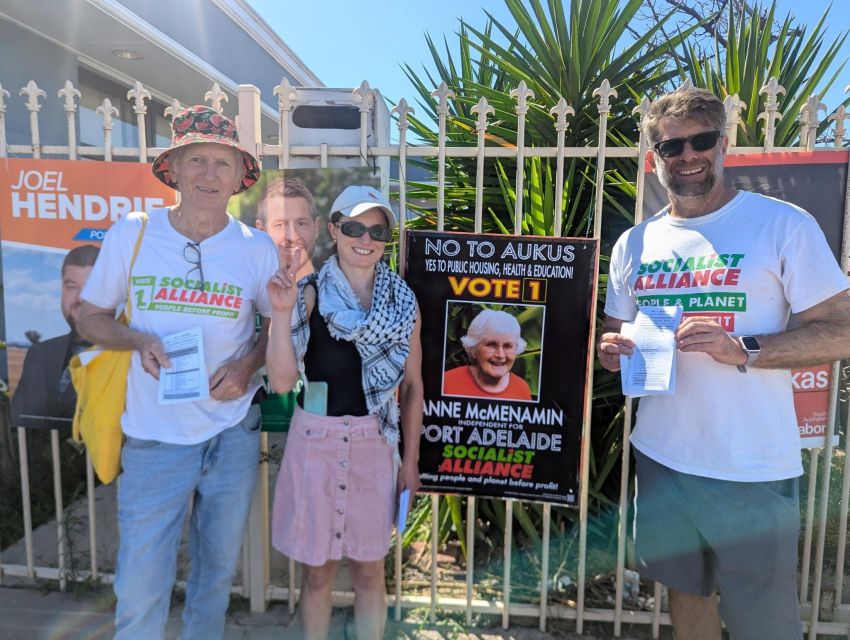
McMenamin was the only one to campaign on the need to reject AUKUS and militarism. Its “NO to AUKUS: Yes to housing, health and education” sat alongside a set of anti-capitalist, ecosocialist and anti-racist policies.
Port Adelaide is home to a diverse set of working-class communities, a large proportion of whom are struggling on low incomes. Socialist Alliance decided to run there because it saw an opportunity to build local support for socialist solutions to militarism and war, as well as present public housing and public transport solutions.
Socialist Alliance called for the new nuclear-powered submarine facility at Osborne to be stopped and a ban placed on the transportation and storage of the AUKUS nuclear waste. Residents are concerned about the health and security risks associated with nuclear-powered submarines and nuclear waste, and many reject the militarisation of the Port Adelaide area, believing public funds need be spent on community needs.
McMenamin is a well-known anti-AUKUS campaigner and resident in the area. With our limited financial and other resources, she drew a solid 1.5% of the vote (306 votes) amid a field of 12 candidates — seven of whom were right-wing or far right. This dispersed the votes, somewhat, but also made clear that those voting for Socialist Alliance were conscious votes.
Socialist Alliance members who staffed the pre-polling and polling day booths reported positive support for the anti-AUKUS message, a solid minority rejecting the other parties’ pro-war and racist rhetoric. They also reported that many were happy to shake PHON candidate Joel Hendrie’s hand.
Labor’s Cheyne Rich won the traditionally safe Labor seat with 39.8% of the vote and a -18.5% swing. PHON came in second, with 21% of the vote. The third highest vote went to Port Adelaide Enfield Mayor Claire Boan — a right-wing independent who opposes abortion rights and the decriminalisation of sex work. The Greens came in fourth with 9.7%.
Port Adelaide voters, like many swinging to the right, are susceptible to online pressure campaigns, funded and promoted by lobbyists. Some argue that the state’s banning political donations has led to more third party campaign groups pushing far-right agendas. Turning Point Australia (a version of the late Charlie Kirk’s organisation) put PHON “1” on its how to vote and local anti-abortion activist and academic Fiona Howe told her online supporters to put PHON first.
Although financial interference in elections is not new, socialists and progressives must oppose right-wing lobbying and other election “gaming”.
The rise of the PHON vote is a concern. While people are clearly very alienated from the major parties and many do not buy PHON’s racist scapegoating and fake fixes, many see PHON as a “protest” vote.
Socialist Alliance is keen to connect with those seeking real solutions to neoliberalism’s austerity and war. Get in touch and help us harness this growing discontent to build support for positive ecosocialist solutions.
[Anne McMenamin appeared as an “independent” on the ballot paper because the Socialist Alliance is still seeking registration in South Australia, although it has federal registration. Click here to help with our registration campaign in South Australia. Markela Panegyres is a member of the Socialist Alliance national executive.]