
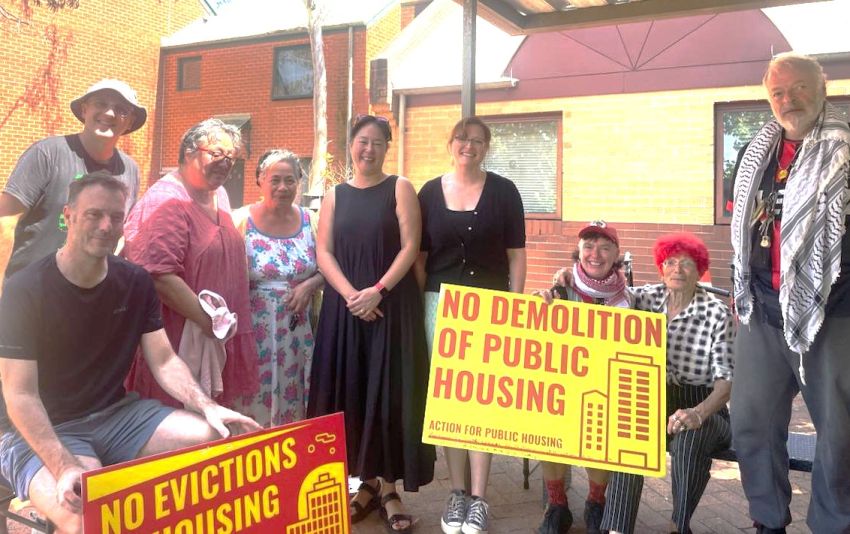
The ACT Supreme Court ruled in favour of three public housing tenants living on Ngunnawal land on January 31. They claimed their rights were breached when a program seeking to redevelop and expand such housing, sought to evict and move them to another property.
If Greens MP Jenny Leong has her way, tenants in New South Wales may soon be protected.
Justice Verity McWilliam found that the three Canberra tenants were denied their basic human rights and procedural fairness, under the Human Rights Act 2004 (ACT).
Yvette Van Loo, one of the tenants who is in her mid-70s, was asked to vacate in 2022, after living in her home of 40 years. After this ruling, the three tenants have been allowed to remain in their public housing homes.
The ruling set a precedent for ACT public housing tenants and renters. It recognised that the ACT public housing units were, in fact, constituents’ homes.
Public housing tenants in NSW do not have the same protections. However, this is set to change if Leong’s Human Rights Bill 2025, which was tabled in last October, is enacted.
The bill scheduled for debate in early March contains a right to housing. Leong has long been campaigning for more robust tenants’ rights; she led the push for a no-grounds eviction law which was passed in 2024.
Leong told Sydney Criminal Lawyers that the ACT judgment “shows that a Human Rights Act is far from symbolic: it is an effective tool that people can use to get justice and fairness when public bodies have denied this.”
She said her Human Rights Bill is modelled on laws in place in the ACT, Victoria and Queensland and “includes a standalone right to adequate housing that protects against arbitrary evictions and the withdrawal of essential services, like water and electricity”.
Proposed section 40 of the act would contain the right to an adequate standard of living and housing.
It specifies that every person deserves a decent standard of living, which includes “adequate food, water, clothing and housing”. It further says that this right applies to all without discrimination.
The right protects tenants from “unlawful or arbitrary eviction” and unlawful or arbitrary withdrawal of an essential utility service.
The right to an adequate standard of living includes sufficient water for personal and household use and to prevent disease.
Leong thinks the NSW Supreme Court could make a similar ruling to that of the ACT Supreme Court in relation to the three public housing tenants.
“After nearly three years of ramming through legislation that erodes our human rights, NSW Labor could do something positive by sending our Greens bill to an inquiry for robust public consultation … in line with the promise they took to the 2023 election to consult the community on improved human rights protections,” Leong said.
Australia is the only Western country without a federal human rights act. As Leong noted, recent heavy-handed anti-protest laws has made it all the more important, that the authoritarian creep taking place across the countries of the Global North is kept in check.
The Albanese government initiated an inquiry into Australia’s human rights framework in March 2023. It was prompted by the Australian Human Rights Commission’s position paper on establishing a federal Human Rights Act.
It recommended passing a Human Rights Act in May 2024. The Prime Minister appears to have since shelved the idea.
As former High Court Justice Michael Kirby has observed, the Constitution’s drafters in the 1890s had considered embedding rights protections, as is the case in the United States.
However, the idea was dumped when it was thought that special laws that discriminated against First Nations Peoples and Chinese people might be voided.
Federal human rights laws have been pushed periodically since federation in 1901. However, they have always been voted down or lapsed with changes in parliament. Progressing human rights has been easier at the state and territory level. Such laws include the Charter of Human Rights and Responsibilities Act 2006 (Vic) and the Human Rights Act 2019 (Qld).
Since the COVID-19 lock-downs, the dearth of human rights protections has been a bigger discussion.
NSW Attorney General Michael Daley has indicated that Labor is willing to work with the NSW Greens on their bill. However, Premier Chris Minns is now in a race to the bottom on rights-eroding laws that violate the right to protest and the freedom of political communication.
Sydney’s rental market has been rated the second most expensive in the world repeatedly for the past decade. There has been a rental and ever-increasing housing affordability crisis in NSW and country-wide since September 2020.
If Leong’s HRA does become law and renters receive protections, it will be a huge step forward in the fight for housing security.
“Where a right cannot be immediately fully realised, that should be clearly stated in the legislation, as recently seen in the Australian Capital Territory where, after 20 years of being in force, its Human Rights Act was amended in September to include the right to housing,” Leong said last October 23 during her second reading speech.
The ACT became the first jurisdiction to protect the right to housing when it was added to the territory’s HRA last September. It has already saved the homes of three public housing tenants and set a precedent for others.
Leong told parliament that the Greens bill recognises that “everyone has a right to housing”. She said it would mean everyone is entitled to that right and that “no one may be unlawfully or arbitrarily evicted or have an essential utility withdrawn”.
[Paul Gregoire writes for Sydney Criminal Lawyers, where this article was first published.]