
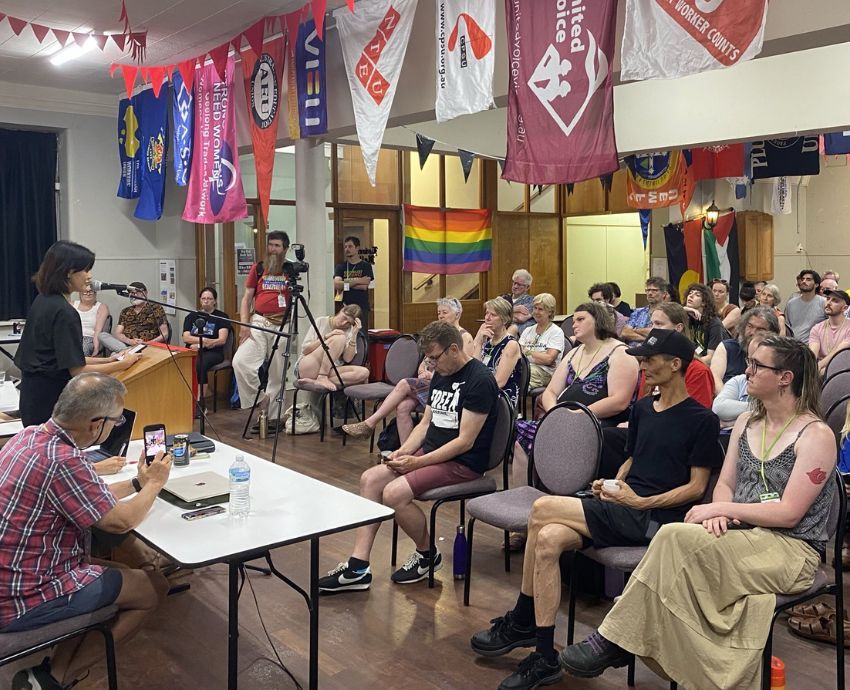
Aiman Farihah is a central committee member of the Socialist Party of Malaysia’s (PSM) youth wing, Pemuda Sosialis. She was involved in coordinating last year’s May Day rally in Malaysia and is organising the KempenMy30 campaign to improve the country’s public transport system.
Below is an abridged version of the speech Farihah gave to the Socialist Alliance’s 20th National Conference, as part of the opening panel on January 9 titled “Socialism not war and ecocide”.
***
Most people don’t wake up thinking about capitalism.
We wake up thinking about work deadlines, rent or whether we have enough money to get through the month.
Life under capitalism feels like we’re stuck on a hamster wheel. We are constantly running — working, commuting, producing but never arriving anywhere. The only time we are forced off that wheel is when something breaks: when we get sick; when we burn out; when a major crisis like COVID-19 shuts the system down.
Even then, we are expected to recover quickly and get back to work.
We are allowed to pause to apply band-aid solutions, be it in the form of self-care or short “gateway” breaks. We never have enough time to examine the root cause of our exhaustion and despair.
I say this not as theory, but as lived experience. I see it in my friends. I see it in myself. The most precious resource we have, which is time, is systematically stolen from us.
If you are feeling this way too, I want you to know this is not your personal failure. This is a structural design.
Because capitalism depends on our exhaustion. It would not function if the working class had real free time. Time to reflect, to organise, to question why life feels so narrow and precarious, despite decades of economic “growth”.
We see the adverse effects of capitalism in our daily lives.
Let me talk about healthcare, because this is something everyone understands.
In Malaysia, public healthcare used to mean something very clear: if you were sick, you would be treated. No matter who you were or how much money you had.
Why? Because healthcare was treated as a public responsibility, not a commodity, not a privilege for those who could afford it.
But capitalism cannot tolerate systems that operate outside profit.
In 2004, when the Barisan Nasional Malaysian government tried to privatise dispensaries in public hospitals by allowing the opening of pharmacy shops in government hospitals, it was framed as “we’re giving patients more choice”, when what it really meant was to let profit into the hospital.
PSM organised a massive rally in front of the Ministry of Health in Putrajaya to protest the plan. The plan was withdrawn and has not been reintroduced to this day.
Since then, the strategy has changed. Instead of open privatisation, we’ve seen quiet and incremental reforms: chronic underfunding, overworked doctors and schemes like Rakan KKM, which introduce market logic into public hospitals without calling it privatisation.
Rakan KKM enables doctors to earn additional income through quasi-private arrangements within the public system. On the surface, it is sold as a way to “ease the burden” on public healthcare and “retain doctors”. In reality, this goes against the Sustainable Development Goals and principles of health for all.
It normalises a two-tier logic inside a system that was meant to be universal. It creates incentives for doctors to prioritise paying patients, where people who can afford to pay get faster, better treatment and poorer patients might have to wait longer.
Today, Malaysia spends just 2.3% of its GDP on public healthcare. Britain spends about 9.6%, Thailand nearly 4% and Singapore spends 3.7%.
What we, PSM, demand through our “Stop the Privatisation of Healthcare” campaign is 5% of GDP for public healthcare, a 5-year freeze moratorium on new private hospitals and stronger regulation of private hospital charges.
At the same time, the cost of living keeps rising.
The unemployment rate reduced to 3%, in 2025, but what they’re not telling you is how many workers are getting on by working two different jobs just to survive and how our household debt is close to 80% of GDP.
Our wages are still stagnant — salary growth in Malaysia is the third lowest in Southeast Asia. Because that’s how my country attracts other countries to invest. Exploitation of the workers is our economic model!
Workers are overworked, underpaid and are burning out. We’re expected to be hardworking, help increase companies’ profits, because somehow, sooner or later, it will trickle down. That’s the promise. But it’s been 400 years — how long do we have to wait for it to trickle down?
What we’re given in return are burned out bodies and promises that things will get better if we work hard enough.
Capitalism shows its brutality most clearly when profit becomes the government’s priority.
The Kampung Papan settlers in Klang, who have lived there since pre-independence, were forcibly evicted to make way for development and are being labelled as illegal squatters by the [High] Court.
The government chose to side with developers over people. Police were deployed, not to protect the people, but to assist in evicting them. Families were forcibly removed and occupied homes were demolished. At least 23 individuals were detained, including activists who stood in solidarity to defend their homes.
We see how capitalism rips us away from empathy, humanity and compassion. When money becomes the compass, you fail as a human being.
Capitalism does not only exploit people; it exploits nature.
In Malaysia, we see this very clearly in how our environment is treated. It is not seen as something to be cared for, but something to be used up; something to be extracted.
Our reserved forests are quietly being degazetted and sold to private developers. Mining activities leave behind polluted soil and poisoned water. Toxic runoff flows into rivers and our freshwater. Flood and landslides happen almost every year, yet are treated as “natural disasters” instead of political outcomes.
Malaysia has been built around the culture of car dependency. Public transport like buses is disconnected and unreliable, while highways keep expanding and car ownership is actively encouraged. People are pushed into driving, into buying fuel. The government spends 52 billion (A$19 billion) on the petrol subsidy every year while only spending 499 million (A$183 million) on the public transport subsidy.
The government often talks about green solutions while, at the same time, expanding fossil fuel infrastructure and mega-projects. As long as profit is prioritised, environmental destruction will continue.
If these problems are so clear, why is building a left-wing alternative so difficult? In Malaysia, but I think this can be applied almost everywhere.
The first reason is exhaustion.
We’re not angry enough about the state of the country, but not because the people running the country are doing a good job. We’re seeing the adverse effects of what capitalism does, where people are too busy with their lives that they would rather turn away from the vicious and horrendous events happening in the world.
They know something is wrong but they’re too tired. When we went on the ground to leaflet for Stop the Privatisation of Healthcare campaign, we saw how many people resonate with the issues. They may not be shouting on social media, but they understand. They agree. They just don’t speak up.
That is where our role as a left-wing alternative comes in: to educate, agitate and organise.
The second challenge is weak class consciousness. Many people are encouraged to see problems as individual failures rather than systemic ones.
The third challenge is division. In Malaysia, politics is framed through race and identity rather than class. Socialism is misrepresented as foreign, dangerous or culturally incompatible.
Conservative narratives are used to pull working-class people away from their material interests. When they hear the word “socialism”, they slap the word “liberalism” on us — they’ll jump off when they hear LGBTIQ and turn a blind eye to every good thing we do.
Race war is still clouding people from seeing the actual war: class war.
Ironically, many socialist principles already exist in practice in Malaysia, like our public healthcare, nationalisation of fuel through PETRONAS and state-owned infrastructure like our trains and buses. Public banking dominance through Maybank and CIMB, which are GLCs (government-linked companies) that are there to keep prices in check but are never advertised as socialist principles.
And there is a material imbalance.
Mainstream parties have money, media access and state resources, whereas left movements like us, we rely on volunteers and small donations from the community,
But despite all this, something important is happening.
Young people are paying attention. They are searching for explanations that go beyond surface-level reforms. When we organise conferences, talks and campaigns, we see growing interest from young people.
Our role is not to invent anger but to organise the anger that already exists. We need socialism because capitalism has shown us its limits and its violence.
We see it in Gaza, where genocide is justified in the name of geopolitics because war is a racket. We see it in what’s happening in Venezuela.
International law is not there to protect us; it’s there to serve the big gangsters. Just because they won’t do anything, that doesn’t mean we’re too doomed to do anything. Just because they want us to feel powerless, it doesn’t mean we are.
Take Indonesia’s uprisings, Nepal’s, Bangladesh’s, Bulgaria’s. That’s the domino effect in action.
We can’t afford to keep our heads down anymore, as these vicious cycles happen in front of our eyes.
Meet the people. Go out on the street. Build a community and organise. We need collective action. We need an uprising in our home country. We need to topple this system that’s brutally taking the life and humanity out of us humans.
To quote poetry from Tian Jian, a WWII Chinese poet:
“If we didn’t fight,
The enemy with his bayonet,
Would kill us
And pointing to our bones would say
Look, these were slaves.”
Hidup Rakyat! Hidup Perjuangan! Hidup Sosialis! [Long live the people! Long live the struggle! Long live socialism!]