
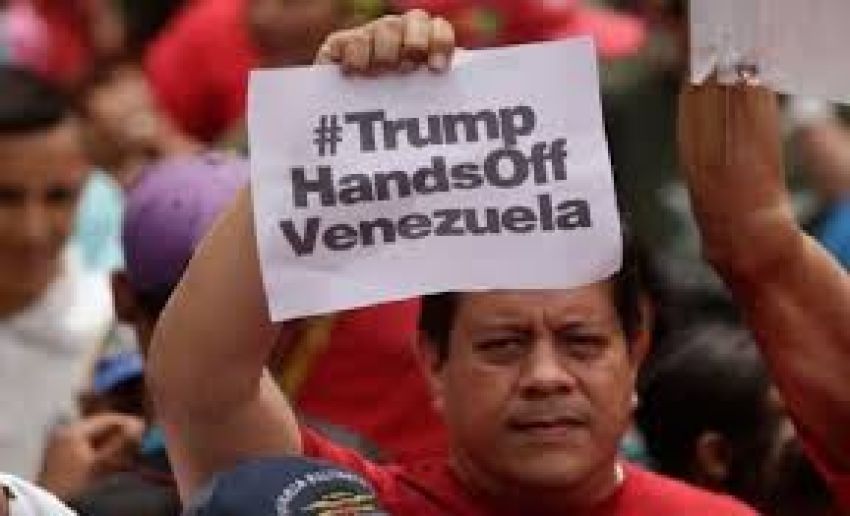
With its violent military intervention into Venezuela — a country I used to live in — the United States has begun this year with entitled and undisguised imperialism. The unapologetic kidnapping of Nicolás Maduro and of Cilia Flores (not just a wife as the media refers to her, but also former head of the National Assembly) and killing of at least 40 Venezuelans, aims to cement and normalise the US’s standard operating procedure for international relations as violence and control. It will take Venezuela’s oil and the Democratic Republic of Congo’s tech minerals, and to hell with Global South self-determination, agency and ownership.
I remember when I lived in Venezuela and we talked about what we would do if the US attacked. We were already facing other kinds of attacks, including basic food shortages orchestrated by private companies, destabilisation attempts, right-wing violence and English-language mainstream media lies. The conversation particularly came up around elections, when the shortages and destabilisation typically increased and US attacks felt less hypothetical.
Even then, though, we would balance the very real and long history of violent US interventions in Latin America with scepticism. How could they kill innocent people and bomb what felt like to me the closest thing to paradise?
Venezuela was never a utopia — there were mistakes and much work to do, but the Andean mountains were intensely green, the coastal waters a peaceful turquoise, the nights full of fairy fog that you could see drifting down the streets. The days were full of the laughter of the tiny children I taught as part of our participatory education project. We solved our own local problems as an organised community, turned empty lots into community gardens, and there was always, always, political debate and high political literacy. People knew their constitution, often by heart, knew the laws and the news. Venezuelans had and have this infinite urge to dance, even on moving buses or after two-day long meetings. How could anyone consider destroying that world? It felt inconceivable. It didn’t make sense, and it still doesn’t.
Yet, we all know that beautiful Gaza, with its beaches, shops, delicious zaatar bread, hospitals, books and resilient people, has been turned into rubble and whole families wiped out. The US-led destruction of Afghanistan and Iraq ruined people and communities and saw key cultural and archaeological sites irreparably damaged, and artifacts looted. I live in Mexico now, and here alone, the US has used the North American Free Trade Agreement and the so-called “War on Drugs” to militarise this beautiful country and systematically turn it into a vast grave (with 131,000 forced disappearances) and into an obedient neoliberal production line for nearshoring US companies. So, in Venezuela, I guess we should have been less sceptical. Friends there messaged me on January 3 in shock, their ears ringing from the sounds of bombs. The new year weekend wasn’t meant to be this.
However, throughout last year, the US had asserted itself more openly as global police chief at the service of big business. It “negotiated” (pressured) a “ceasefire” in the DRC, which would give it access to the country’s highly sought-after tech minerals and metals and to security control. It has supported Israel, bombed Nigeria and killed Venezuelans with complete impunity.
It closed its borders to refugees in violation of international law, and breached migrant and human rights within its own borders. It also bombed Syria, Iraq, Iran, Yemen and Somalia. It carried out or was partner to 622 overseas bombings in total, and also intervened in manipulative ways, such as Donald Trump’s comments days before the Honduran election in November that led to the victory of the right-wing candidate he backed, or the US’s role in the international “Gang Suppression Force” in Haiti.
While global institutions like the International Criminal Court and the United Nations have demonstrated their ineffectiveness at doing anything at all about the US’s illegal sanctions against Cuba, the genocide in Gaza or climate destruction, Trump has been able to fortify the US as a force that actually decides international affairs.
In his press conference on January 3, Trump said the US would be selling Venezuelan oil. Though he laid the groundwork for the military intervention into Venezuela with evidence-free talk of drug cartels, bombing what were likely fishing boats in the second half of last year, most people knew this was always about regaining control over the country with the largest known oil reserves. However, Venezuela also represents defiance. The US has sanctioned the country for such behaviour for more than a decade, killing or contributing to the deaths of more than 40,000 people in 2017–18 alone.
The US doesn’t just treat the Global South as a resource buffet. In order to secure its access to the goods, it wants the countries’ governments at its beck and call. Venezuela, especially during the 2010s and through initiatives like the Community of Latin American and Caribbean States, was playing a role of uniting Latin America against such dominance and towards independence and social and economic alternatives.
The bombing of Venezuela, beyond the oil itself, is about US control over Latin America and part of a right-wing pushback against movements, grassroots empowerment and alternatives to violent capitalism. Beyond Nayib Bukele in El Salvador and Javier Milei in Argentina, last year the right wing also won in Bolivia, Honduras and Chile. With Trump, these “leaders” are furthering racist, homophobic, sexist and privatisation agendas.
Normalising empire
Beyond the horrific event itself, the events of January 3 are part of a move towards normalising a global state of danger, insecurity, human rights abuses and disregard for international law. It does not matter what anyone thinks of Maduro; whether he won last year’s election is an important discussion for another place and time. The US has no right to determine the heads of other countries. It wants to be, but is not the world boss, and beyond that, has no moral standing to decide or control anything.
But Trump’s latest move, as a continuation of US policy last year, upholds military intervention as a solution to problems. It is a signal to wayward countries to obey. Such imperialism not only kills people; in the long term it perpetuates racist tropes of Global South countries that can’t run themselves, while legitimising US- and euro-centrism that stipulates their monopoly on wisdom and democracy.
Imperialism scares its victims into silence and submission and cements a global apartheid dynamic where some regions are politically and financially controlled, subjected to unliveable wages and to resource robbery. Through debt systems and trade and income inequalities, rich countries have drained US$152 trillion from the Global South since 1960.
The intervention machine is rigging the world for US big business interests, at the price of Global South dignity and agency. For invaded and intervened countries, there are hidden impacts as well; lower self-worth and an unsubstantiated belief that one’s education, art and inventions are inferior, disillusion with organising and movements, and often, a need to migrate that is then met with rejection by those forces causing that need — as of course is the case with the US.
The Venezuelan people are not a threat. The country doesn’t even produce or traffic significant amounts of drugs. In reality, much of the cruelty and harm globally is coming from the US. The Trump government and the US elites are the ones committing human rights violations, shirking democracy by orchestrating coups like the one on January 3 and shirking legality, let alone decency, by killing people in Venezuelan boats under the pretext of opposing drug trafficking, but without any trials or any proof. With each intervention, the US furthers its and Israel’s impunity for war crimes, abuses and violations.
[Tamara Pearson is a Australian-Mexican journalist, editor, activist and literary fiction author living in Puebla, Mexico. Her latest novel is The Eyes of the Earth, and she writes the Global South newsletter, Excluded Headlines.]