
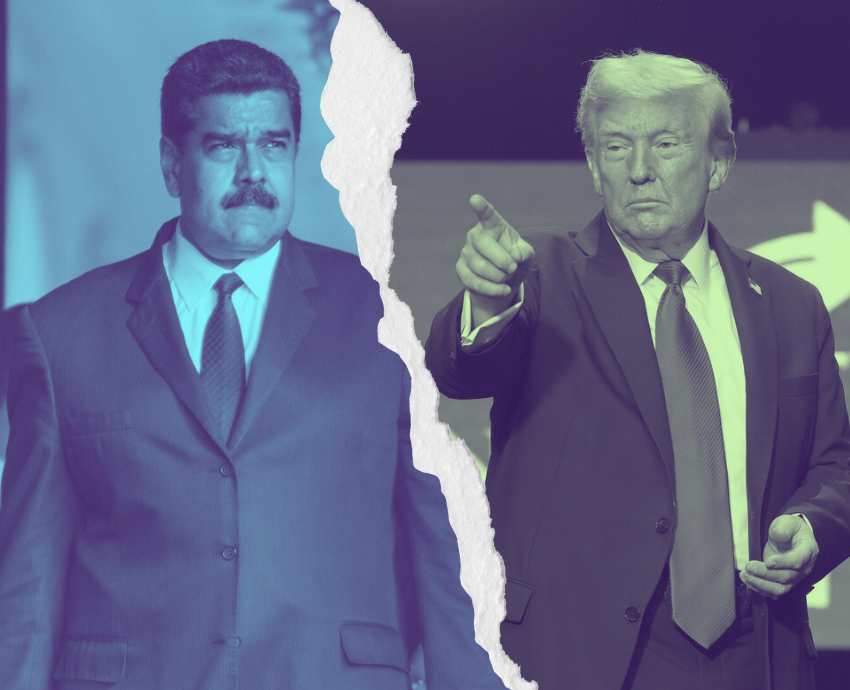
The United States administration’s double standards towards Venezuela have seen it move between buying oil from Venezuela (under neocolonial conditions, a result of US imposed sanctions) to claiming Venezuelan state leaders are part of a criminal drug cartel, to justify a military deployment and eventual attack.
The US is fully aware of the Nicolás Maduro government’s lack of internal and international legitimacy. It has a clear lack of democratic credentials (especially since last year’s presidential elections), has undergone an authoritarian and neoliberal shift (despite its leftist rhetoric) and has overseen a clear deterioration of working people’s quality of life (with a monthly minimum wage of less than US$1 amid triple-digit inflation and basic consumer prices double the regional average).
Forced migration of millions of Venezuelans has torn apart families and eroded the government’s popularity, meaning the Maduro government has failed to forge a broad national anti-imperialist front against the US offensive involving all sectors of the country.
None of this is enough justification for US, Latin American and world public opinion to accept a disproportionate military attack. That is why the US seeks to portray as criminal the same government that has submissively handed over its oil to the US since the start of the Ukraine war.
But if Maduro was already engaged in open negotiations with the US since the Ukraine war, effectively turning Venezuela once again into a reliable oil supplier to the North, why then the unprecedented military deployment against Venezuela?
US military deployment
In mid-August, the US initiated a naval, amphibious and troop deployment in the Caribbean, particularly around the Venezuelan coast.
The US initially announced the mobilisation of 4000 military personnel, including parts of the Iwo Jima Amphibious Ready Group (ARG) together with the 22nd Marine Expeditionary Unit, Arleigh Burke-class destroyers, a guided-missile cruiser (the USS Gettysburg), a nuclear submarine (USS Newport News, SSN-750), a P-8 Poseidon maritime patrol aircraft and Marine Corps helicopters.
Other destroyers and support units later joined the deployment, to carry out surveillance and deterrence operations in the Southern Caribbean.
Progressive governments have responded in different ways: Chilean President Gabriel Boric has insisted on highlighting the authoritarian and non-socialist character of the Maduro government; Colombian President Gustavo Petro has emphasised the lack of democracy in Venezuela, while saying this does not justify a military invasion; Brazilian President Luiz Inacio Lula da Silva has said this is a concern for the entire continent’s sovereignty; and Mexican President Claudia Sheinbaum has prioritised an anti-imperialist discourse.
Venezuela’s government responded by launching a media offensive (initially blaming US Secretary of State Marco Rubio for the deployment and insisting he had deceived [Donald] Trump); a political offensive to activate its dwindling social base and the militia, calling for national unity (though refusing to release all political prisoners, restore the legal status of leftist parties, and persisting with its neo-capitalist accumulation model); a military offensive (through designing a strategy of prolonged resistance, which in reality would require even broader social fronts); and a diplomatic offensive in various multilateral forums (from the United Nations to the Community of Latin American and Caribbean States).
In October, the Venezuelan government organised military exercises, mobilising its airforce and anti-aircraft defences to respond to potential provocations. But anti-imperialist sentiment remains precarious among the population, a product of the terrible social exhaustion caused by 11 years of unprecedented economic crisis.
This does not mean that a significant portion of the population — right-wing, non-partisan and even left-wing — agrees with some kind of military aggression against the country; rather they are increasingly fed up with the current government.
Faced with this, a segment of the population seems to prefer the “devil you don’t know”, holding illusions that this might provide a way out of a situation characterised by average incomes below the poverty line — as if history does not show that wherever the gringos invade, misery, chaos and destruction ensue.
At the end of November, there were announcements about possible US ground operations against drug trafficking — a euphemism for a military attack on Venezuelan territory — while Trump himself discussed a possible meeting with Maduro.
At the time of writing, the New York Times has reported that an initial telephone conversation took place, but no progress was made toward a non-aggression pact.
Neocolonial policy
Trump is not a “wild bull” leading the world’s most important imperialist nation; on the contrary, he reflects structural policies, albeit applied in his own eccentric and strident style, typical of illiberals.
What is happening in the Southern Caribbean is part of a broader picture connected to restructuring the global capitalist governance system that emerged after World War II.
China’s rise as an economic power, and Russia’s position as a nuclear military giant, as well as the relocation of a powerful innovation hub between China and India, and Europe’s diminishing geostrategic-military influence, are just a few signs of the radical transformation occurring within the capitalist order.
As always, the new order will be the result of negotiations or war — the latter being apocalyptic for humanity and capitalism itself. But the pieces have already started moving.
Much of what is occurring today began with former president Joe Biden. Both Democrats and Republicans see that the US’ real interest lies in geopolitics: the US needs to show the world it is still the most powerful arms-producing nation, with large-scale destructive capabilities and an extraterritorial military presence in many countries.
The central objective is to recognise that US economic prosperity depends on the uninterrupted flow of goods, services, people, capital, information and technology across borders.
Homeland Security’s Trade and Economic Strategy policy provides a conceptual framework for the current military deployment in the Caribbean, but marks an evolution in approaches: from Biden’s economic diplomacy with eventual military support, to the centrality of offensive military action under Trump.
Trump and Latin America and the Caribbean
Since the start of his second term, Trump has focused significant efforts on the US’s military presence in Latin America and the Caribbean.
Some of the most relevant initiatives include the memorandum of understanding signed by Panama’s President José Raúl Mulino and announced by war secretary Pete Hegseth, involving the “rotational use” of former bases, airfields and naval stations that the US had in Panama before the 1977 handover of the Canal.
In Puerto Rico, the US Roosevelt Roads naval base has reopened and operations reinforced, with military exercises on the island of Vieques. Ecuador’s parliament approved a constitutional reform to allow the expansion of US military presence on its territory; however, a popular referendum rejected the measure.
In November, the Dominican Republic authorised the use of local bases (Isidro Air Base and Las Américas International Airport) for counternarcotics logistics operations, and the Trump government has promoted the intensified use of Cooperative Security Locations in El Salvador, Curaçao, Palenque/Apiay/Malambo, and other airfields (Colombia).
Within just a few months, Trump has successfully repositioned the US military in the region.
The US has long sought to establish military bases in Venezuela. Given this, military pressure on Venezuela appears aimed at not only controlling oil but securing US military deployment on Venezuelan territory — either through an agreement with Maduro’s government or a potential succession government led by María Corina Machado, who recently hinted at this possibility.
This would partly explain why, despite Venezuela supplying oil to the US under neocolonial conditions in recent years, the US is pushing a disproportionate military offensive against it and the Maduro government.
Anti-imperialism and a culture of peace
We can have many differences, of various kinds, with the Maduro government and Madurismo, but these do not justify a US intervention on Venezuelan soil.
Progressive, democratic, nationalist, popular and socialist forces across the continent and the world must denounce the Trump government’s attempts to violate sovereignty. A military attack on Venezuela is an attack on the sovereignty of all Latin America.
We must combine this with denouncing the anti-democratic, anti-working-class and neoliberal nature of the Maduro government, which masquerades behind left-wing rhetoric.
The Venezuelan people have suffered terrible misery for the past decade, with families torn apart by migration, social institutions destroyed and wages disappearing as a source of survival.
They do not deserve to die under the bombs and bullets of an invasion force that disregards their interests, like Madurismo does.
Any initiative that prevents the military escalation of the conflict should be welcomed from the perspective of the people.
[A longer version of this article first appeared on links.org.au.]