
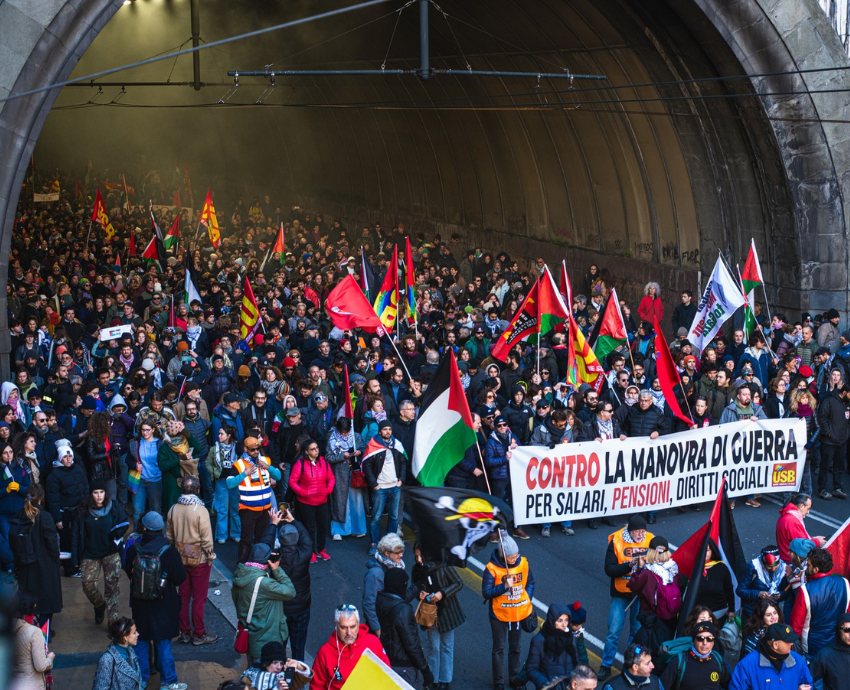
A powerful wave of international labour and civil society solidarity with Palestine, focused on blocking supplies to Israel, was led by striking Italian dockworkers on November 28–29.
Unionised workers, community groups and environmental activists protested in 40 cities across Italy. They were joined by protests across Europe, including in the Spanish state’s capital Madrid, in Portugal (Lisbon, Porto), France (Paris), Germany (Berlin), Belgium (Brussels), Norway (Oslo), Luxembourg, Poland (Warsaw), Austria (Vienna) and Ireland (Belfast, Dublin).
In South America, solidarity actions took place in Mexico (Mexico City, Guadalajara) and in four cities across Brazil (São Paulo, Florianópolis, Serra Grande, Porto Alegre). In North America, protests took place in Canada (Montreal, Toronto) and in the United States (Chicago).
In South Africa, actions were organised in Cape Town and Johannesburg.
In Muloobinba/Newcastle, Australia, the environmental group Rising Tide joined forces with Palestinian solidarity groups and 40 grassroots organisations for a “Paddle Out for Palestine”, on November 29, part of a five-day climate-focused blockade of the world’s biggest coal port.
The Italian protests were amplified by high-profile international figures who travelled to Genoa and Rome to stand alongside the striking dockworkers. Among them were United Nations Special Rapporteur on the occupied Palestinian territories Francesca Albanese; climate and pro-Palestine activist Greta Thunberg; former Greek finance minister Yanis Varoufakis; Pulitzer Prize-winning journalist Chris Hedges; and Brazilian pro-Palestine activist Thiago Ávila.
This was the third strike in Italy against Israel’s genocide in Palestine and represented a developing power of coordinated global action at the docks against Israel.
From the stage in Rome, speakers issued a global call for further strikes and marches to defy the “illegal” UN Security Council resolution 2803.
The Italian national strike was led by Unione Sindacale di Base (USB) and joined by union federations Confederazione Unitaria di Base, Comitati di Lotta Autonomi Precari/Autonomo and Confederazione dei Comitati di Base, reported DIEM25. The Italian Confederation of Labour (CGIL) did not participate in this strike, opting to hold its own day of action on December 12.
It called for an end to Europe’s war economy and to the “complicity that binds it to Israel’s ongoing assault on the Palestinian people”.
The USB said its members were exercising “workers’ power” to compel the Italian state to fulfill its legal obligations as a signatory to the 1948 Genocide Convention. The convention obligates states not only to refrain from genocide but also to prevent and punish it.
As reported in Peoples Dispatch, a statement from the USB and Genoa-based autonomous dockworkers’ collective CALP said: “The [Giorgia] Meloni government’s rearmament budget is in line with the warmongering policies pursued in recent years … with public services being sacrificed on the altar of the war economy. We want at least €2000 in base pay, retirement no later than 62, an end to subcontracting, reduced working hours with no loss of pay, guaranteed housing rights, new public-sector hiring and free, universal public health care.
“These are urgent needs in an exhausted country, needs that are incompatible with the government’s warmongering.”
Italy’s previous general strike in October, which was joined by the CGIL, caused days of disruption to shipments to and from Israel.
Former US Green Party presidential candidate Jill Stein sent a solidarity statement to the strikers, saying: “The Italian dockworkers have shown us the way.”
“We have won in the court of public opinion and in the court of law,” Stein said. “We must now exercise worker power to shut down the genocide.” She called for strikes and actions worldwide in solidarity with USB and “in defiance of the illegal UNSC Resolution 2803”.