
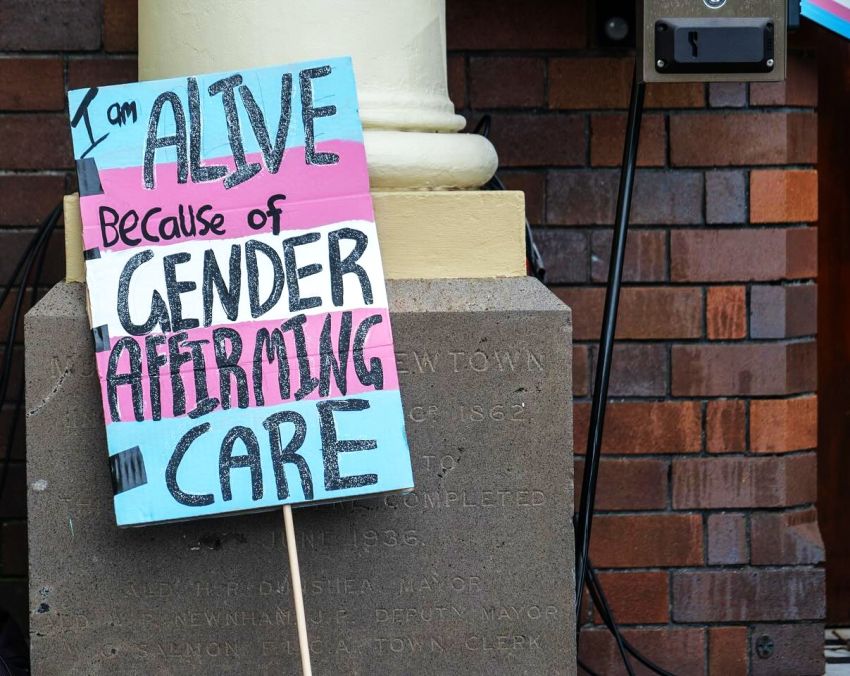
It is undeniable that LGBTIQ people in Australia have more legal rights than those in other countries, largely due to decades of campaigns by oppressed communities. But they still face discrimination, homophobia and transphobia, in some cases pushed by the state.
Far-right groups and sections of the mainstream media are quick to whip up a moral panic about queer people and, as trans identities become more visible, they become scapegoats for prejudice or for structural social problems.
Anti-trans campaigner Kellie-Jay Keen-Minshull’s tour across major Australian cities two years ago helped embolden attacks on the trans community, including closing down rainbow story times.
More recently, Queensland’s Liberal National Party (LNP) government suddenly decided last year that it was going to prevent young people from accessing gender-affirming public healthcare. The Supreme Court struck that ruling down at the end of last month, but left an opening for the LNP to put more barriers in place — which it took six hours to do — thereby cutting loose a younger cohort of an oppressed minority that is 15 times more likely to experience suicidal ideation, or attempt suicide, than the general population.
The Northern Territory Country Liberal Party has even announced plans to amend its anti-discrimination laws to allow religious discrimination in schools and institutions. Those trying to claim injury would have to prove their case at a higher threshold for racial, sexual and gendered vilification.
Overseas, United States President Donald Trump’s executive order attacking transgender and non-binary people, as one of the first orders of his second term, has given licence to any number of bigoted attacks on transgender people.
All this means that those fighting for the rights of LGBTIQ people still have a lot of work to do.
Origin of LGBTIQ oppression
Queer oppression is connected to the emergence of class society and developed alongside the oppression of women. The newly forming ruling class needed women to procreate and to then undertake the lion’s share of the burden of raising the next generation of workers. The ideology used to push women to play this critical, but unpaid, social role was centred on the heterosexual, monogamous family unit being God-given, “natural” and inevitable.
Queer identities and relationships were seen as a threat to the established social order and the religious ideas that underpinned and justified it. As the nuclear family unit became a fundamental socioeconomic institution supporting capitalism, queer people were characterised as dangerous and a threat to society.
To maintain the nuclear family unit as the bedrock of the new capitalist order, the ruling class needed to regulate sexual behaviour and, along with religious institutions, this became another way of propagandising around the idea that same-sex relationships are “unnatural” and that procreation is the sole reason for having sexual relations.
Today in Australia this is not as pronounced, as capitalism has found ways to market the family unit as “diverse”. However, extremist sections of the ruling class and their social agents perpetuate and prey on prejudices, and are always looking for an opportunity to roll back legal and ideological gains that the LGBTIQ movement has won.
Trans people and First Nations culture
One of the conservatives’ arguments that fuels transgender hatred is that trans people are somehow “new”. This is simply untrue.
First Nations cultures across the world have recognised and celebrated diverse concepts of gender.
Colonisation imposed gender norms on First Nations peoples, as part of the colonial project to eliminate Indigenous cultures and kinship systems. Strict hierarchical systems of gender and sexuality were used by the colonisers as violent forms of oppression and regulation.
The first major gay rights movement started in Germany in the late 1800s, mainly speaking out against anti-homosexual laws. A radical “free love” movement, based around feminist and anti-capitalist theories, began to challenge the oppressive family and gender norms of that era. At the beginning of the 20th century, German writer and medical practitioner Magnus Hirschfield started an institute to defend homosexuality, which was then still considered a “disease”. Many could see that the Nazi’s were hell-bent on eliminating queer people.
The Bolsheviks had an enlightened view and, after the 1917 Russian Revolution, decriminalised homosexuality. The newly formed Soviet Union also granted divorce on demand, made childcare free and legalised abortion. It started to set up frameworks to ensure equal rights for women.
The Bolsheviks viewed sexual behaviour as belonging to the private sphere, and therefore not to be sanctioned or regulated by the state. However, this changed in 1933 when Stalin reintroduced laws criminalising homosexuality.
The two world wars, in which more than 100 million people died, had a huge impact on family life, gender roles and patterns of sexual behaviour. Because so many men were killed, there was a significant drop in marriage and birth rates.
Women were encouraged into the workforce in unprecedented numbers, and not only to the low-paid jobs traditionally afforded to them. The economy needed their labour, including in traditionally male-dominated jobs. For these, they received not only much better rates of pay, but also the freedoms that came with being economically independent.
The wars also opened up the possibility for greater sexual freedom, which impacted on the social expression of queer relationships.
But during the post-war boom of the 1950s, capital needed women back in the home doing the unpaid domestic labour of reproducing the next generation of workers, who were now in short supply. A new ideological campaign began to buttress the traditional family form, and against sexual freedom and queer identities.
It was around this time that psycho-social theories of sexual and social deviance were developed to justify discrimination and legitimise the use of brutal psychiatric treatments to “cure” homosexuals. Homosexuality was added to the Diagnostic and Statistical Manual of Mental Disorders.
Stonewall rebellion
A celebrated pushback against this conservative tide came in the 1969 Stonewall Rebellion. After a police raid on a gay bar in New York, activists took to the streets against homophobia, gay- and trans-bashing, police brutality and discrimination.
Gay liberation groups sprang up across Australia in the early 1970s. Gay men were the main targets of punitive laws and faced significant threats of being bashed, imprisoned and even murdered. These groups campaigned to educate the public and push for governments to remove discriminatory laws against homosexuality. They also challenged the reactionary views of police and the medical and psychiatric professions.
The movement for lesbian rights developed out of the second wave women’s liberation movement’s struggles. As the gay liberation movement gained traction, there were debates inside the women’s movement about its failure to also champion the rights of lesbians as part of the overall struggle for women’s liberation.
Lesbian women also contributed to the movement for women’s rights, with many understanding that capitalism was the driver of all women’s oppression and that solidarity was critical to winning liberation.
Essentialism
Today, some of the same debates are being rehashed, although the context is very different; there is no mass women’s movement, consciousness about women’s legal right to equality is higher, but sections of self-described essential feminists have fallen for conservative ideologies about sex and gender.
Transphobic ultra feminists or liberal feminists argue that trans people are to blame for women’s lack of rights — whether it be women’s toilets, women’s sport or safety. This is despite the evidence that trans people are far more likely to be the victims of violence than the perpetrators.
These essentialist feminists even take issue with inclusive, non-binary language, such as the use of “parent” or “people who menstruate”, mistakenly believing that it somehow erases women and the acknowledgement of women’s oppression, thereby weakening women’s rights campaigns.
But, as history shows, women’s oppression is about more than biology. Capitalism needed women to perform a particular role within the traditional family unit, placing the burden of most of the unpaid domestic labour on women.
Patriarchal capitalism insists this is the “natural order”, thereby allowing the capitalist class and its state to reap the economic dividends. Women not only earn less than men, they continue to perform the lion’s share of domestic work and care (61.5%). Unpaid “women’s work” now amounts to $688 billion — about one third of gross domestic product.
In the 21st century, neoliberal capitalism is looking to squeeze even greater profits from working people, while pinning the consequent cost-of-living crisis on anyone but themselves. To achieve this, they have to roll back democratic rights and stir prejudices against those who can more easily be scapegoated.
The political parties that defend this rotten system make up divisive narratives to pit worker against worker, thereby weakening the working class’s and all oppressed people’s ability to resist the attacks.
This is why solidarity with trans people is so important. Socialist feminists decry stereotyping and fight for everyone, including gender-diverse people, to have equal rights: Standing alongside any oppressed and marginalised community goes to the very core of what it means to be a socialist.
[Angela Carr is a member of the Socialist Alliance.]