
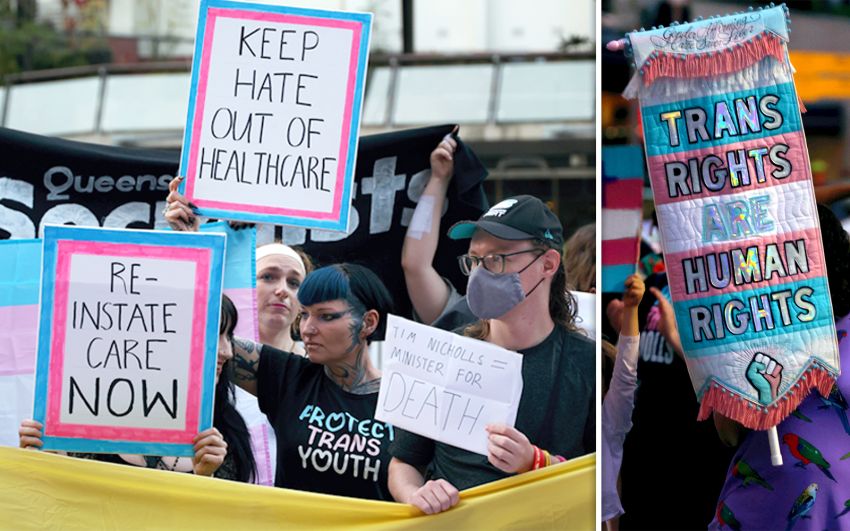
Since Trans Week of Remembrance began in 1999, it has sought to memorialise those murdered as a result of transphobia, uplift the community and highlight their struggles.
United States President Donald Trump’s efforts to erase trans people are having a global impact. State attacks on trans rights, as well as physical violence against trans people from far-right governments and groups has grown, including in Australia, where trans and gender diverse people make up just 0.9% of the population — 180,000 people.
Despite efforts to demonise this oppressed group, LGBTIQ advocacy group Equality Australia found that most Australians support trans rights. A poll commissioned before the federal election, in response to transphobic ads funded by Clive Palmer’s Trumpet of Patriots party, found 91% agreed that trans people should have the “freedom and choice to live their lives in the way that makes them happy” and 81% agreed that trans people “deserve the same rights and protections as other Australians”.
Compared to a 2020 report, it shows a significant growth in support for trans people. However, the lived experiences of trans people paint a darker picture.
A 2024 report, prepared by Gendered Violence Research Network at the University of New South Wales, looked at the prevalence of sexual violence against LGBTIQ people. It is the first comprehensive survey on the subject and included a significant cohort of First Nations respondents.
More than 3000 LGBTIQ people participated in the National Survey of LGBTIQA+SB Experiences of Sexual Violence, 28% of whom identified as trans or non-binary (SB refers to “sistergirls” and “brotherboys”, who are First Nations people with trans lived experience).
Seventy-five percent said they experienced sexual violence, either in childhood, adulthood or both. The report found that trans or non-binary people are more likely to experience sexual violence throughout their life, compared to cisgendered gay/lesbian/bisexuals.
In addition, First Nations participants, particularly trans or non-binary, experienced higher rates of recent and severe victimisation. More than 80% of the identified perpetrators of sexual violence were cisgendered men and more than two-thirds of perpetrators were heterosexual.
Fuelling Hate: Abuse, Harassment, Vilification and Violence Against Trans People In Australia, a 2023 report, looked at violence and hate against trans and non-binary people and compared the results to a similar survey in 2020. This Trans Justice Project and Victorian Pride Lobby report found that anti-trans hate was widespread and rising: 94% reported seeing anti-trans abuse or harassment online and 85% said there is significantly more online abuse since 2020. Just over half (54%) reported seeing anti-trans abuse or harassment in-person and 39% reported seeing more in-person abuse since 2020.
In the 12 months prior to the survey, 49% of trans participants reported online abuse; 47% reported in-person harassment; 15% reported physical violence; and 13% reported they had experienced significantly more physical violence. The report said hate towards trans people spiked just before and during British anti-trans lobbyist Kellie-Jay Keen’s tour in 2023.
Governments have also sought to strip back trans rights. The Queensland Liberal National Party’s ban on young people receiving gender-affirming care in the state’s public clinics was overturned by the Brisbane Supreme Court in late October. It found the ban to be “unlawful because of a failure to properly consult health executives on a decision affected by political interference”.
However, just six hours after the court’s decision, health minister Tim Nicholls imposed a new ban. The initial case was brought by the mother of a trans child who had been scheduled to begin gender-affirming care just days after the ban was imposed. She has since vowed to continue fighting.
Mothers of trans children have approached the Department of Health to obtain a “statement of reasons” about their decision-making. It replied asking for their children’s personal details including their “name, their date of birth and any other evidence which supports your child having a clinical diagnosis of gender dysphoria”.
“It feels like having to ‘out’ your child to actually get a response … it’s terrifying,” one mother told the Guardian. “My daughter is incredibly private,” another said. “She is immensely fearful of being outed in any public space.”
The LNP is seeking other ways to undermine trans people’s rights. At the LNP State Council meeting on November 7, LNP Women proposed to legislate restricting the use of toilets based on a person’s “biological” sex. The far right has used this scare tactic to whip up fear against trans people, insinuating that trans women threaten cis-women, despite evidence suggesting the opposite.
On November 1, a 25-year-old trans person was attacked by a group of youths on a tram on Kombumerri/Gold Coast. They were targeted for wearing an LGBTIQ sticker. The victim sustained facial injuries and police say they have not yet found the perpetrators.
The far right in Australia, emboldened by the Make America Great Again movement, is focused not only on blaming immigrants for the cost of living and housing crises, but has also spouted anti-trans hatred at “March for Australia” events.
At a 2023 event by Keen in Naarm/Melbourne, members of the National Socialist Network were arrested for performing Nazi salutes while Keen was addressing the crowd. This is not the first time Keen has been associated with Nazi ideologies.
Trans rights activists were again targeted by Victoria Police in August, as they attempted to protest the transphobic Women Will Speak rally on the steps of Victorian Parliament. A group of trans rights activists showed up to transphobic protest, and a few eggs and water balloons were thrown. Police deemed this to be “violence” and used capsicum spray on them, before making arrests.
[Trans awareness week is on November 13–19. Find a local event to show your support.]