-
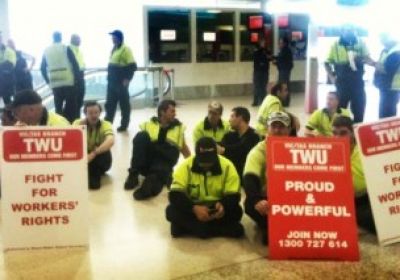
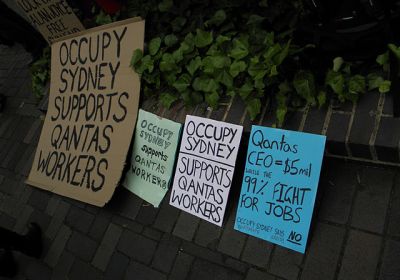
Transport Workers Union national secretary, Tony Sheldon, has condemned Qantas’s training of overseas strikebreakers after the company’s chief executive, Alan Joyce, admitted to the practice in media reports. Sheldon said in an April 5 media release: “They really need to come clean on who they are training, who is doing the training and why it has to be done in secret in another country? Why are they hiding it around the other side of the world? -
The bad news for Ohio’s 350,000 public workers is that a new law bans them from striking — the good news is at least they will no longer risk jail for doing so. A March 30 Reuters article said: “Ohio’s legislature on Wednesday passed a Republican measure to curb the collective bargaining rights of about 350,000 state employees, and Governor John Kasich said he will sign it into law.” The new law will ban unions from striking in support of public workers and limit workers’ ability to collectively bargain. -
Economists warned on March 31 that the British government’s public-sector cuts will leave a shortfall of more than half a million jobs. The New Economics Foundation (NEF) also warned that nowhere in the budget or “plan for growth“ was there “any evidence that the business tax cuts, regulatory tweaks and relatively minor changes to public-sector investment that are promised will deliver major economic transformation”. Trade Union Congress general secretary Brendan Barber said the findings showed that “in recent years, the market has become the master, not the servant, of society”.
-
About 500,000 people marched in London on March 26 against the British government’s program of huge spending cuts. Called by the Trade Union Congress (TUC), the march drew people from every part of Britain — a splendid cross section of the country with numbers dominated by the working class.
-
There has been intense activity in 2011 around the social and community services pay equity wage case pursued by the Australian Services Union (ASU) and four other unions. The claim, which was lodged in March 2010, is rapidly approaching its conclusion. Since late January 2011, there has been: • A new round of site visits, during which members of the Fair Work Australia tribunal hearing the case visited public sector workplaces to see how the work compared to that in the non-government sector. -
Migrant Trade Union (MTU) president Michel Catuira is facing visa cancellation and possible deportation from South Korea. On February 10, the Korean Immigration Service issued a number of measures against Catuira. These included the cancellation of his visa and a departure order to leave the country by March 7. It also threatened him with forcible deportation to his home country of the Philippines.
-
In a significant break through, a rank-and-file ticket — Members Voice (MV) — won the presidency in the NSW Rail Tram and Bus Union (RTBU) elections in February. Members Voice stood on a clear platform of opposition to privatisation. This was the first challenge to the ALP-controlled leadership since the 1980s. Green Left Weekly’s John Coleman spoke to incoming president Tony Clear about his vision for the union. Why did you decide to run in the elections? -
Legal action was launched on March 16 against Wisconsin’s Republican lawmakers in an attempt to repeal the anti-union bill that was signed into law on March 11. The law bans collective bargaining for most public sector workers in Wisconsin. Associated Press reported on March 16 that a legal challenge was mounted by Dane County district attorney Ismael Ozanne. AP said: “Democrats in the Wisconsin Assembly had alleged that Republican leaders did not give enough public notice that a committee planned to meet to amend the bill.”
-
About 8000 people marched on the Western Australian parliament on March 15 to demand more local jobs from the resource export boom. The Construction Forestry Mining Energy Union, Australian Manufacturing Workers Union and Maritime Union of Australia all mobilised big contingents for the protest. Manufacturing employers also supported the rally. Local workshops are sitting idle while billions of dollars of infrastructure is being imported for the mining and offshore oil and gas industries. -
The standard of living for the people of Greece has dropped dramatically since the signing of the first “memorandum” — the agreement signed by the Panhellenic Socialist Movement (PASOK) government with the IMF and European Union (EU) representatives last May. The agreement has meant — among other things — unprecedented salary cuts, a rise in the allowed number of dismissals and a reduction in termination pay, and a cut in the minimum wage for those entering the workforce. -
This appeal is reprinted from the website of the Maritime Union of Australia. You can also support the appeal launched by Europe solidaire sans frontières (Europe in Solidarity Without Borders). * * * Japanese dockworkers, seafarers hit hard by tsunami March 15 Tens of thousands of people have been rocked by earthquake, engulfed by tsunami and now, in the port of Sendai, consumed by fire. -
Wisconsin Governor Scott Walker signed into law a bill that bans collective bargaining by most of the state’s public sector workers right on March 11. High school students in the capital, Madison, walked out of school in protest the same day — the second straight day of student strikes in the city.