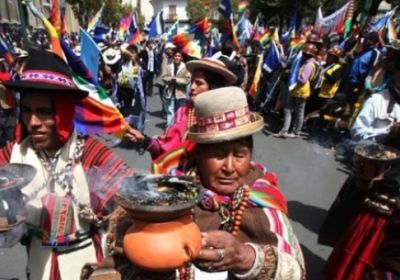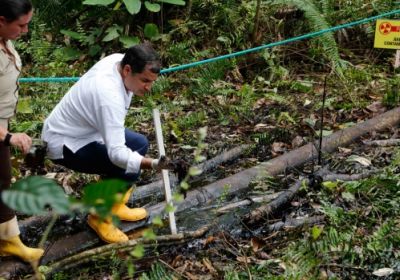
Honduran indigenous and environmental organizer Berta Cáceres has been assassinated in her home in Honduras. She was one of the leading organizers for indigenous land rights in Honduras. In 1993, she co-founded the National Council of Popular and Indigenous Organizations of Honduras, or COPINH.
-
-
On February 27, 1989, the poorest Venezuelans took over the streets in protest against price rises.
Thousands of Venezuelans took the streets in February 1989 in a wave of protests that highlighted the right-wing misrule in the South American country. The protests came to be known as the Caracazo — an uprising that began in the capital Caracas — and ultimately shaped the country's future.
-
Venezuelan President Nicolas Maduro announced the creation of a National Productive Corporation on February 22, as part of a new socialist enterprise system aimed at coordinating efforts among existing state, communal and mixed firms. Speaking from the Ana Maria Campo Petrochemical Complex in Zulia state, the socialist leader said the new entity would be tasked with unifying the more than 1000 public enterprises in a “single vision of planning, management, productivity, and maximum efficiency”. -
The “no” vote narrowly won with 51.3% of the vote in a February 21 referendum in Bolivia held to resolve whether left-wing President Evo Morales could run again in 2019.
-
Democrat presidential hopeful Hillary Clinton secured a narrow win over Vermont Senator Bernie Sanders in the Nevada caucus on February 20. The former secretary of state gathered 53% of the vote, while the self-described democratic socialist Sanders secured more than 47%. Despite his loss, Sanders proved his campaign could mobilise quickly and battle the odds. In a speech following the results, Sanders recalled that just a few weeks ago, he was 25 points behind Clinton in the polls in Nevada. "We have the wind on our backs, we have the momentum," he said. -
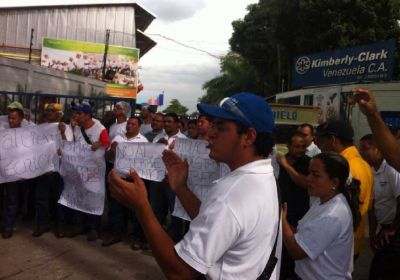
Protesters in working-class western Caracas hijacked trucks belonging to Venezuela’s number one private food chain, Polar, on February 18, demanding the company cease hoarding essential goods. The Polar food and beverage conglomerate is Venezuela’s largest private food provider, selling a range of products from beer to corn flour. But its owner, millionaire businessman Lorenzo Mendoza, has been consistently embroiled in scandal. -
A whole packet of new economic initiatives are set to take effect in Venezuela after socialist President Nicolas Maduro announced a series of far-reaching measures in response to the country’s economic crisis on February 17. In a televised five hour address to the nation, Maduro explained the extent of the economic crisis afflicting the country as well as his government’s plan to tackle it. Economic initiatives include changes to the country’s multi-tiered exchange rate, an increase in domestic petrol prices, a new tax system and expansion of community control over food distribution. -
The new Zika virus threat has caused alarm among pregnant women around the world, due to the threat of those infected giving birth to babies with microcephaly, or small brain, which can cause brain damage and mental incapacity. -
Venezuela's President Nicolas Maduro has announced the establishment of a committee to oversee the creation of a revolutionary assembly on January 23. The assembly will bring together the country's progressive social movements and socialist politicians to reinvigorate the Bolivarian revolution, Maduro said. Maduro oversaw the first meeting of an interim committee, which will lead to the creation of the broader people's congress, being called the Congress of the Homeland. About 100 people were sworn-in to the committee. -
Two recent events — the victory of right-wing candidate Mauricio Macri in Argentina's presidential election in November and the win by Venezuela's right-wing Democratic Unity Roundtable in the December National Assembly elections — have radically altered South America's political map. -
Venezuela's rate of extreme poverty has continued to decline despite what the government has described as an “economic war” by right-wing opposition-aligned business sectors. TeleSUR English said on January 17 that the latest official figures showed about 4.78% of Venezuelans now live in extreme poverty. That figure is slightly lower than those reported in November, which put the extreme poverty rate at 4.9%. -
Every year from around Christmas through to February, Argentina is wrapped in a summer trance. The usual, frenzied pitch of city centres is muffled as if by vast blankets of cotton and sticky heat. Families find reprieve from work by travelling to the coast and mountains, visiting distant family and towns in the interior. This lull often translates into a dialling-down of class struggle. There are fewer and smaller mobilisations, strikes and political activism.