-
A new magazine focused on Aboriginal rights, Tracker, was launched in Sydney by the New South Wales Aboriginal Land Council (NSWALC) on April 4. The monthly publication was co-founded and launched by former National Indigenous Times editor Chris Graham. It will feature analysis and investigation of land rights, Aboriginal issues and expose the challenges of institutional racism and discrimination across Australian society. -
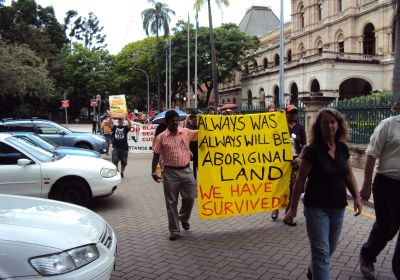
“Of the 339 recommendations of the royal commission into black deaths in custody handed down in 1991, the first people to receive funding were the police and prisons,” Murri community leader Sam Watson told an April 15 rally to commemorate the 20th anniversary of the commission. “The big bucks went to the cops and the jails. Aboriginal legal services and other Indigenous organisations only got the crumbs. Instead of decreasing the rate of incarceration of Aboriginal people, that rate has increased over the past 20 years in Australia." The rally and march attracted about 100 protesters. -
Peruvians went to the polls to elect a new president on April 10. In a first round result reminiscent of the 2006 election, the electorate has sent the previously languishing “left-nationalist” candidate Ollanta Humala (of the Gana Peru alliance) through to the presidential runoff on June 5. As in 2006, Humala will face a candidate representing elite interests: Keiko Fujimori, the daughter of ex-president and architect of Peru’s neoliberal development model, Alberto Fujimori. -
Opposition to the Brighton bypass bridge over the Jordan River in southern Tasmania escalated after the April 12 decision by the Tasmanian heritage minister Brian Wightman to give final approval for works to proceed. The bridge will destroy kutalayna, a site of 42,000 years of Aboriginal occupation. On April 14, protesters entered the site and stopped the works. On April 15, 21 people were arrested after protesters scaled the fence and entered the site in waves, stopping the work on several occasions. -
ITEC Employment and its related entity Community Enterprises Australia (CEA) are preparing a submission to the federal government that will argue “the pendulum has swung too far in favour of the jobseeker”, in relation to changes to the Community Development Employment Projects (CDEP) on Aboriginal communities, The Australian said on April 2. CEA is the largest CDEP provider in Australia. You could be forgiven for thinking that the pendulum swinging “too far in favour of the jobseeker” meant, perhaps, that people were finding work. -
Despite crisis levels of overcrowding, many urban Aboriginal communities have been denied federal funding for new housing. On March 18, ABC online said town camps around Darwin were not allocated any of the $1.5 billion in upgrades planned for Aboriginal communities. -
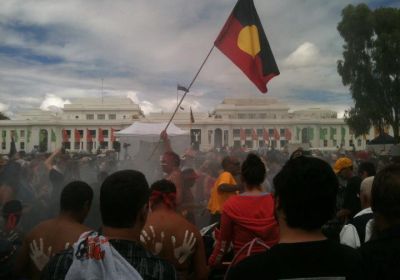
Locals from Lake Tyers, a small Aboriginal community in East Gippsland, set up a roadblock leading into their township on March 8. The action was to protest against a Victorian government-imposed administrator and call for a return to democracy in their community. The only exceptions allowed through the blockade were health service employees and school buses. -
When Australian Football League player Nathan Lovett-Murray was growing up, his favourite record was “Black Boy” by Coloured Stone. “Black boy,” goes the song, “black boy/The colour of your skin is your pride and joy/Black boy/Black boy/Your life is not destroyed.” Lovett-Murray still marvels at its power.
-
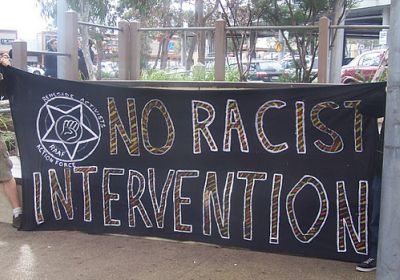
Former ABC journalist Jeff McMullen attacked the federal government’s intervention into Northern Territory Aboriginal communities as racist and harmful in a March 21 letter to indigenous affairs minister Jenny Macklin. McMullen said Macklin had “not responded to the calls by an overwhelming majority of the Aboriginal leaders in … occupied communities to end the Intervention now”. McMullen wrote in response to a letter Macklin sent him on March 2 that defended the intervention. -
Twenty people attended a meeting in Melbourne on March 23 organised by the Indigenous Social Justice Association (ISJA) in support of the family of TJ Hickey, a young Aboriginal man who died in February 2004 in the Sydney suburb of Redfern. He was impaled on a fence after being chased through the streets by a police car while riding his bicycle. Barrister Emrys Nekvapil told the meeting the case had been taken to the United Nations Human Rights Committee (UNHRC) by TJ's mother Gail Hickey.
-
Aboriginal man Mulrunji Doomadgee died in custody at Palm Island police station on November 19, 2004. His liver had been cleaved almost in two. Nearly three years later, senior police sergeant Chris Hurley told Townsville Supreme Court he had come to terms with the fact that he caused the death.
-
"There are two systems of justice in Queensland: one to protect the police service, and another to crush Aboriginal people," Sam Watson, Murri community leader, told a rally outside State Parliament in Brisbane on March 23. More than 50 people gathered to protest the decision of the Queensland Police Service and the Criminal Misconduct Commission (CMC) not to lay any charges against six police officers involved in the cover-up of the death in custody of Mulrunji Doomadgee in November 2004 on Palm Island.
Indigenous
Indigenous