
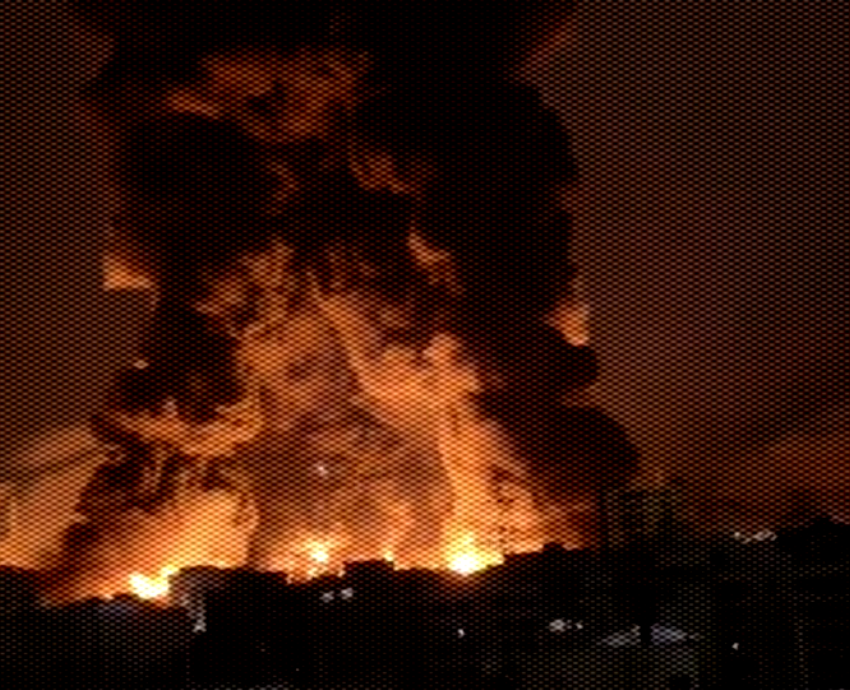
Kurds have long described the violent upheavals in their region as the beginning of a third world war. Now, this terrifying concept has become the subject of mainstream discussion, bringing fears that the “cradle of civilisation” — the birthplace of ancient societies and of the Judeo-Christian and Islamic traditions — could become humanity’s deathbed. Worse, some of those directing the 21st-century’s sophisticated killing machine, do not fear the possibility of this destruction but actively strive for the end of the world.
Those at the helm of the government, which has just launched a terrifying war of aggression, include a group of men who believe that Armageddon is the gateway to the return of the messiah. Religious fanaticism is helping to remove the final constraints from power-hungry and trigger-happy leaders.
On the other side, Iran’s theocracy supports and is supported by a brutal and unyielding oppression that has no sympathy for its citizens. However, it is the United States, the “leader of the free world” and defender of “Western civilisation”, which is bringing us all to the edge of a cliff. The US and Israel, but since Israel is bankrolled by the US, the responsibility ultimately rests across the Atlantic.
The latest tsunami of developments in the long history of US imperialism is taking the world into very dangerous terrain, and, while the upheavals this brings may eventually provide openings for more positive developments, that is far from certain.
As we look at the continuing genocide in Gaza, the imposition of centralised jihadi rule in Syria, the takeover of Venezuela, the siege of Cuba, the extension of Israel’s scorched earth tactics into Lebanon, the deliberate and callous destruction in Iran and the many threats made to other nations under the US’s might-is-right winner-takes-all philosophy, one can only conclude that for the sake of all our futures, the US juggernaut must be stopped.
In these circumstances — without in any way absolving the Iranian government of its own crimes — any collusion with the US and Israel, be it by a European government or by an oppressed minority, becomes deeply problematic, tactically, strategically and ethically.
So, where does this leave the Kurds of Iran?
Kurds in Iran
Kurds suffered under the Persian nationalism of the shah Mohammad Reza Pahlavi and his notorious secret police. They were active in the revolution that overthrew him, and when that revolution was taken over by Islamists, they continued the struggle for secularism and autonomous local democracy.
Ayatollah Ruhollah Khomeini responded to the Kurds’ refusal to accept his Islamic republic by calling for a jihad against them, and imposed state control through war and executions that cost thousands of lives. The state has maintained control through an intense securitisation of the Kurdish regions, and by a lack of economic development that has left the people struggling for day-to-day existence.
Kurds make up 8–17% of Iran’s population, but last year, Hengaw Organisation for Human Rights reported that out of 1546 people known to have been arrested or abducted by the government for political, cultural, civil, or religious reasons, nearly half were Kurds.
Even the British immigration authorities admit that “Kurds face discrimination by the state which affects their access to basic services.” And that “Kurds who are members or sympathisers of Kurdish political parties, or who are involved in Kurdish civil and cultural activities may be surveilled, arrested and detained, and charged with broadly defined security offences, often leading to lengthy prison sentences, and in some cases the death penalty.”
Iran’s Kurdish parties
Kurdish political parties have escaped Iran to organise from exile in the Kurdistan region of Iraq. In February, after months of dialogue, five of these parties announced a formal coalition, and these have since been joined by a sixth.
Despite the accusations of “separatism”, and the understandable wish by many Kurds to have their own independent country, they have agreed on the more pragmatic — though still distant — aim of autonomy within a democratic Iran. And they have expressed willingness to work with all other democratic forces who accept the principle of their right to self-determination.
These are political parties with their own militias, and they are ready to defend their land and communities with their lives, but tactically and strategically this is not easy, and they know they must choose their moment carefully. During the Women Life Freedom protests, they refrained from any military intervention, but their camps were still targeted by the Iranian military, which also put pressure on the Iraqi government to move them away from the border and reinforce border defences.
Working with the US?
The recent protests against the Iranian government, along with the US attack, generated hopes that there might soon be an opportunity for the Kurdish militias to take action. Recently, the militias were thrust into the limelight by media reports claiming that the CIA was working with the Kurds and that a Kurdish ground operation was imminent. US President Donald Trump claimed the plan to be “wonderful”. There were even reports — immediately denied — that Kurdish forces had crossed the border into Iran from the Kurdistan Region of Iraq.
If, as suggested by Ezgi Başaran on Turkey recap, these well-publicised “leaks” were intended to pressure the Kurds into a fait accompli, the plan failed. Kurds could not be persuaded to embark on what many saw as a suicide mission that had been called for their own interests by a US government Kurds had learnt not to trust.
Occasionally, like a broken clock that sometimes shows the correct time, the US empire has acted on the right side of history. But Iran is not Syria — where, without US help, Kurds faced probable death at the hands of ISIS — and even in Syria, Kurds have again discovered the truth that the US acts only in the perceived interests of its own elite, and has no concern for allies they consider no longer useful.
Concerns were not limited to the Iranian Kurdish groups. The leaders of the Kurdistan Region of Iraq protested that they would not allow such a border crossing, which would make their region into a target for Iran. The wife of Iraq’s president spoke for many Kurds in an open letter headed “Leave the Kurds alone. We are not guns for hire.” She detailed examples of past broken promises, concluding, “it is very difficult, indeed impossible, for Kurds to accept being treated as pawns by the world’s superpowers”.
Within days, Trump had made one of his abrupt turns and was claiming that he didn’t want the Kurds to go in and “make the war more complex than it already is”. He would have felt the need to make this seem to be his decision, but perhaps he had also heeded warnings that such a strategy would solidify Persian nationalism and alienate Iraq and Turkey; and he had received a phone call from Turkey’s foreign minister.
Targets of war
Although the Kurds have not taken action, they have been targeted by Iran and Iran’s Iraqi militias. Rudaw reports that “The Kurdistan Region [of Iraq] has been targeted by 294 drones and missiles during two weeks of war… killing six people and wounding 35 others.” The dead included four fighters from the Iranian Kurdish groups, and a further 14 fighters have been wounded. Rojehlat Info gives the names of five Iranian Kurdish fighters killed by Iran’s attacks on their camps.
Inside Iran, where the heavily militarised Kurdish region has come under repeated US-Israeli fire that has destroyed many military installations, regime forces have been installing themselves in civilian buildings, such as schools, mosques, and sports halls, exposing the whole population to potential attack. Border areas of Kermanshah are being taken over by the military, forcing hundreds of nomadic families to migrate to the summer pastures while the weather is still dangerously cold for their animals.
Hengaw has been trying to keep a tally of the deaths caused by US-Israeli attacks. It reported 390 recorded civilian deaths up to March 10 (including the schoolchildren killed the first day). More than 50 of these deaths were in the Kurdish areas.
Leading figures within Iran’s Kurdish coalition do not rule out working with the US provided they are given air cover and guarantees against abandonment. Asso Hassan Zadeh, a prominent member of the Kurdish Democratic Party of Iran, told Amberin Zaman for Al-Monitor “the information I have suggests that a form of partnership between Iranian Kurdish political forces and the Americans is still on the agenda”.
For the Free Life Party of Kurdistan (PJAK), which has bases hidden deep in the mountains and already has many fighters inside Iran, Rewar Abdanan told the BBC’s Jiyar Gol: “So far, we have not received any weapons or support from the US. We maintain some level of contact with the US government but the actions of international coalitions, particularly the US who abandoned the Syrian Kurds, have raised doubts and concerns among us.”
Another PJAK leader Fuad Beritan told the Wire “We have no illusions about any power in the world. Naturally, every country pursues its own projects and interests. We Kurds also pursue our own struggle and the freedom of our people… we rely first and foremost on our own inherent strength and the capacities of our people.
“At the same time, we consider diplomacy and different alliances … we do not see dialogue or even partnership with the United States as contradicting our interests.”
He stated that they “do not have direct contact with Israel ... at present”, but that, “Israel is an important actor in the region” and “as a political principle, dialogue with Israel is not unusual”. For Beritan, it is the Islamic Republic that “has become a threat to regional and global peace and security”.
From a base in the mountains of the Kurdistan Region of Iraq, Duran Kalkan, a leading figure in the now officially dissolved Kurdistan Workers’ Party, takes a more critical perspective. He described the war as a clash of similar mindsets that was being carried out for hegemony, profit and influence, and that it has no benefit for the people of the Middle East. He stated that Kurds are “not in a position to be anyone’s soldiers or instruments of anyone’s interests”.
He asks, “Let’s assume the attacking forces, the US and Israel, win. What will change? Israeli hegemony and US influence will replace Iranian sovereignty. Will it be more democratic, more peaceful, more liberal? No … Say Iran survives the attack, gains strength, and remains standing. What will happen then? It will return to the past, and we know what that past is.”
He calls on the Kurds of Iran not to “focus solely on Rojhilat”, the Kurdish region in Iran, but to “see the freedom of Rojhilat’s Kurds as part of Iran’s democratisation”, and “build friendships and alliances to democratise Iran”.
“The real danger is the nationalism of the nation-state and racist chauvinism, which pits … peoples against each other. Kurds must stay away from that.”
For now, the Kurds continue to wait and watch.
[Reposted from News From Kurdistan. Sarah Glynn is a writer and activist — visit her website and follow her on Twitter or bluesky.]