
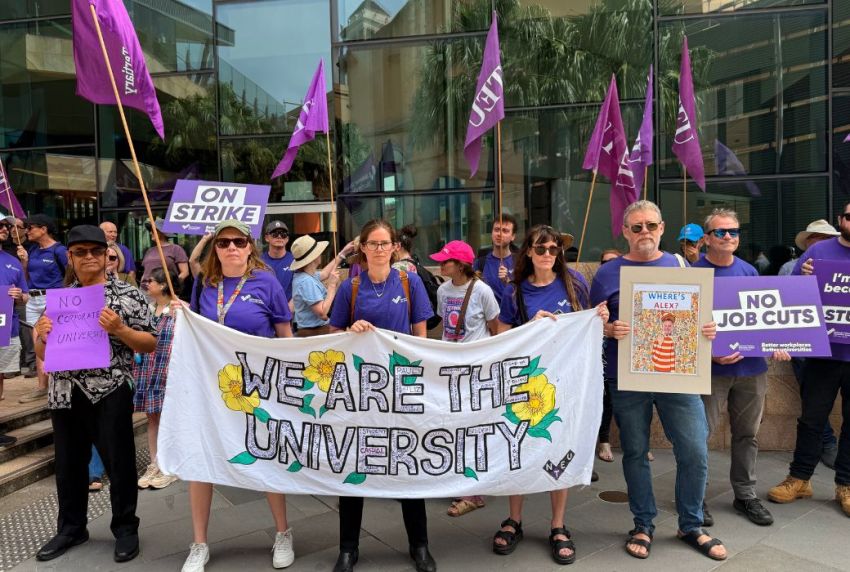
Members of the National Tertiary Education Union (NTEU) at the University of Technology Sydney (UTS) went on strike on March 19 to demand improved job security and pay.
After six months of bargaining, the NTEU said UTS management came back with clauses that undermine workers’ rights. It ignored requests for modest improvements to workloads, governance and job security and even refused to provide a pay offer, let along one that matched inflation.
Industrial action was organised, with the union saying the strike is part of broader efforts within the tertiary education sector to secure better working conditions for academic staff.
University of Newcastle (UoN) staff rallied outside NUspace on March 18, escalating industrial action as negotiations over pay and conditions remain unresolved after more than a year.
NTEU members walked off the job for 24 hours and called on university management to finalise a new enterprise agreement. NTEU Newcastle branch president and associate professor Terry Summers said while progress had been made, several important issues were not resolved, according to the March 18 Newcastle Weekly.
Summers said staff had been left with limited options, describing industrial action as one of the few remaining choices available to push negotiations over pay and superannuation, particularly for part-time staff.
“We’ve got very few levers to pull,” Summers said, saying that conditions between casual and permanent employees were inequitable. “At this university … we get 17% and our casuals get 12% … that means there is a 5% gap. You’ve got the same person, the same job, same qualifications … getting paid effectively less. That is inequitable as far as I’m concerned and it has to be fixed.”
Summers said if university management won’t come to the table “obviously the staff will get even more upset”.
Meanwhile, the Federal Court on March 17 overturned a decision from last year that found that award-covered casual academics could be required to perform unlimited marking as part of the “rolled-up” hourly rate they receive for lecture and tutorial delivery.
The appeal judgment confirmed universities cannot use casual lecture and tutorial pay rates as a bottomless pit for unlimited unpaid marking work.
Thousands of casual academics are owed millions of dollars in back pay after the NTEU intervened in the appeal between the Fair Work Ombudsman and Torrens University.
The ruling clarifies that how much “associated working time” a casual academic works is a matter for them to determine, rather than the employer.
NTEU General Secretary Dr Damien Cahill described this as a “massive victory for the tens of thousands of casual academics who are victims of wage theft from doing hours of unpaid work.
“Last year’s decision threatened to unravel a decade of progress on tackling wage theft in our universities. This ruling slams that door shut,” Cahill said. “This decision puts vice-chancellors on notice: the days of treating casual staff as an endless source of free labour are over.”