In April 1915, in the midst of a stalled military campaign on the Western Front, Britain and its allies attacked Turkey’s Gallipoli Peninsula in an attempt to gain control of the Dardanelles Straits and take German-allied Turkey out of World War I.
This impressively researched volume, which relies extensively on unpublished first-hand accounts from soldiers of all sides of the conflict, is a detailed account of this “doomed” and “pointless” campaign.
-
-
The NATO attack on Libya was debated at a meeting sponsored by the Castan Centre for Human Rights Law in Melbourne on April 20. Don Rothwell, a law professor at the Australian National University, argued that the intervention is consistent with the doctrine of "responsibility to protect". This doctrine, adopted by the United Nations General Assembly in 2005, endorses outside intervention to protect people from genocide, crimes against humanity or war crimes carried out by their own government. -
Shortly after the end of World War I, Australian troops bloodily suppressed a popular independence revolution in Egypt. This overlooked episode in Australia’s military history has never prompted much national soul-searching — but it should. The war in which some 60,000 Australians died was supposedly fought for liberal democratic values and the right of peoples to pursue national “self-determination”. Episodes like the Egyptian revolt suggest that a squalid imperial reality underlay the noble rhetoric, which is why it has been relegated to obscurity. -
Richard Seymour (“Libya: Spring time for NATO”, GLW #876) has done an admirable job debunking justifications of “humanitarian” wars and its defenders. But his analysis of the internal dynamics of Libya leads him astray — so much so that bold assertions are taken as facts with nothing to back it up. He says the co-option of the Libyan revolution by NATO is a victory for reaction. Then he says it is no good hoping that the militias will shake themselves free of such constraints if they take power.
-
The Euro-US attack on Libya has nothing to do with protecting anyone; only the terminally naive believe such nonsense. It is the West’s response to popular uprisings in strategic, resource-rich regions of the world and the beginning of a war of attrition against the new imperial rival, China. US President Barack Obama’s historical distinction is now guaranteed. He is the US’s first black president to invade Africa. -
Two wars are being waged simultaneously in Libya. One has grown out of a revolutionary struggle for democracy. The other is an attempt by imperialism to strengthen its domination of the country. Both wars appear to share the goal of “regime change”, but they stand at opposite ends of the political spectrum. The regime change that the revolutionary struggle seeks to achieve is the overthrow of the Muammar Gaddafi dictatorship and the establishment of a system of democratic rule.
-
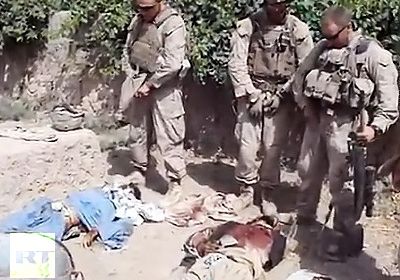
The disgusting and heartbreaking photos published in March by the media are finally bringing the grisly truth about the war in Afghanistan to a wider public. All the PR about this war being about democracy and human rights melts into thin air with these pictures of US soldiers posing with the dead and mutilated bodies of innocent Afghan civilians. I must report that Afghans do not believe this be a story of a few rogue soldiers. We that is part and parcel of the entire military occupation. -
We now know what Washington’s model is for the Middle East, in its most attractive guise. In answer to Egypt’s Tahrir Square uprising, they have smoking craters filled with the charred remains of rebels, conscript soldiers, civilians and other blameless people who must have seen the joy in Egypt and Tunisia and wished it for themselves. In answer to the turbulent, democratic republic, with its tumult of leftist, Nasserist, Islamist and liberal currents, they offer a prolonged civil war at best, culminating in a settlement with Muammar Gaddafi’s son Saif and his sibling. -
The online journal Links International Journal of Socialist Renewal is hosting a series of commentaries from left-wing groups and commentators from around the world on the crucial question of whether or not to support the US-NATO military intervention in Libya.
-
The US-NATO intervention in Libya, with United Nations Security Council cover, is part of an orchestrated response to show support for the movement against one dictator in particular. In doing so, it aims to bring the Arab rebellions to an end by asserting Western control, confiscating their impetus and spontaneity and trying to restore the status quo. It is absurd to think that the reasons for bombing Tripoli or for the French airforce’s “turkey shoot” (the bombing of fleeing Libyan soldiers) outside Benghazi are designed to protect civilians. -
See the activist calendar for details of screenings in your city. John Pilger’s latest film, The War You Don’t See, looks at the power wielded by journalists reporting conflict. It examines the responsibility of the media in justifying and supporting the wars our governments wage. Pilger asks: “What is the role of the media in rapacious wars like Iraq and Afghanistan and how are the crimes of war reported and justified? “Those whose job it is to keep the record straight ought to be the voice of people, not power.” -
The hypocrisy, double standards and selectivity displayed in the Western military action in Libya defy enumeration. In Yemen and Bahrain, Western-backed regimes are violently repressing the democracy movement the West claims to back in Libya. In Iraq, a US-sponsored regime protected by 47,000 US troops is trying to do the same —shooting demonstrators, detaining thousands and subjecting many to torture.