For every dollar the Australian government spends on cutting carbon pollution, it spends $11 encouraging it, new research from the Australian Conservation Foundation (ACF) has revealed.
ACF said on March 1 that its analysis showed: “The Australian government spends $11 billion more on subsidies that encourage greenhouse pollution than it does on programs to tackle climate change.”
-
-
About 6000 people rallied outside PM Julia Gillard’s Melbourne office on March 12 for an emergency action on climate change. The rally was organised by GetUp! Publicity for the rally did not explicitly refer to the proposed Labor/Greens carbon price. But at the rally itself, the organisers campaigned for the carbon price plan as the most effective way to deal with climate change. Many at the rally had concerns with the proposed carbon tax, but mobilised in spite of this to call for urgent climate action.
-
Many millions of tonnes of coal have been exported since activists dubbed the Rising Tide Seven temporarily shut down coal loaders in Newcastle in September last year. They were convicted on January 31 of “remaining on enclosed lands”. Each was fined $300, plus $79 in court costs. However, on March 3, they were vindicated when magistrate Elaine Truscott rejected the Port Waratah Coal Services’ (PWCS) $525,000 “compensation” claim. -
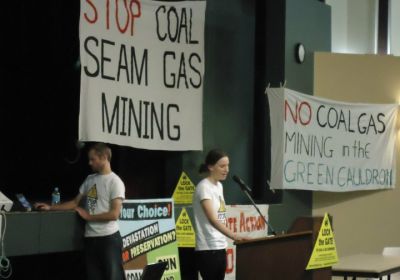
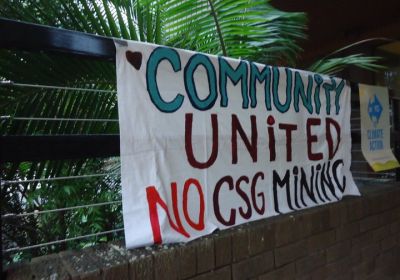
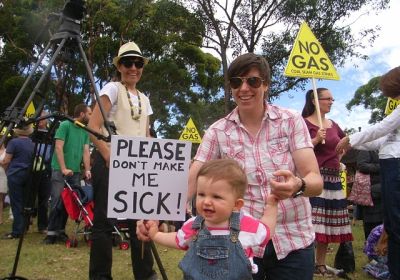
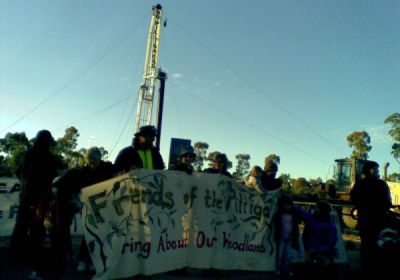
The Greens candidate for Heathcote in the NSW elections, Phil Smith, has renewed his party’s call for a moratorium on coal seam gas mining in the state. He said gas extraction poses real risks for communities throughout the Heathcote electorate, a seat that spans from southern Sydney to the northern Illawarra. The Labor state government recently approved 15 coal seam gas wells in the northern Illawarra region. “The Greens are leading the call for an immediate moratorium,” Smith told Green Left Weekly. -
In a joint statement on February 25, indigenous communities that make up the Native Federation of Madre de Dios River and Tributaries in south-eastern Peru rejected a military crackdown on illegal mining on their lands. The statement said it was a “false solution to a problem that has social and economic roots”. Environment minister Antonio Bracks authorised the operation in mid February —involving about 1000 police and infantrymen — to destroy illegal mining equipment including bombing of dredges.
-
When the Kyoto Protocol was being negotiated in 1997, the European Union opposed the United States’ proposal to introduce carbon trading and “offsetting” as a form of compliance with mandated greenhouse gas emissions reductions. Instead, the EU favoured coordinated policies and measures. But by 2001, when the US unilaterally abandoned climate negotiations, the EU had already reversed its position and enthusiastically supported delivering the fate of climate policy to a speculative market. -
Victorian Premier Ted Baillieu announced on March 1 that the government would push ahead with the unpopular plan to build Australia’s largest desalination plant in Wonthaggi. This is despite pre-election promises that he would re-examine the contract with Aquasure, the private consortium commissioned to build and operate the plant, which was approved under Labor premier John Brumby in 2007. According to the Age on March 1, the eventual price tag is "$24 billion that is expected to double household water bills over the next five years". -
The casual observer might easily conclude that there are just two clear sides in the parliamentary debate over the Labor/Greens carbon price deal. But there is a lot more to the debate than this. Clearly the Greens are in favour, and appear to have won over PM Julia Gillard’s government to an interim carbon tax. On the other hand, opposition leader Tony Abbott has promised a Tea Party-style uprising against it. Abbott will push to rouse a fascistic “people’s” movement to try to bury the deal. -
The statement below was released by the Socialist Alliance on March 6. * * * The carbon price framework recently agreed to by the ALP and the Greens is a step in the wrong direction. This is not because, as the Coalition says, the economy — read the profits of big business — cannot afford to cut emissions. It’s because the framework will be counterproductive to real action on climate change. The highest prices now being discussed will simply stimulate a mass rollout of gas, extending Australia's commitment to fossil fuels at the expense of renewable energy. -
More than 80 people attended an at-times heated meeting on March 3 organised by Illawarra Residents for Responsible Mining (IRRM) in Russellvale, north of Wollongong. The meeting was held across the road from the entrance of Gujarat NRE’s number 1 colliery. This meeting doubled as a meet-the-candidates event for the NSW state elections and a question and answer session about Gujarat NRE’s plans to expand coal production. Representatives of the mine attended the meeting. -
Don’t believe the hype. The carbon price deal announced by Labor and the Greens on February 24 is not a breakthrough and does not set Australia on a path to a zero-carbon future. Rather, it entrenches a framework that puts market forces at the heart of Australia’s response to the climate emergency. It’s a step in the wrong direction. The full details of the deal — including the price and compensation measures — are yet to be finalised. But the agreement made clear the scheme will begin by mid-2012 and become a fully-fledged emissions trading scheme three-to-five years later. -
Under heavy public pressure, the South Australian government of Labor Premier Mike Rann appears to be wavering in its support for mining uranium in the Arkaroola wilderness in the state’s north. On February 18, the Adelaide Advertiser gave front-page headlines to reports that Arkaroola, a privately-held nature sanctuary and ecotourism site in the Flinders Ranges about 600 kilometres north of the state capital, could be declared a national park.