
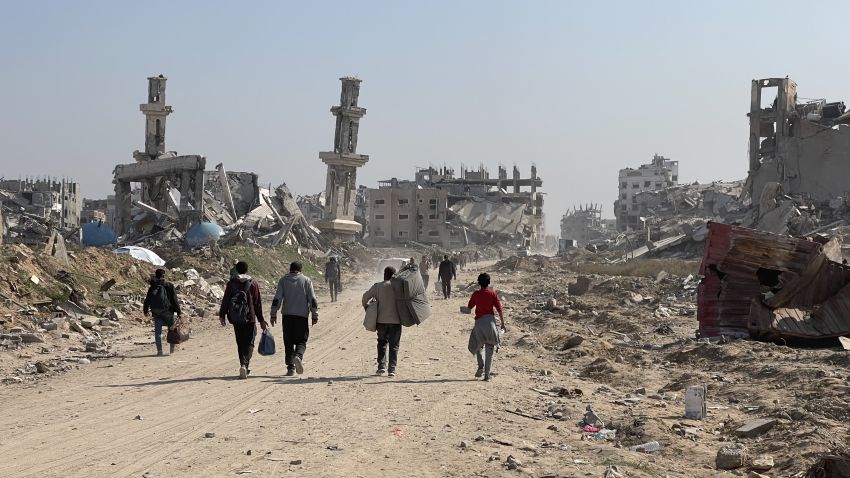
United States President Donald Trump’s Board of Peace, ostensibly to oversee the reconstruction of Gaza, was always problematic, given US complicity in Israel’s genocidal campaign in the Strip.
Trump has put himself at the helm of the handpicked corporate overseers to “revive” a pulverised enclave. The envisaged structure of control over Gaza, seen as part of fulfilling Trump’s 20-point plan for the territory, opens the second phase of the peace process.
To what end? We already have a sense of how the pantomime will unfold.
The board comprises billionaires and pro-Israel figures, with Bulgarian diplomat Nickolay Mladenov being named its “High Representative”.
A Gaza Executive Board will work with the Office of the High Representative and a Palestinian technocratic body, the National Committee for the Administration of Gaza (NCAG).
The White House said the NCAG will be led by technocrat Ali Sha’ath, formerly of the Palestinian Authority, who will be charged with restoring core public services, the reconstruction of civil institutions and “the stabilization of daily life in Gaza, while laying the foundation for a long-term, self-sustaining governance”.
It includes Trump lieutenants Secretary of State Marco Rubio; and Middle East envoy Steve Witkoff; son-in-law Jared Kushner; and former British Prime Minister Tony Blair, a figure never indicted for the crime against peace for his role in the 2003 invasion of Iraq.
The charter of the Board of Peace, a copy of which was circulated to dozens of heads of state with invitations to join, carries a fee of US$1 billion for those seeking a permanent seat. Those not wishing to provide the fee can serve for three years.
The document is notable for what it does not say; Gaza does not make it into the text and neither does the United Nations. It does, however, speak about the need for “a more nimble and effective international peace-building body”, which looks like a stab at the United Nations. It states that to make peace durable, it was important to have “the courage to depart from … institutions that have too often failed”. Why such institutions fail is not considered.
Israeli Prime Minister Benjamin Netanyahu was angry that Turkey and Qatar were invited to the Gaza Executive Board. “The announcement regarding the composition of the Gaza executive board, which is subordinate to the Board of Peace,” said the PM’s office “was not co-ordinated with Israel and runs contrary to its policy”.
On January 19, in an agitated debate in the Knesset, Netanyahu was adamant that involvement by Ankara and Doha would not be military in nature: “Turkish or Qatari soldiers will not be in the Strip.”
These sentiments are seemingly misplaced, given that Qatar lacks a force suitable to make such a contribution.
Netanyahu also insisted that both countries would be denied any authoritative role, or have any influence on the various bodies, despite Trump’s willingness to include Turkish and Qatari representatives on the Gaza Executive Board.
Netanyahu insisted that standing up to Washington was something he was good at. “When it comes to Israel’s essential interest, we can argue, we can sharpen our positions, and, by the way, we can come to agreements.”
This did not convince Yair Lapid, opposition leader and chair of the Yesh Atid party. As with most Israeli politicians, the idea that Palestinians must achieve sovereignty remains inconceivable and abhorrent.
Allies of Hamas, Lapid complained, “have been invited to run Gaza”, while the “dominant factor” of the Palestinian technocratic committee was the Palestinian Authority.
This suggested one of two possibilities: either Netanyahu had slyly “agreed behind our backs that Turkey, Qatar, and the Palestinian Authority would be in Gaza” or he had been ignorant of their inclusion, in which case “Trump doesn’t give a damn about you”. Israel was “returning to Gaza, not at the starting point, but to a point much worse than at the beginning”, Lapid said.
Those worried about this venture displacing the UN (Julien Barnes-Dacey, of the European Council on Foreign Relations, is of this view) should think again.
Chaos seems imminent, with the board looking much like a waxwork effort likely to melt when heat is applied. Narcissism lies at its core and may well die with it.
[Binoy Kampmark lectures at RMIT University.]