
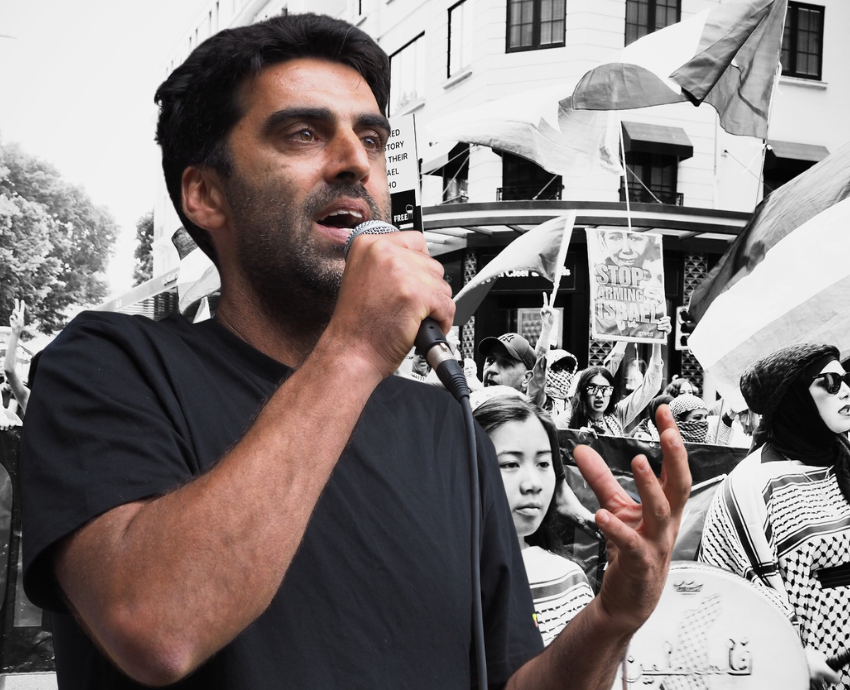
Surya McEwen was one of hundreds imprisoned by Israel in October after participating in the Global Sumud Flotilla to Gaza. He told the Green Left Show that when he realised that people were “going to be sailing directly into the holocaust”, he felt it was his “historic duty” to get involved.
“It felt like a potential rupture moment, just after South Africa had taken Israel to the ICC [International Criminal Court] for genocide, and had the potential to open up possibilities for liberation for Palestinians.”
He said the genocide was “as horrific as it had ever been, but it also felt like there was hope in the global movement that hadn’t existed before”.
The flotilla aimed to deliver urgently needed humanitarian aid to Palestinians in Gaza, who are starving at the hands of Israel’s blockade and siege.
More than 40 vessels with 500 participants on board from at least 44 countries participated in the flotilla, including high-profile activists such as Swedish climate activist Greta Thunberg, French MEP Rima Hassan and Mandla Mandela, the grandson of Nelson Mandela.
McEwen was one of seven participants from Australia, alongside Madeleine Habib, Abubakir Rafiq, Hamish Paterson, Juliet Lamont, Bianca Webb-Pullman and Dan Coward.
McEwen said it was amazing to have 500 people coalescing to try to break Israel’s siege. “It functioned on two different levels — we were trying to bring in aid and break the siege but we were also trying to open up possibilities for the global movement.
“We got closer than anyone has gotten to the shores of Gaza for 18 years. I was on the Mia Mia, which got within 26 nautical miles of Gaza.
“We spent about nine hours at night ducking and weaving around Israeli military vessels. The captains on that ship were so amazing, we avoided water cannons and sound bombs and interceptions from different boats.
“I felt like if we got to sunrise, we would make it, and we got to sunrise and I was speaking to some comrades on the shore who had come to meet us. It was a very euphoric, beautiful moment.”
The flotilla set sail in late August and was intercepted by Israeli forces over October 1–2, with hundreds of participants detained for several days in prison then deported.
McEwen was abused by Israeli officers who destroyed his passport, slammed his head into a concrete floor and dislocated his arm. Others, including Thunberg, have also spoken out about their horrific treatment in Israeli prisons, including being beaten and left without food and medication.
Lamont told the ABC that the Australian government had been “absolutely shameful” and had “not really supported us at all”.
International solidarity
Despite the brutal treatment, and the disappointment that they didn’t reach Gaza, McEwen said the flotilla had an impact on the solidarity movement internationally.
“Italy sent a vessel — which was basically a surveillance operation for Israel — but the work of comrades in Italy to shut the country down created a scenario where [Italian Prime Minister Giorgia] Meloni’s pro-Israel government was forced to concede to the movement in some way.
“Forcing governments to act who don’t want to act, or creating space for governments who do want to act but won’t act alone, was one of the biggest successes of the flotilla.”
McEwen said the flotilla also helped to train a new layer of activists and build links between campaigners around the world. “It helped contribute to a new internationalism, which has been eroded over the past 40 years.”
He said the Palestine movement is helping build practical links between various movements to begin to tackle important issues that have taken on a global dimension.
In Australia, he said, it is important to continue to unite various strategic perspectives to work together in a broad movement that allows space for tactical differences. “We need a sense of communal solidarity.
“Some people are very new to things, we have to invite people in and encourage them to do more, rather than repelling people.”
McEwen said Israel and the United States are sensitive to public opinion and that, without the ongoing protest movement, the so-called “peace plan” would not have been implemented.
“Hundreds of thousands of people came to the Harbour Bridge march, in part because of the long-term efforts of activists to build the movement, but also because images of starvation were coming out of Gaza.
“The extreme effects of Israel’s deliberate starvation program were coming into popular consciousness, and very soon after that, they pivoted away from that.”
He said the peace plan is another pivot to shift public opinion from the idea of Israel committing a genocide. “The genocide is ongoing in a different form. The so-called ceasefire agreement is a way to enable the genocide to carry on without having to deal with the intense battle with the resistance factions.”
He said the movement has to find strategic ways to inform people that the genocide is ongoing without “banging our heads against the popular consciousness”.
“Coalescing around the long-term struggle against Israel’s brutal military occupation and apartheid, in a similar fashion to what happened in South Africa, will be the freedom struggle towards a democratic, equal state in historic Palestine.”
McEwen said the next flotilla will take place between March and May next year. “It is going to be bigger, stronger and better organised in lots of ways.
“We had 30,000 people express interest in being on a boat this time, now it is hundreds of thousands.”
He said the best way to support the next flotilla is continuing to strengthen the movement here. “What’s happening at sea is only meaningful to the extent that it is reinforced by and opens up opportunities for the global movement.
“The main responsibility is stopping our power structure from propping up and supporting Israel.
“Let’s get closer to the point where, when we are at sea, we can shut Australia down in the way that the Italian comrades did.”