-
“In a few short months,” principle speaker for Left Unity Salman Shaheen said in a March 31 New Statesman article, the new party “has attracted more than 1,800 members. With a new member joining every 10 minutes over the weekend, the party is going from strength to strength.”
-
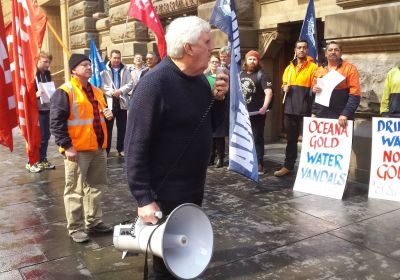
Federal minister for the environment Greg Hunt faces two big threats to waste reduction in Australia, but appears not to be aware of the problems. Hunt boasted on March 6 about the effectiveness of the National Television and Computer Recycling Scheme. Australia had recycled “the equivalent of four Eiffel Towers in weight” of used televisions, computers and other electronic waste, he said. However, growing piles of e-waste on the ground in Queensland show that Hunt is out of touch with reality. Australia is amassing e-waste with no plan for recycling it. -
A decision by the Fremantle City Council at its March 26 meeting to reject a Main Roads WA request to voluntarily hand over land began a dramatic new phase in the campaign against the state government's freeway building agenda. The state government wants to replace a section of High Street on the eastern approach to Fremantle with a freeway at a cost of more than $100 million. This is intended to be the first link in their plan to build a six lane "freeway standard" route connecting the Kwinana Freeway to the Fremantle container port. -
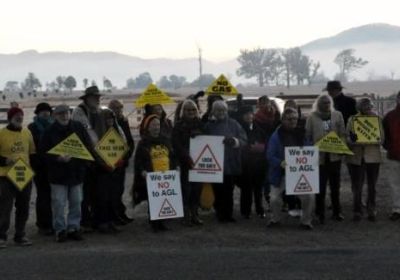
NSW Premier Barry O’Farrell implemented a six-month freeze on processing new applications for coal seam gas (CSG) exploration licences on March 26. At the same time, the minister for resources and energy, Anthony Roberts, announced that the licence application fee would increase from $1000, set by the ALP state government in 2002, to $50,000. Roberts had earlier refused five CSG exploration licence applications sought by Grainger Energy which, covered 43,000 square kilometres of land in the Riverina.
-
The Great Barrier Reef is almost certainly going to suffer permanent damage due to coral bleaching if countries do not act to reduce carbon emissions, the Fifth Assessment report by the Intergovernmental Panel on Climate Change (IPCC) said on March 31. A lead author of the report, Chris Field, told the ABC’s 7.30: “Warm water coral reefs are one of the world's ecosystems that's most threatened and especially threatened by the combination of a warming climate and acidification of the ocean waters.” -
The campaign against Melbourne's East West Tunnel received a boost when about 1500 residents and members of community groups rallied in Brunswick on March 30. The rally sent a strong message to the Denis Napthine government that the project should be scrapped and the money be spent on expanding Melbourne’s public transport system. The rally was organised by Moreland Community Against the East West Tunnel (MCAT), a grassroots community organisation supported by the council. -
Mainstream media coverage of the first round of France's March 23 local elections stressed the rise in support for the far-right, racist National Front (FN). The only other stories found worthy of comment were the sharp decline in support for the ruling Socialist Party (PS) of president Francois Hollande and the rise in abstention to a record 36.5%. -
With Newmont-Buenaventura set to resume building operations at the controversial Conga mine site this year, the Peruvian government has passed a new law granting legal immunity to security personnel who injure or kill protesters. The promulgation of Law 30151, which was officially gazetted on January 14 after being signed by President Ollanta Humala, indicates the state and its transnational corporate backers are planning an expanded campaign of repression against Peruvian communities resisting their neoliberal development model.
-
“Ecological strain” and “economic stratification” could lead to the global fall of modern civilisation within decades, researchers warn in a disturbing new study sponsored by NASA's Goddard Space Flight Center. History shows that “complex, advanced civilizations” from the Roman to the Han empires are capable of collapse, note the authors, who hail from the Universities of Maryland and Minnesota.
-
New Caledonia, a French-administered archipelago in the south-west Pacific, passed a law on February 13 banning the importation of genetically modified seeds for cereals and fruits. Vegetables, however, are exempt from the law. A proposal for mandatory labelling of GMO products is still to be approved by the Congress. -
The March in March protests across Australia over March 15-17 were a resounding success – not just because of their size, focus and breadth. Just as significant is the fact that March in March tore apart the idea – seeded by the cynical rhetoric of John Howard's spin doctors in the wake of the invasion of Iraq – that protests don't work. This protest worked precisely because it brought between 80,000 and 110,000 people out of their homes and into the streets in a disparate yet united way against the Tony Abbott government's attacks. -
Community gardeners were stunned when AusVeg, the peak body for the vegetable industry, publicly welcomed the federal government’s cut in funding the Food Grants Program. Mentioning “biosecurity risks” and “food safety concerns”, AusVeg spokesperson William Churchill said the program “has been identified as a potential risk to the national horticulture industry”.
Environment
Environment