“Forgetting Fukushima makes it more likely that such a nuclear disaster could happen elsewhere,” said Tatsuko Okawara, one of the hundreds of thousands of victims of the Fukushima accident that began on March 11, 2011.
The nuclear industry, however, is trying its hardest to make us forget. It is downplaying the impacts of the accident, ignoring the fact that the Fukushima reactors are still not under control and claiming that lessons have been learned. Nothing is further from the truth.
-
-
The Biggest Estate on Earth: How Aboriginal people made Australia Bill Gammage 434pps, $40 Allen & Unwin, 2012 This is an extraordinary book that details how Australian Aboriginal people cared for the land, or as Bill Gammage calls it the “Biggest Estate on Earth”. Gammage describes, with many examples, how Aboriginal people looked after the land. No corner was ignored, from deserts and rainforests to rocky outcrops, across the entire continent for at least 60,000 years until British colonisers began to destroy all this work after their arrival in 1788. -
The dangers of global warming due to greenhouse gases in the atmosphere is well-established. But there is more damage done by the capitalist system of production, including the release of toxins into the atmosphere, water and the rest of the biosphere. Two notable examples have occurred in the first months of this year in the United States. In January there was a huge spill of 10,000 gallons of crude MCHM, a chemical mixture used in the coal production process, into the Elk River near Charleston, West Virginia. -
Modestly describing herself as “Australia's richest intellect”, Gina Rinehart has launched a new intervention into Australian politics that is calling for a cut in government spending and other measures to make private corporations “thrive”. True, she is not calling for an end to government subsidies to the mining industry. She is not calling for an end to corporate welfare and she's not calling for a reduction in wasteful military spending. -
A New York judge has overruled the US$9.5 billion (A$10.5 billion) in compensation for toxic waste dumping that Chevron had been ordered to pay to Ecuadorian villagers. The oil company, the world’s third largest, was found guilty in 2012 by an Ecuadorian court of causing huge environmental damages in the Amazon Basin. At the time, it was the largest environmental damages lawsuit ever. Texaco oil company, which merged into Chevron Corporation in 2001, operated in the Sucumbios province of Ecuador, in the uppermost headwaters of the Amazon Basin, from 1964 to 1992. -
Events were held around the country on March 11 to mark three years since an earthquake and subsequent tsunami laid waste to the north-east coast of Japan. The earthquake and tsunami disasters killed 18,600 people and about 2700 bodies have never been recovered. The disaster damaged the Fukushima nuclear power plant, whose cooling systems failed, leading to a series of explosions and catastrophic meltdowns in three reactor cores. More than 150,000 people who were forced to evacuate the area are still unable to return to their homes in the Fukushima region. -
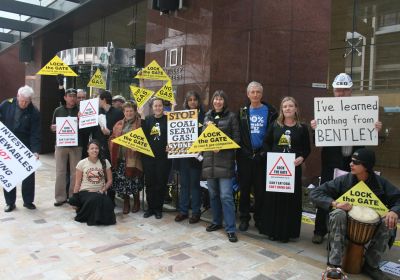
Coal seam gas (CSG) company Santos has admitted to polluting an aquifer in north-western NSW with uranium, the Sydney Morning Herald reported on March 8. The incident is the first recorded groundwater contamination in Australia from CSG operations. -
Community opposition may soon put fracking on hold in the Kimberley region of north-western Australia. This could culminate in the first big victory for the anti-fracking movement in Western Australia. Buru Energy, partnered with Mitsubishi, intends to frack four wells east of Broome 34 times this year, starting in May. This is the largest single fracking proposal to be put forward in Western Australia so far. The area is a wetland used by Aboriginal owners. -
The Universal Declaration of Human Rights provides that “everyone has the right to work, to free choice of employment, to just and favourable conditions of work and to protection against unemployment.” Yet one of the defining features of latter-day capitalism is the extraordinary levels of youth unemployment. Across the eurozone, youth unemployment is about 25%. In Spain it is almost 58%.
-
First there was climate denial. But the mocking laughter of the informed public – along with the indignation of the scientists – finally reached the energy-company boardrooms. So now instead we get the non sequitur. That’s Latin for “it doesn’t follow”. Rather than lying outright, the fossil-fuel chiefs make nakedly contradictory statements and count on us not to notice. -
“Forgetting Fukushima makes it more likely that such a nuclear disaster could happen elsewhere,” said Tatsuko Okawara, one of the hundreds of thousands of victims of the Fukushima accident that began on March 11, 2011. The nuclear industry, however, is trying its hardest to make us forget. It is downplaying the impacts of the accident, ignoring the fact that the Fukushima reactors are still not under control and claiming that lessons have been learned. Nothing is further from the truth.
-
Beyond Nuclear Initiative released this statement on March 11. *** On the third anniversary of the continuing Fukushima nuclear crisis, environment groups have called on New South Wales Premier Barry O’Farrell and his government to shelve plans for uranium exploration and mining in the state. ACF nuclear free campaigner Dave Sweeney said: “It was confirmed to the federal parliament in October 2011 that Australian uranium directly fuelled Fukushima.