
When Thomas Eric Duncan died on October 8, shortly after his arrival from Liberia, west Africa, the Ebola crisis burst onto millions of news screens in the United States, generating deep levels of fear and xenophobia.
To be sure, Ebola is a serious health concern, for it has a 70% mortality rate. But, to beat back the fear, public officials have been playing down the threats posed by the virus, often armed with little more than hope and false confidence.
For politics, often more imagery than reality, is a poor barrier against the seriousness of viruses, disease and death.
-
-
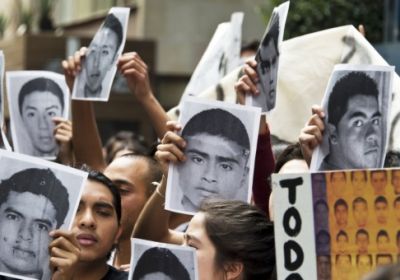 A national strike for November 20 to protest the government’s ineffective investigation in the case of 43 missing Ayotzinapa students was announced on November 12 by the Mexican Inter-university Students Assembly, chaired by the Ayotzinapa Teacher Training School “Isidro Burgos”. The assembly, attended by students from 79 schools, decided to support the national strike summoned by the parents of the missing students.
 -
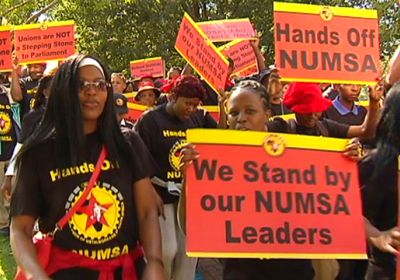 It is arguably the most important political development of South Africa’s post-1994 era. In the early hours of November 8, South Africa’s largest union, the National Union of Metalworkers of South Africa (NUMSA), was expelled from South Africa’s largest union federation, the Congress of South African Trade Unions (COSATU). The political significance of NUMSA’s expulsion derives from three key, interrelated areas of impact. ANC-led alliance
 -
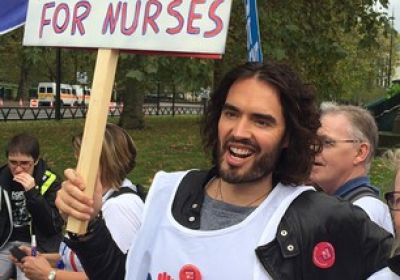 This week, by law, I have to deride Russell Brand as a self-obsessed, annoying idiot. No article or comment on Twitter can legally be written now unless it does this, so by the weekend the Sunday magazine recipes will go, “Goose and marmalade paella, serves six ― unless one of the six is Russell Brand in which case he can make his own dinner as he’s such a rebel I suppose he doesn’t agree with ovens”.
 -
 Images of rioting protesters and burning cars in Brussels were published in mainstream media across the globe on November 7. The previous day’s protest in Brussels did end in violent clashes, with 50 injured and 30 arrested, but it was the spirited but peaceful demonstration of 120,000 Belgians that was the key aspect of the day.
 -
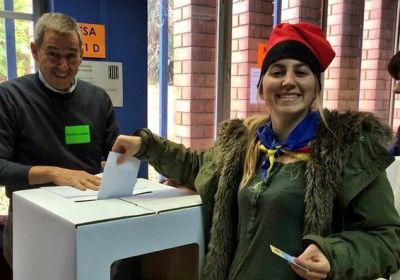 On November 9, 2.305 million residents of Catalonia defied a November 4 Spanish Constitutional Court ruling and voted on what future political status they wanted for their country, now one of the 17 “autonomous communities” (regions) within the Spanish state. Because of their rebellion — festive but determined — it was not just another voting day. Initiative for Catalonia-Greens (ICV) co-coordinator Joan Herrera called it “the biggest demonstration in the history of this country”.
 -
Bolivian President Evo Morales asked the Mexican government on November 10 to clarify the case of the 43 students of the Ayotzinapa teachers college. The students were forcibly disappeared in September after an attack by local police, in which six people were also killed. “I wish to express our solidarity with the families of the 43 students,” Morales said during a press conference. “We regret what has happened in Mexico.”
-
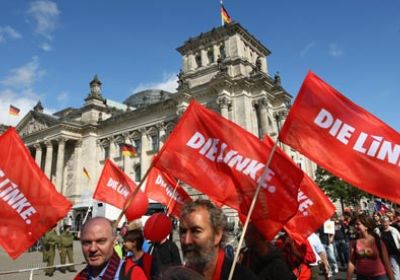 Nearly twenty-five years to the day after the fall of the Berlin Wall, socialist party Die Linke (“The Left”) looks set to form government in the eastern German state of Thuringia for the first time. After two months of uncertainty following September 14 state elections, the way was cleared for Die Linke to head a coalition government in December, alongside the Social Democrats (SPD) and the Greens, on November 4 when nearly 70% of SPD members in Thuringia voted to enter the coalition.
 -
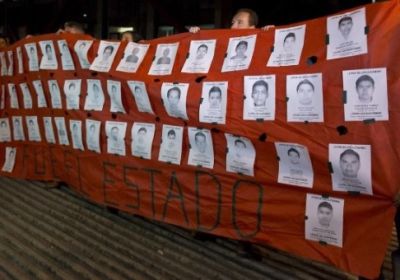 The protests over the 43 missing students in Iguala, who are now said to have been assassinated and burned, have continued in Mexico City. Hundreds of Mexicans protested overnight on November 8 in Mexico capital. They expressed theri outrage in relation to statements given the day before by the head of the attorney-general's Office, Jesus Murillo Karam, who said the 43 students were executed and burned in Ayotzinapa.
 -
Bolivian President Evo Morales has handed over three new schools and two roofed outdoor community centres in the Sacaca Municipality of the southern Potosi Department. “We are going to continue working, your vote has not been in vain,” said Morales, who was re-elected on October 12 with more than 60% of the vote. In the Caripuyo municipality in Potosi, Morales also inaugurated a market and an electrical system for the Caripuyo community.
-
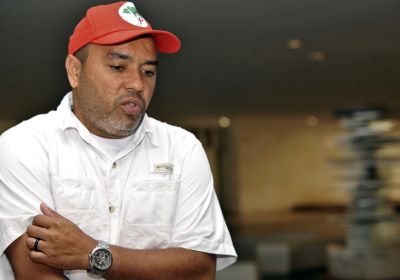 In an interview with Pagina do MST's Iris Pacheco, Alexandre Conceicao, a national leader of the Movement of Rural Landless Workers (MST), said social movements played a fundamental role in the October 26 re-election of President Dilma Rousseff, the candidate of the Workers' Party (PT). Dilma won 51%, defeating her main rival, Aecio Neves. The interview, below, was translated by Federico Fuentes. * * *
 -
Representatives of victims of Colombia's decades-long civil war, who are taking part in the peace talks in Cuba, issued a statement on November 2 requesting more protection from the Colombian government. They were responding to death threats and warnings from right-wing paramilitary groups. The talks are taking place between the Colombian government and the left-wing Revolutionary Armed Forces of Colombia.