
On my wall is the front page of the Daily Express of September 5, 1945, and the words: “I write this as a warning to the world.” So began Australian journalist Wilfred Burchett's report from Hiroshima. It was the scoop of the century.
For his lone, perilous journey that defied the US occupation authorities, Burchett was pilloried, not least by his embedded colleagues. He warned that an act of premeditated mass murder on an epic scale had launched a new era of terror.
-
-
 The proposal by Russia, accepted by the regilme of Bashar Al-Assad, for Syria’s chemical weapons to be turned over to an international authority (presumably the United Nations) for destruction, has temporarily put off Washington’s plans for war against Syria. Obama has postponed asking Congress to approve of his plans to attack Syria. This represents a political defeat for the war drive. Even if Washington scuttles the proposed agreement and goes ahead with war, it will do so with even less support at home and abroad than it had before the Russian proposal.
 -
In response to a chemical weapons attack by unknown perpetrators on August 21, US President Barack Obama, in a “coalition of the willing” with the governments of Britain and France, has made escalating threats for a military attack on Syria. With the likelihood of Russia and China opposition in the UN Security Council, Obama has indicated that his coalition, calling itself the “international community”, may strike Syria unilaterally.
-
 The Socialist Alliance released the statement below on August 28. * * * The Socialist Alliance condemns the threatened US-led Western military assault on Syria. We call on the Australian government to reject this latest imperial aggression, to extract itself from its military alliance with the US and end its involvement in all aggressive multinational military operations.
 -
More than two years ago, the Syrian people, inspired by the Arab Spring, began a democratic revolution against the viciously authoritarian Bashir al-Assad regime, a revolution that we enthusiastically supported from its beginning and continue to support. For two long years now, we, like the rest of the world, have watched in horror as the Syrian government waged merciless war on its own people. Some of the revolutionaries argued that for strategic if not for pacifist reasons, the movement should have remained non-violent despite the mounting repression it faced.
-
For much of the past two years, Israel stood sphinx-like on the sidelines of Syria’s civil war. Did it want Bashar al-Assad’s regime toppled? Did it favour military intervention to help opposition forces? And what did it think of the increasing visibility of Islamist groups in Syria? It was difficult to guess.
-
The mass, democratic uprising that broke out in Syria in 2011 against the regime of Bashar Al-Assad has increasingly turned into a prolonged civil war, with violence worsening and accusations of war crimes levelled against the regime and sections of the armed opposition. The situation has been worsened by the intervention of Western-allies in the region, Saudi Arabia and Qatar, selectively arming Islamic fundamentalist sectors of the anti-Assad forces.
-
 The latest United Nations figures put the death toll from the conflict in Syria a third higher than previous estimates by the UN and anti-government activists. “We can assume that more than 60,000 people have been killed by the beginning of 2013,” UN High Commissioner for Human Rights Navi Pillay said in a January 2 statement. “The number of casualties is much higher than we expected, and is truly shocking.” The UN has compiled a list of 59,648 named individuals reported killed between March 15, 2011, and November 30, 2012.
 -
 Angered by the non-stop, one-sided propaganda on CNN and BBC World, usually a prelude to NATO bombing campaigns (including the six-month onslaught on Libya, the casualties of which are still hidden from the public) or direct occupations, I was asked to explain my views on RTV. I did so, denouncing the promotion of the Syrian National Council by Western media networks and pointing out that some of the armed-struggle opposition were perfectly capable of carrying out their own massacres and blaming them on the regime.
 -
Free Syrian Army (FSA) leader Abdul Salaam types on his Dell laptop while a comrade sitting nearby taps a text message on his iPhone. Eight of his fighters lounge around an apartment living room late one night. Their 150-man brigade, Ahrar Syria (Free People of Syria), even has its own Facebook page. The brigade sports modern techno gadgets, but it lacks sophisticated arms and ammunition. So instead of fighting in the battle of Aleppo, the militants help smuggle refugees and injured fighters from war-torn Syria into Turkey.
-
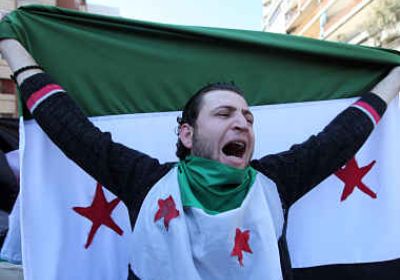 The 50-year rule of the Ba’ath Party in Syria looks to be effectively over. In the past month armed clashes have spread to the Syrian capital, Damascus, and the largest city, Aleppo. Armed opposition forces have taken control of several border points. On August 6, Prime Minister Riad Hijab defected to the opposition. The regime of Bashar al-Assad — who inherited the presidency in 2000 from his father, Hafez al-Assad, who seized power in a 1970 military coup — no longer controls the country.
 -
Despite escalating rhetoric and sectarian violence, it seems for the time being NATO is not planning a direct military assault against Syria along the lines of its attack on Libya last year. If NATO had been looking for a pretext for such an assault, the June 22 shooting down by Syrian forces of a air force F4 phantom jet belonging to NATO member Turkey provided one ― notwithstanding evidence the plane was shot down in Syrian airspace.