About 400 people filled the Fitzroy Town Hall for the launch of the “trains not toll roads” campaign on June 13.
The Yarra City Council organised the launch to advocate for a rail line from the CBD to Doncaster Hill, as well as to oppose the state government’s proposed East-West road link.
-
-
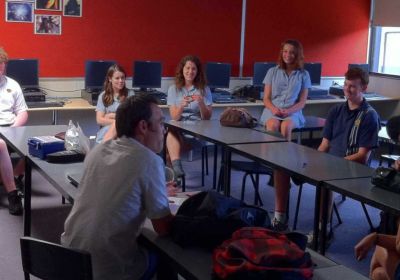
Najaf Mazari, an Afghan refugee, rug-maker and author addressed a meeting of about 70 people at the Eltham College in Melbourne on May 17. He described his life in an Afghani village and his journey to a new life in Australia, including his time in a detention centre. The event was organised by the Diamond Valley Oxfam group and supported by the Eltham bookshop. -
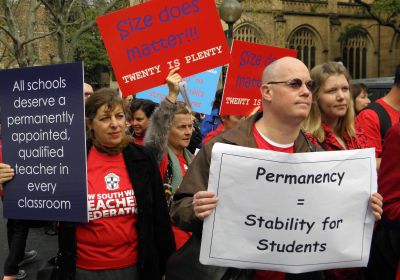
In an article in the Australian on April 20, Adam Creighton asserted that: “Teachers’ unions in Australia and worldwide have been astonishingly successful at hoodwinking the public into thinking smaller classes matter.” As a teacher with over 30 years’ experience and a member of the Australian Education Union, I can say articles such as that display ignorance about what it is really like to be a teacher in front of a class. -
The Victorian state council of the Australian Education Union (AEU) held a special meeting on April 17 to consider an offer from the Coalition state government to commit to a new Enterprise Bargaining Agreement (EBA). The AEU and the state government have been in dispute over the EBA for more than two years. AEU members had previously voted to continue the industrial campaign until their demands for improved working conditions and pay were met. This decision was taken at a mass stopwork meeting of over 12,000 teachers and education support staff on February 14. -
For many years the Manningham council in Melbourne’s northeast, which consists of 10 suburbs, the largest being Doncaster and Templestowe, has been advocating for some form of mass rail transport. Manningham is the only Melbourne metropolitan municipality without train or tram services. At the 2011 census, Manningham had a population of 111,300 people, 41% of whom are classified as low-income earners — a higher percentage than Melbourne’s average. -
I have always found tests and exams, whether the NAPLAN or Victorian Certificate of Education, very problematic. For one thing, it only tests English and numeracy, as if other subjects are not important and do not contribute to numeracy and literacy skills. For several years, educators have known that there are different learning styles and techniques. Some people have one dominant learning style, others use different styles in different situations, and styles are not fixed. -
More than 30,000 Victorian teachers and education support (ES) staff walked off the job on February 14 in their campaign for better pay and conditions. Government figures show that 65% of school staff took part in strike action and 300 schools did not have students. Meredith Peace, Australian Education Union (AEU) state president, also reported that more than 300 schools were brought to a standstill and that every school in the state had some form of disruption.
-
Thousands of government and private school teachers plus education support (ES) staff will stop work for 24 hours on February 14. They will attend two separate stop work meetings, then join to march together on the Victorian parliament to show their determination to win better working conditions and pay. Why are teachers and ES staff striking?
-
One day after the huge stop work and rally of Australian Education Union (AEU) members on September 5, Mary Bluett, the Victorian AEU’s branch president, announced she was retiring. Her husband AEU branch secretary Brian Henderson, also announced his retirement. Bluett has been an education union official for 31 years. The Victorian AEU is a 51,000 member strong union. Teachers have come increasingly under attack in recent years, but they, like nurses, still have a lot of public support. -
The independent Gonski review, commissioned by the federal government into school funding, was released in February. It concluded that Australia is investing far too little in education and that in our wealthy country there are many schools that are underprivileged. It also concluded that our education system is not fair — that our school system is stacked against the disadvantaged, while it gives the most privileged the most advantages. -
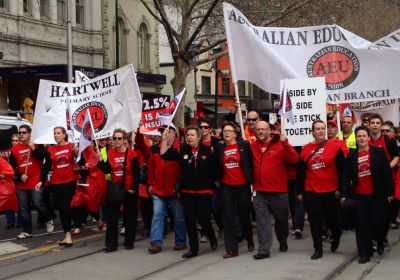
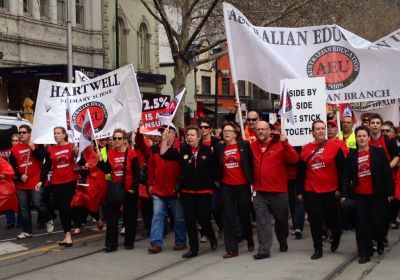
Up to 30,000 Victorian school teachers took strike action on June 7 in what the Australian Education Union (AEU) said was the largest teachers’ strike in the state’s history. More than 11,000 — many wearing the AEU signature red colours — marched through the streets of Melbourne to rally at state parliament. Before the march, teachers packed out Melbourne’s Hisense Arena for a mass meeting. Several hundred more people who could not fit in gathered outside to watch and listen to the proceedings on huge screens. -
On June 7, Australian Education Union (AEU) members — primary and secondary teachers in Victorian government schools — held their first stop-work meeting since 2008. About 25,000 teachers took part in Melbourne and marched to the steps of Victoria’s parliament house. In 2008, teachers were campaigning for their Enterprise Bargaining Agreement (EBA), which expired at the end of last year. Since then the AEU officials have been unsuccessfully negotiating with Victoria’s Ted Baillieu state government for a new EBA.