
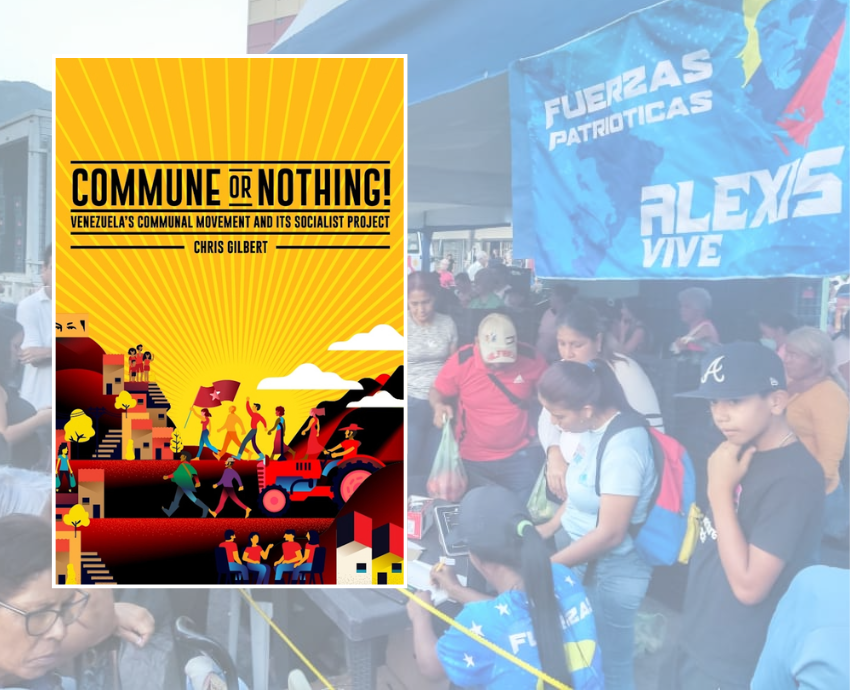
Commune or Nothing: Venezuela’s communal movement and its socialist project
By Chris Gilbert
New York: Monthly Review Press
2023
This book is one of the best available accounts of Venezuela’s communal movement, which points the way forward for future popular democratic experiments for poor and underdeveloped countries.
Author Chris Gilbert has lived in Venezuela for 20 years, teaching political studies at the Bolivarian University of Venezuela. His book is brilliant, with many ideas and suggestions for tackling the transition away from capitalism to socialism, including avoiding common errors.
In 2009, about 10 years after the Bolivarian process began in Venezuela, President Hugo Chávez proposed a historic road to socialism through the communal system.
Chávez had been influenced in his thinking by Canadian socialist Michael Lebowitz, Chilean sociologist Marta Harnecker and Hungarian Marxist economist István Mészáros. There is an entire chapter on the discussion between Chávez and Mészáros about his 1995 book, Beyond Capital.
Gilbert traces the destruction of the relationship between craftspeople and their communities and the history of communes. “[Under capitalism] all is subordinated to an inexorable process of economic valorisation that amounts to a virtual treadmill of senseless expansion ... By contrast, communal systems are more sustainable, less destructive and alienating … and more humanely gratifying.”
Gilbert argues we must recover some of the elements of an indigenous communal system, but with the adoption of personal freedoms, cultural diversity and some of capitalism’s technological advances, as well as a democratic approach to production. Life could then be rational and sustainable for all peoples, and the natural environment could be sustained.
Gilbert sees the commune as a socialist building block. The essence of the commune is a new set of social relations. A prominent feature is social labour, where human activities are carried out with goals and methods that the community itself decides.
At present, we have a bizarre break under capitalism between production and consumption, as all commodities appear in the market as exchange-values. In a communal system, production of use-values would be reconnected to real needs.
This would also allow the historic division under capitalism between production and reproduction, such as household work and raising children, to be equally valued.
Communal councils first emerged in 2005 in Venezuela. Then, in 2009, the law of the communes was developed, which was adopted as the Popular Power Laws. They laid out the basic structural model for Venezuelan communes, which were to be built by joining communal councils and other popular organisations into a zone. The laws had specific conditions for indigenous communities.
These laws also had roots in the Chávez government’s longstanding commitment to participative, grassroots democracy. They were very different to capitalist laws and are an indication of the complex relationship between state power and the social revolution.
Chávez opposed the formation of cooperatives as, in his view, they only perpetuated, in a different form, the logic of private property. Chávez sought out another form of social property, where the surplus is distributed through many different social channels. That is how the idea of the commune came about.
Before his death in 2013, Chávez encouraged people to take the initiative, assume the responsibility and build communes using the new laws. He also warned about the importance of the communes keeping their independence from the party he founded, the United Socialist Party of Venezuela.
Chávez also foresaw a problem developing between official government bodies and the new grassroots commune system over power and planning. Gilbert points to the resistance to this concept from the Venezuelan intellectual class, many of whom argued that the main bone of contention with United States imperialism was the oil reserves, which they saw as more important, rather than the direction of Venezuela towards socialism using the communes.
In 2009, when Chávez launched the commune project, there was still limited traction among the masses, partly because the state-owned oil industry was still able to provide huge profits for the welfare of the people. Why make life difficult building communes when profits from oil can pay the social debt?
Gilbert explains the ups and downs of the commune system due to various factors — a key one being the debilitating US sanctions on Venezuela, and another, the retreat of the Latin American “Pink Tide” progressive governments on the continent.
When Nicolás Maduro came to the presidency, after Chávez’ death, the economic crisis in Venezuela hit hard, with heightened US imperialist assaults, various coups, guarimbas (right-wing uprisings) and thousands of sanctions on many vital imports, such as medicines and machinery parts.
The Maduro government responded by tending to take a path of lesser resistance: price controls were eliminated, wages reduced and social programs defunded, as communes were put on the back burner.
Gilbert writes that, on the other hand, “Quietly and unbeknownst to most urban residents and navel-gazing bureaucrats, the commune project had been assumed by small groups of people around the country, not only as a solution to the problems they faced, but also as a way of restoring Chavismo to what they understood to be its original path and project.”
For example, the El Maizal Commune began to seize land in Lara State in 2009. The Andean Che Guevara Commune recovered cooperative coffee growing, and the urban Commune El Panal began building small modules throughout the west of Caracas.
There was also a much wider web of communal projects that were taking their first steps after the original idea had fallen on hard ground.
The book covers the history of the El Maizal Commune founded by Angel Prado. A huge problem developed with local capitalists, who harassed the commune, together with regional officials. This problem was also reflected in the national bureaucracy, who refused to sell vital seeds to the commune. When they bought them on the black market, the El Maizal members were imprisoned.
Gilbert also covers Latin American Marxist theory, as developed by Peruvian writer José Mariátegui and others, Caribbean anarchism and the collective nature of Incan communist society, which had a lack of private property of land. In the 1930s, Mariátegui’s ideas sent shockwaves through Eurocentric communism, which was focused on the Soviet Union.
Another chapter deals with the Che Guevara Commune in the Andes. Here, they built their commune on two labour-intensive cash crops: chocolate and coffee. The commune fell on hard times with the COVID-19 pandemic and the fuel crisis.
For two years, they created their own currency, called the cafete, equal to one kilogram of coffee. They managed to get some coffee-drying equipment from Colombia with Venezuelan federal government money and survived the crisis.
In the east of Venezuela, the Luisa Cáceres urban commune in Barcelona, in the neighbourhood of Lecheria, is discussed. A rural community can grow food or tend cattle, cultivate coffee or cacao, but what can an urban commune do productively in the midst of the concrete jungle?
It took them six years to find a viable urban project. The solution was Barcelona’s garbage collection. They were able to succeed by taking over the whole garbage collection by having their own truck drivers, who were all committed to the project.
Gilbert also details stories of failed communes — the challenges, problems and difficulties that didn’t get solved.
A very interesting last chapter is on the story of Robert Longa, who grew up in Barrio 23 de Enero, on the hillside overlooking Caracas. Barrio 23 de Enero was originally built by dictator Marcos Pérez Jiménez to provide for 10,000 of his soldiers and government members. When he was overthrown by a national uprising in 1958, the desperate masses invaded the buildings.
Longa built the organisation Alexis Vive, which drove drug traffickers out of the barrio. The police and the Social Democratic governments of the time had introduced drugs into Barrio 23 de Enero to quell the rebellious spirit of the inhabitants.
Alexis Vive started building the El Panal Commune (the Beehive) in 2006, based on Marxist readings from the Paris Commune. The El Panal communards did much volunteer work cleaning stairways of the tall residential blocks and also linked the commune to a socially owned bakery, textile factory, fish farm and piggery. El Panal is the most successful of the Venezuelan urban communes.
There is also the fascinating story of Carlos Betancourt, 90 years old, who had been the commander of the revolutionary guerrilla movement in the 1970s. He had also founded the Bandera Roja party, which sadly turned to the right in the 1990s.
Betancourt returned to Caracas from his farm and set up in the basement of the old Shell Oil headquarters at the University Bolivariana de Venezuela. He harangued government ministers and anyone who would listen on the need for horizontal decision-making and the commune as a model for production, with its project for self-emancipation through self-organisation. He died in 2021 during the worst of the COVID-19 pandemic.
I was lucky enough to visit El Maizal, Che Guevara Commune and the Luisa Cáceres Commune in 2016.
As the book was being finished, there was a new interest in communes expressed by grassroots leaders, intellectuals and the government. In 2023, Maduro insisted that “everything that needed to be changed would be changed” and that “2023 would be the year of the Communes”. Prado was made Minister for Communes. There was a new optimism that the Bolivarian process could be redirected towards socialism.
Events within and outside Venezuela since then have severely impacted the development of the communal project, particularly the rising US economic and military aggression under President Donald Trump and the kidnapping and jailing in the US of Maduro and his wife Cilia Flores.
We must launch a campaign for their return, so that Venezuela can loosen the shackles of the mad men in the White House, and prepare to return to independent, popular democratic measures, such as fully developing the communal process.