
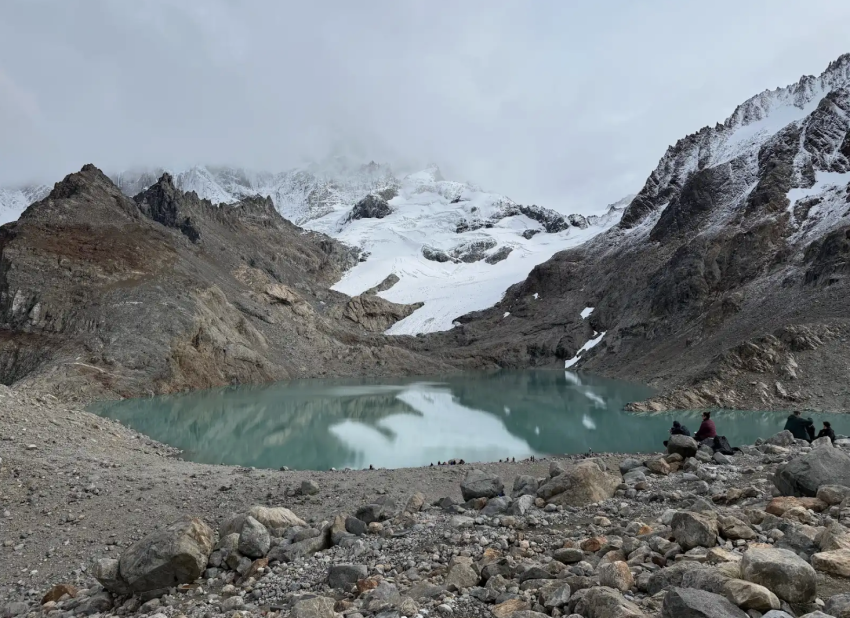
On a brisk Sunday in El Chaltén, the Patagonian town perched in the shadow of Los Glaciares National Park, environmental activists are talking about water to whoever will listen.
A band plays under a banner that reads “hands off the Glaciers Law” while children play games and their parents share yerba mate. Snow-capped peaks, still and ancient on the horizon, tower in the background. Local environmentalists educate passersby on decisions currently being discussed in the government buildings of Buenos Aires — over a thousand miles away — that threaten the region’s precious glaciers.
The El Chaltén Water Assembly’s manifesto begins with the following: “We are a community of guardians of glaciers, watersheds, and water reserves fundamental for life in our region, for Argentina, for the continent and for the world. From the community of El Chaltén, that lives at the foot of one of the most important solid freshwater reserves in the world, we raise our voice to unite the shout from the mountains, and we say ‘HANDS OFF the national Glaciers Law.’”
The pioneering Glaciers Law has protected Argentina’s ice reserves for 15 years. More than 7 million people across the country depend on interconnected glacial ecosystems to feed watersheds and safeguard against drought.
Now the law is up for modification. Argentinian activists say gutting the Glaciers Law would put water security for millions in peril, risk the health of communities rooted in the mountain range, and attack the majestic glacial bodies core to the country’s identity, all for the benefit of foreign mining companies and investors.
Innovative ice protections under pressure
The 2010 Glaciers Law was the first in Latin America dedicated to protecting glaciers and periglacial environments, the frozen soils that surround and regulate glaciers. The law was a hard-won victory after environmental activists throughout the country put pressure on the government of Cristina Kirchner for two years. The law established a national glacier and periglacial inventory and mandated that national and provincial governments share the responsibility for their protection.
In the decade and a half since the innovative law has been in effect, it has faced attempts at overhaul from mining companies and provincial politicians. Even still, it has remained on the books, a testament to its groundbreaking nature. “We’re the first country to have a law to protect all its glaciers and all the periglacial areas, to protect our water,” said Agostina Rossi Serra, a biologist working with Greenpeace Argentina. “It’s a law that all Argentinians have to be proud of.”
In December last year, far-right President Javier Milei filed a bill to modify glacier protection laws, aiming to loosen barriers to mining in glacial and periglacial areas. The reform, merely the latest in a series of policies pushed by Milei to attack environmental regulations, was approved in the Senate in February while environmental groups protested outside.
The next step for the bill is a vote in the Lower House, expected to happen in April. Lawmakers opposing the bill pushed for two days of in-person and virtual public hearings before the vote, to give environmental groups, provincial representatives and experts the chance to share their perspectives. Of more than 105,000 people registered to participate in the hearings on March 25 and 26, only 213 people were ultimately authorised to speak: less than 0.2%. The majority of those presenting spoke out against the modification to the Glaciers Law, but participants and registrants criticised the process for being anything but participatory.
Supporters of the bill claim it could bring more than US$40 billion in copper mining investment from international companies, expected to be especially favourable for the Donald Trump administration’s economic agenda. Many think the bill is guided behind the scenes by US interests. In January, the US treasury secretary stated that US companies want preferential access to mining.
More recently, Argentina’s foreign minister signed an agreement regarding US access to mineral resources, and there have been meetings in New York between Argentina’s Foreign Ministry, JP Morgan and multinational mining companies to discuss “unblocking Argentina’s mining frontier”.
If passed, the reform would chip away at nationwide protections of glaciers and periglacial environments, opening those without a proven function as essential water reserves to mining and development — leaving the definition of “essential” at the provincial level. The change would mean local governments throughout Argentina can choose which glaciers are protected in their province, and which are not, removing the baseline of protection at the national level.
But glacial and periglacial systems don’t abide by provincial lines. “We will see uneven protection along the mountain range,” explained Rossi Serra. “You’ll have provinces with glaciers in their territory, deciding about the water of another province with rivers fed by the glaciers … if the glacier that feeds your watershed is not in your province, you won’t have the right to decide what happens.”
As an environmental activist in El Chaltén explained, it’s not just the glaciers that need protection, but the periglacial environment too — the water in frozen soil. “It’s all interconnected across watersheds and province lines, like veins bringing water to the country,” she said.
Chipping away at water security
With the frosty freshwater stored in and around glaciers at stake, experts warn that jeopardising watersheds would have serious consequences.
An estimated 7 million Argentinians depend on water from nearly 17,000 Andean glaciers across 12 provinces, feeding 36 watersheds.
Glacial water flows also sustain agriculture and countless foods eaten throughout the country are grown with water from glacier-fed rivers. “We say that 20% of Argentinians benefit in a direct way from water from glacier and periglacial ice — or if not directly, indirectly through cultivated products,” says Rossi Serra. “This is a change that would affect a lot of Argentinians.”
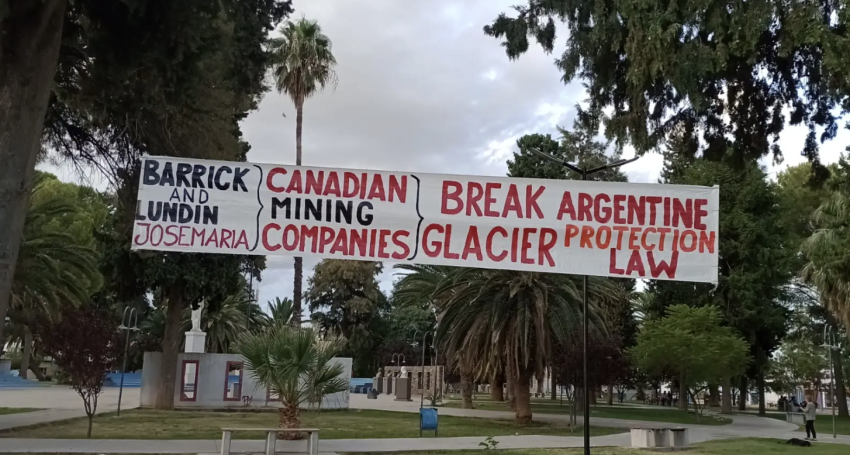
Glaciers and the frozen soils that surround them also offer water reserves in dry times of the year. “A lot of the country is arid or semi-arid, so every drop of water in the glacier ice counts,” Rossi Serra said. Some provinces are already facing droughts and water crises in recent years.
When there isn’t enough snow in winter, the snow around glacial masses and periglacial ice melt to feed rivers in his province of San Juan, explained Saúl Zeballos, representative of the local activist group Jáchal Asemblea No Se Toca. “Without those strategic water reserves, in the years when it doesn’t snow enough, we’ll be left with a dried up river,” Zeballos said. “It’s an interrelated system that provides the water keeping these towns alive.”
“If they approve the modification of the Glaciers Law, it’s going to be a disaster for our provinces,” said Zeballos.
Proponents of abolishing the national inventory of protected ice masses have their sights set on mining, which has residents of mining-heavy provinces concerned. Zeballos’ home city of Jáchal was the site of the country’s biggest mining chemical spill just over 10 years ago, sparking the formation of Jáchal Asemblea No Se Toca to demand justice. This local assembly is now speaking out against weakening glacier protections.
Zeballos and his neighbours have seen firsthand how expanded mining devastates the health of local communities. Last November, thousands of fish began dying in the Jáchal River, with no clear explanation from provincial authorities. Working with a university in a neighbouring province, Zeballos and the assembly tested the water and found high levels of mercury and chlorine — they discovered the nearby Veladero Mine had added sodium hypochlorite to the water, likely attempting to neutralise a cyanide spill.
“The system that’s supposed to serve justice denied us that possibility of justice, and ended up lying to protect the mine,” Zeballos said.
Zeballos added that he grew up drinking water from the Jáchal River, but after the mine opened, residents began to feel uneasy about their water supply. The mining company built an aqueduct to provide water, but Zeballos made clear that the water is not always reliable in drier years.
“Some summers, we lack water for the neighbourhoods that are more elevated,” he said. We suspect they might mix the good quality water with water polluted with mercury from the Jáchal River.”
For a region that’s seen mining go hand in hand with pollution and water insecurity, opening new areas to mining is risky. One glacier in the area is already slated to be destroyed for a mining project. “The first thing they’ll do in San Juan province if the change to the Glaciers Law is approved, is they’ll take that glacier out of the inventory,” said Zeballos.
A reserve of frozen time and identity
Glacial and periglacial ecosystems, refuges of biodiversity, are already threatened by climate change — the surface area covered by glaciers in Argentina’s dry Andes region has shrunk by 17% over the last decade. Though rapidly vanishing, glacial ice helps to cool the planet from growing climate change, explained Rossi Serra. Solar radiation reflects off of ice instead of that heat being absorbed, helping with cooling.
Layers of ancient ice also form rich stores of information for environmental researchers, helping them understand Earth’s climate and life forms stretching millions of years into the past. For this reason, the manifesto of the El Chálten Water Assembly reads “what you see is not just solid water, it’s frozen time”.
The manifesto also claims that failing to protect glaciers puts at risk the identity of all Andean peoples, their existence and their livelihoods. Indigenous activist Nina Lou, member of the Pueblo Nación Diaguita, writes that changing the Glaciers Law fails to consider the interests of Argentina’s Indigenous people, thousands of whom have publicly expressed opposition to the amendment.
She writes that changing the law is “an attempt to profit from the destruction of glaciers, of Indigenous peoples, and of the intangible heritage they represent for humanity. Essential foundations of life materially, biologically, but also our invaluable reserves of memory and worldview … How do we imagine the future development of a country without reserves of water or of wisdom?”
Speaking out to defend glaciers
The record-breaking number of registrations for the public hearing show supporters of the Glaciers Law are mobilising to make their voices heard. The unifying message is that Argentina’s solid water resources, crystallised on mountain peaks and facing an increasingly uncertain climate future, are not something to be bought, sold or destroyed. “It speaks to the people’s need to express themselves, and ask that our representatives don’t support trampling the Glaciers Law,” said Rossi Serra. “The law was born from the fight of all Argentinians to reclaim and defend our water.”
“We’re sure that if they change the Glaciers Law, the bad example of Jáchal will be repeated in all the mountain towns: pollution by megamining projects and the risk of extreme drought when it doesn’t snow enough,” said Zeballos.
Fernanda with the El Chaltén Water Assembly explained that since the iconic glaciers surrounding the town are part of a national park, it’s likely that even if the law is changed these glaciers would still be among the most protected. Yet the local water assembly stands in solidarity with other communities living alongside glaciers, a bond rooted in part in their own water security challenges.
With slogans on stickers like “without water there’s no wine,” and “without water there’s no yerba mate,” the El Chaltén Water Assembly is aiming to reach a wide audience of Argentinians. For them, it’s part of the nation’s responsibility to protect the glaciers.
“Water is something we can’t get back once it’s contaminated,” she said. “It’s urgent we protect it.”
[Reprinted with permission from NACLA. Olivia Ferrari is a New York City-based freelance journalist with a background in research and science communication.]