
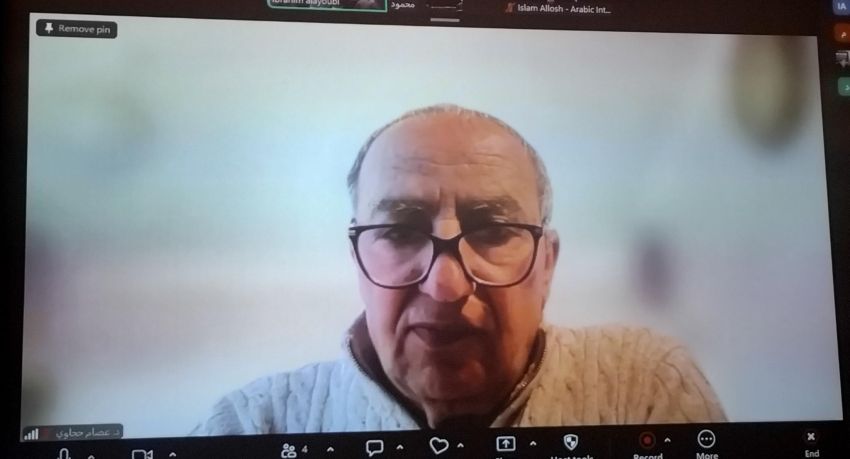
The persecution experienced by Palestinian people in Israeli prisons and their unwavering strength in the face of this was discussed at a forum on April 12, hosted by the Palestinian Community of Western Australia and All for Gaza/All for Palestine.
The forum, held at the State Library of WA, highlighted the stories of Dr Issam Hijjawi, a Scottish-Palestinian doctor, recently incarcerated for his activism, and Mahmoud Al Arda, who spent 32 years in Israel’s prison system and staged a daring escape in 2021.
Both spoke online with interviews and translations provided by the organisers.
Al Arda gave an insider account of the abuse many Palestinians experience under occupation, which has become worse since October 7, 2023.
“It was not the killing, although some people did die under the extreme torture — and they know this, and it’s documented,” Al Arda said. “But it’s the level of humiliation that we had to endure. They would not even give us the rights that animals have.
“We were not allowed to stand, we had to kneel; they would move us around from cell to cell while kneeling and handcuffed, on all fours.
“But the worst was when they made us prostrate to them, while naked. Then they would abuse us, they would put their hands behind our neck and press to indicate that we were to move. But then we would get severely punished if we did not know to move without that signal.”
United States President Donald Trump’s election on November 5, 2024, was a day of particular brutality. Al Arda was forced to crawl on all fours, across 500 metres from one cell to another, while being abused.
However, Al Arda also reported on the solidarity expressed by Palestinian prisoners, such as their collective action to access books and education, and about his aptitude for discovering “magic doors” that could lead to escape tunnels.
“People don’t normally think about escaping when they’re in prison, but I find it beneficial, because the thought and the planning give you a sense of freedom,” he said.
“The hardest part of digging a tunnel is the entrance or door of the tunnel. It’s really hard to pinpoint where the door of the tunnel will be, and I seem to have a gift for finding the door.
“In 2021, I opened the tunnel of freedom. This was a dream I had carried since 2016. I was sneaky: I convinced them after my confinement that I was rehabilitated, and was going to stay on the straight and narrow, but I immediately started digging.”
Al Arda was referring to his escape from the maximum-security Gilboa Prison, on September 6, 2021. He led five other Palestinian inmates in a daring break-out, achieved via a tunnel that had been dug over 10 months, using only spoons. The escape shocked the Israelis and hit international headlines.
Al Arda’s resilience is particularly notable, given that he had been incarcerated since his teenage years, during the Second Intifada in 1992. After four years in prison, he was released for eight months, before being re-arrested in September 1996 and sentenced to life imprisonment, plus 15 years.
After his final release in October last year, Al Arda was deported to Egypt, where he now lives. He shared some footage of his wedding, and expressed the joy he felt when speaking to children for the first time since his own youth before incarceration.
Hijjawi addressed the forum from his home in Edinburgh. He detailed the repression and violence against Palestinian inmates and how Israel integrates this into its wider system of persecution across the Occupied Territories.
He highlighted the terrifying escalation in violence over the past two years, reflected in the Gaza genocide and the escalation in settler pogroms across the Occupied West Bank. Nearly 100 people have perished in the Israeli prison system since October 2023.
A report published last November by Physicians for Human Rights-Israel — cross-checked by the Guardian and 972+ Magazine — indicated that at least 98 Palestinian people had died in this time, based on records taken from Israel’s prison system.
When the data was first collected in May last year, 65 people from Gaza had died within the prison system, with civilians accounting for 44 of those deaths. The number from Gaza is now 68. Added to this, are the deaths of 27 people from the West Bank.
Hijjawi had been imprisoned in Northern Ireland, spending more than 16 months on remand and in solitary confinement in Maghaberry Prison, following his arrest by British counter-terrorism police. He was accused of being part of the “Newry Ten” and of attending a meeting of a proscribed organisation.
While incarcerated, Hijjawi was denied treatment for a serious spinal injury and later suffered a heart attack. But he advocated for the rights of fellow prisoners and staged a hunger strike to obtain medical treatment.
In the high-profile trial that followed — in September 2023 — it emerged that key prosecution evidence had been sourced by MI5 through infiltrator Dennis McFadden, resulting in a stay of proceedings on the grounds of entrapment and abuse of process.