
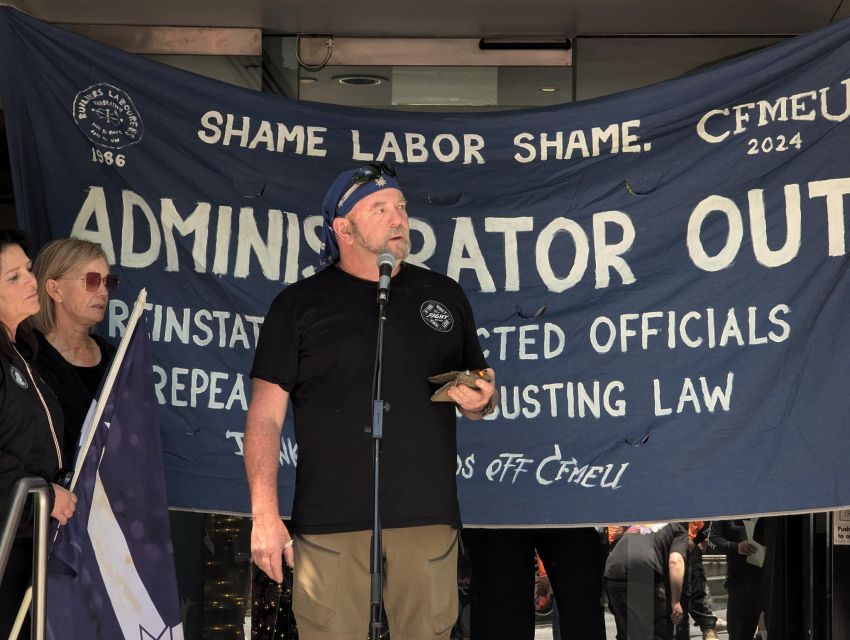
I am a retired Construction Forestry Maritime Employees Union (CFMEU) member and a former union health and safety trainer for nearly 20 years and I am horrified that Geoffrey Watson’s February 11 report to the ongoing Queensland Commission of Inquiry into the CFMEU and Misconduct in the Construction Industry is being taken seriously.
The allegations sound bad but hard evidence of the union’s criminality is missing in his Rotting from the Top: the CFMEU in Victoria During the Setka Era.
It is also clear that what originally began as a union investigation into the CFMEU in Melbourne, in July 2024, has now been turned into a propaganda piece for an inquiry in another state.
The union’s alleged criminality is assumed to be a fact. But it is based on very few convictions, or even arrests, and rather on hearsay and guilt by association.
For instance, mainstream media’s obsession with allegedly “$15 billion” worth of corrupt payments connected to the CFMEU is not included in the report yet continues to be front page news. No one can substantiate what that figure represents, nor whose pockets it supposedly ended up in.
Yet, even the ABC continues to believe this link to the CFMEU.
Safety and EBAs
Watson has not provided a balanced account of the building industry, its history and traditions. He only seems interested in pushing the idea that the CFMEU was not a trade union but rather “a crime syndicate”.
Yet this union, that represents tens of thousands of workers, helped to drive down fatality rates on job sites, Australia-wide, in just a few decades. It made building sites some of the safest in the world.
It also helped workers win significant wage rises and improved conditions, by taking collective action when necessary. This is one of the reasons why building workers left the Australian Workers Union and joined the CFMEU, because the latter tried to ensure members received similar pay and conditions across the state — even under laws forcing the union to negotiate individual agreements with each company.
The enterprise bargaining agreement (EBA) process usually begins with making an agreement with the big builders and, after that, negotiating with smaller companies. Each EBA is checked by a legal expert under the direction of the union executive, signed off and then sent to the Fair Work Commission for approval.
If the principal contractor has a union EBA, it does not allow non-EBA companies onto its sites. The union does not decide that. It does, however, use the EBA process and the fact that these are union-agreed documents, to win better pay and conditions for members.
Yet, Watson uses this as another stick with which to beat the CFMEU by citing alleged violence and rising costs.
Watson says CFMEU members pushed up traffic control costs, for instance, by more than $100 million, through their wage agreements. Yet, he quotes the employers’ charge-out rates, not the actual rises in workers’ wages. He also ignores the fact that significant numbers of women employed as traffic controllers would be getting their first ever decent wage.
However, the CFMEU’s successes have not been without a cost. I heard blood-curdling accounts of injuries and deaths on site, intimidation from bosses with firearms and endless stories of the organisers being arrested for just doing their jobs — which was helping their members on sites.
There is probably no other industry where union organisers are bashed and threatened with being thrown off scaffolds for trying to defend or service their members, often over health and safety disputes.
Yet, Watson equates the thousands of times CFMEU organisers were convicted for entering sites “illegally” under current industrial laws, with unsubstantiated claims of violence and lawlessness.
These were the very laws that Australian Council of Trade Union secretary Sally McManus said in 2017 were “unfair” and justifiably broken.
Watson dismisses the construction bosses’ history of violence and corruption by saying: “It is not an answer to say that the CFMEU’s convictions occurred because the building industry is hard, tough or edgy.”
Watson argues that there is a link between workers collectively breaking bad industrial laws and the CFMEU’s working-class mistrust of police, by saying this made “the union amenable to crime and corruption”. He blames crime in the construction industry on the CFMEU, not the bosses who paid the wages of suspicious individuals.
Excusing builders
He exaggerates the union’s connection to criminal activity by saying: “To understand organised crime in the Victorian building sector requires an understanding of the various ways in which the CFMEU allowed this to happen.”
This excuses builders and contractors in a multi-billion-dollar industry, where the drive for profit is cut-throat.
Watson’s allegations that the union was “at the centre of a criminal network” is laughable. It is also surprising that a lawyer seems happy to admit that some claims are based on rumours — such as the allegation that a former CFMEU vice president’s wedding was allegedly paid for by corrupt money.
Watson tries to sensationalise an incident involving former assistant secretary Derek Christopher who was arrested, but not charged, over alleged free or inexpensive home renovations. Watson implies that the fact Christopher has not been charged was irrelevant, saying: “That has never been the real test as to whether something happened or not.”
Watson, a member of the Bar, would know that a fundamental principle of law is that a person is innocent until proven guilty. If he knows individuals have committed a crime, he should hand over his evidence to authorities, not use a report to provide gossip for those wanting to join the anti-union witch hunt.
Watson’s July 2024 report began with interviewing 15 CFMEU officials in the wake of the sensationalised allegations aired in the Building Bad series. He acknowledged the interim report was incomplete, and that he had not checked it with those same officials.
His conclusions appeared to show little understanding of the building industry, with the “evidence” fitting his foregone conclusion that the CFMEU was criminal and corrupt.
Many of Watson’s informants, in both the interim and final report, are individuals with a grievance against the union, or are known to be untrustworthy, such as self-proclaimed CFMEU “fixer” Harry Korras, who was caught in a sting offering to bribe CFMEU officials.
However, Watson, an investigator for CFMEU administrator Mark Irving, can say whatever he likes without fear of litigation because that is what the Fair Work (Registered Organisations) Amendment (Administration) Act 2024 allows.
How can workers respect the rule of law when a Labor government presides over its destruction based on unsubstantiated evidence and rumours?
It should not be acceptable for any organisation, including a union, to be trialled by the media and receive no procedural fairness or right of appeal. It is also unacceptable that no evidence is required to be produced to prove the alleged criminality.
This union has been investigated before — including by two royal commissions — which failed to find any evidence of criminality.
We are witnessing the most serious and blatant attack on the labour movement since Federation. The campaign to demonise and destroy the CFMEU is a warning to all unions still fighting for their members’ rights in a class society.