
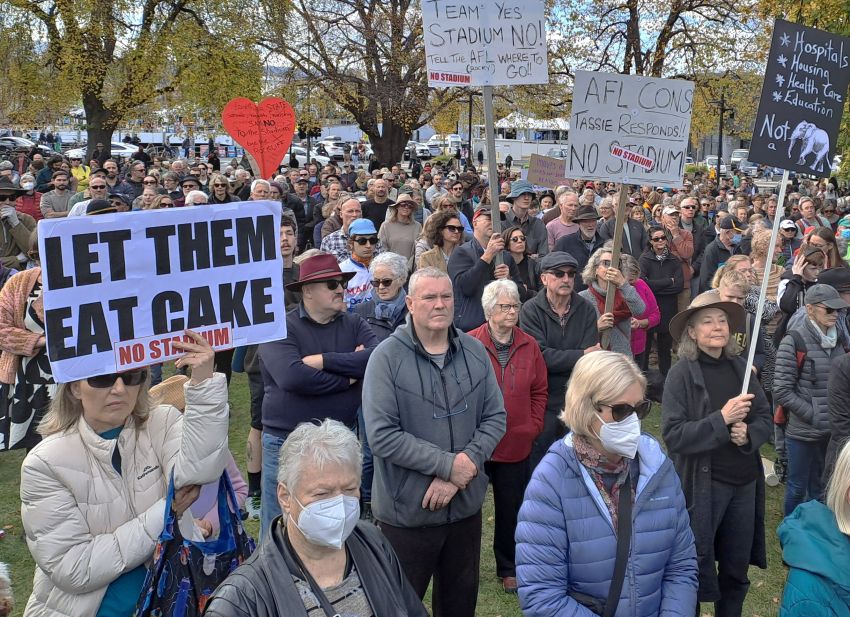
Minutes after addressing a Salvation Army charity event and listening to people describe how they have had to resort to sleeping in their cars, Tasmanian Liberal Premier Jeremy Rockliff urged parliament to approve the new Australian Football League (AFL) stadium at Macquarie Point.
The controversial stadium, planned for Hobart’s waterfront, is a proposed 23,000-seat roofed venue. The AFL and AFL Women’s have made a modern, enclosed stadium central to their conditions for Tasmania securing a team.
The amount of funding expected from the state and federal governments has shifted over the more than three years of debate, raising even more questions about its viability.
The Liberal Tasmanian government pledged to cap its capital contribution at $375 million; the Labor federal government has committed $240 million; and the AFL has agreed to $15 million.
Everything beyond that — the bulk of the stadium’s cost — is expected to be covered by loans.
Labor and the Liberals claim it will be a good investment, delivering long-term economic benefits. But critics point to figures from the Tasmanian Planning Commission, which said the stadium should not proceed.
Two independent MLCs have also voiced concerns about a new stadium that would add $1.8 billion to the state’s debt over 10 years; net debt is predicted to exceed $10 billion by 2028.
Cost estimates have risen sharply since the initial stadium bill was introduced in 2023.
Originally expected to be $715 million, it quickly rose to $775 million and then $945 million. Now the expected cost has risen by a further $185 million, taking it to $1.13 billion, and is expected to continue rising.
The Macquarie Point Stadium Enabling Bill passed the House of Assembly on November 13, by 25 votes to 9. Besides its cost and impact on state debt, key concerns remain over whether the allocation of public funds could be better used to address failing state infrastructure and meet community needs.
The next step in the stadium’s approval depends on a majority vote in the Legislative Council on December 3 and 4.
Labor opposed the stadium until opportunistically flipping just before the election in July, and the Liberals are strongly in support, with six of the eight required votes.
Independent MLCs Bec Thomas and Dean Harriss are now speaking out about the cost blowouts, debt risk and equity.
Economist Dr Nicholas Gruen warned in an independent report, commissioned by the government, that the benefits are “overstated”, while the risks are “significantly understated”.
Gruen told the ABC that the stadium project “can reasonably be estimated to exceed $1 billion, with a benefit-cost ratio of 44 cents in every dollar invested in Tasmania”.
Chris Jenkins, from Socialist Alliance Lutruwita, told Green Left that “This means its economic losses are twice its gains.”
Jenkins pointed out the Tasmanian Planning Commission’s report, which said the stadium would “diminish the economic welfare of the state”, citing excessive debt, weak projected benefits and landscape and heritage damage.
The report noted that the government’s initial construction debt would begin at $1 billion, before rising to $1.8 billion over the next decade.
“Taxes would need to increase by $50 million a year for 30 years from the implementation date, creating even more of a burden on households amid a cost-of-living crisis,” said Jenkins.
He noted that the projected debt would directly undermine funding for essential state infrastructure. “This means less room for hospitals, housing, education and essential social services that are already rapidly backsliding.”
“Right now, more than 5200 people are on waiting lists for housing — a rise of 10.1% since 2023–24. This is the largest it has ever been. The average wait time is 82 weeks.
“Tasmania also faces one of the worst hospital bed shortages in Australia and ambulance ramping has doubled in the past five years. Public schools are in desperate need of maintenance.
“Tasmanians have also indicated in several polls, the latest one in June, that housing, healthcare and cost of living are their greatest concerns.”
Jenkins pointed to the commission’s report, which said Tasmania lacks the required infrastructure — including transport upgrades, access roads, parking, sewerage and adequate short-stay accommodation — to support the stadium and its expected visitor influx.
The enabling law also hands the planning minister extraordinary powers to fast-track the stadium project and future controversial ones.
“Trying to fast-track this stadium highlights how removed the major parties are from ordinary people’s lives and concerns,” Jenkins said. "They want their tax dollars spent on public institutions that function for them."